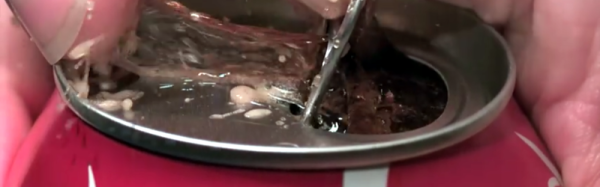
He’s back, [Bill Hammack] aka The Engineer Guy. He has a habit of revealing how the ordinary is extraordinary with a meticulous unveiling of all the engineering that goes into a thing. This time around it’s the aluminum beverage can. You might know it as a soda can, a beer can, or a salt-free air can. But we challenge you find someone who isn’t intimately familiar with these containers.
We know what you’re thinking: you already saw how these come into being on an episode of How It’s Made. You’re wrong. We saw that episode too. But just give [Bill] a few minutes of your time and he’ll suck you in for the rest of the episode. Now the die-forming of the base and side-wall, we’ll give it to you that you know what that’s all about. But then [Bill] busts into the history of these containers, citing the aluminum savings through reducing the top diameter of the can. He rounds it out with a celebration of the ingenuity of the modern “stay-on” tab which should make your glasses fall off with excitement.
If this is your first time hearing of The Engineer Guy you have a delightful weekend ahead of you. Binge watch his entire back cataolog! Our favorites include an analysis of a mechanical Fourier computer and the concepts involved in color anodization. We even read his book.
Continue reading “You Betta’ Recognize The Aluminum Beverage Can”

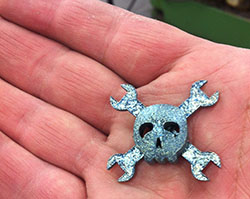 [Wilfred] was testing a titanium 3D printer at work and was looking for something to print. The skull ‘n wrenches was a suitable candidate, and the results are fantastic. From [Wilfred]: “Just out of the printer the logo looks amazing because it isn’t oxidized yet (inside the printer is an Argon atmosphere) Then the logo moves to an oven to anneal the stress made by the laser. But then it gets brown and ugly. After sandblasting we get a lovely bluish color as you can see in the last picture.”