Putting A Poor Man’s Vector Analyzer Through Its Paces

If anything about electronics approaches the level of black magic, it’s antenna theory. Entire books dedicated to the subject often merely scratch the surface, and unless you’re a pro with all the expensive test gear needed to visualize what’s happening, the chances are pretty good that your antenna game is more practical than theoretical. Not that there’s anything wrong with that — hams and other RF enthusiasts have been getting by with antennas that work without really understanding why for generations.

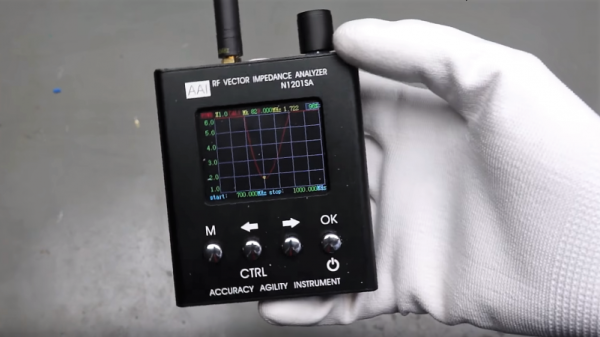
But we’re living in the future, and the tools to properly analyze antenna designs are actually now within the means of almost everyone. [Andreas Spiess] recently reviewed one such instrument, the N1201SA vector impedance analyzer, available from the usual overseas sources for less than $150. [Andreas]’s review does not seem to be sponsored, so it seems like we’re getting his unvarnished opinion; spoiler alert, he loves it. And with good reason; while not a full vector network analyzer (VNA) that will blow a multi-thousand dollar hole in your wallet, this instrument looks like an incredible addition to your test suite. The tested unit works from 137 MHz to 2.4 GHz, so it covers the VHF and UHF ham bands as well as LoRa, WiFi, cell, ISM, and more. But of course, [Andreas] doesn’t just review the unit, he also gives us a healthy dose of theory in his approachable style.

[The guy with the Swiss accent] has been doing a lot of great work these days, covering everything from how not to forget your chores to reverse engineering an IoT Geiger counter. Check out his channel — almost everything he does is worth a watch.

Continue reading “Putting A Poor Man’s Vector Analyzer Through Its Paces”

3D Printed Antenna Is Broadband

Antennas are a tricky thing, most of them have a fairly narrow range of frequencies where they work well. But there are a few designs that can be very broadband, such as the discone antenna. If you haven’t seen one before, the antenna looks like — well — a disk and a cone. There are lots of ways to make one, but [mkarliner] used a 3D printer and some aluminum tape to create one and was nice enough to share the plans with the Internet.

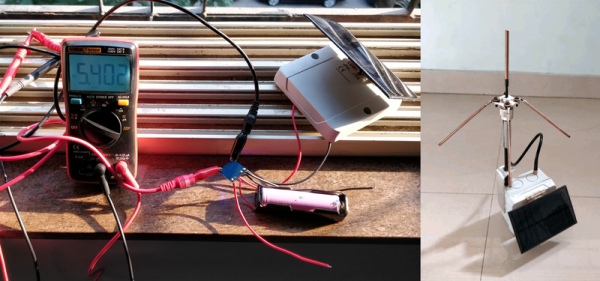
As built, the antenna works from 400 MHz and up, so it can cover some ham bands and ADS-B frequencies. The plastic parts act as an anchor and allow for coax routing. In addition, the printed parts can hold a one-inch mast for mounting.

Continue reading “3D Printed Antenna Is Broadband”

Harvesting Energy From The Earth With Quantum Tunneling

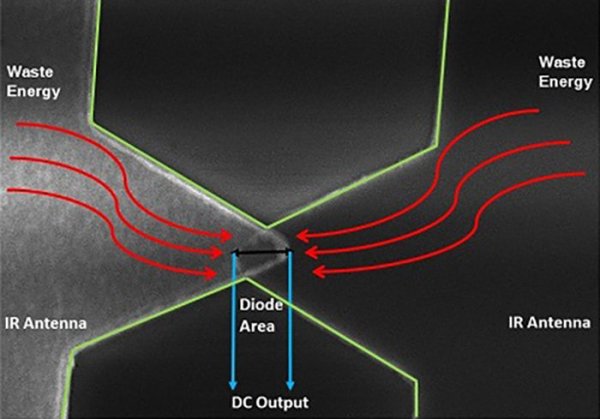
More energy hits the earth in sunlight every day than humanity could use in about 16,000 years or so, but that hasn’t stopped us from trying to tap into other sources of energy too. One source that shows promise is geothermal, but these methods have been hindered by large startup costs and other engineering challenges. A new way to tap into this energy source has been found however, which relies on capturing the infrared radiation that the Earth continuously gives off rather than digging large holes and using heat exchangers.

This energy is the thermal radiation that virtually everything gives off in some form or another. The challenge in harvesting this energy is that since the energy is in the infrared range, exceptionally tiny antennas are needed which will resonate at that frequency. It isn’t just fancy antennas, either; a new type of diode had to be manufactured which uses quantum tunneling to convert the energy into DC electricity.

While the scientists involved in this new concept point out that this is just a prototype at this point, it shows promise and could be a game-changer since it would allow clean energy to be harvested whenever needed, and wouldn’t rely on the prevailing weather. While many clean-energy-promising projects often seem like pipe dreams, we can’t say it’s the most unlikely candidate for future widespread adoption we’ve ever seen.

Behind The Scenes At A Pair Of Cell Sites

Those who fancy themselves as infrastructure nerds find cell sites fascinating. They’re outposts of infrastructure wedged into almost any place that can provide enough elevation to cover whatever gap might exist in a carrier’s coverage map. But they’re usually locked behind imposing doors and fences with signs warning of serious penalty for unauthorized access, and so we usually have to settle for admiring them from afar.

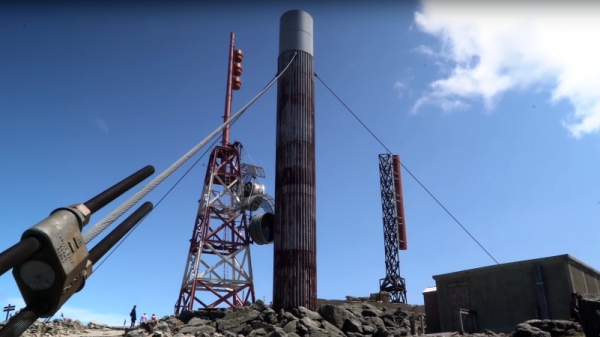
Some folks, like [Mike Fisher] aka [MrMobile], have connections, though, and get to take an up close and personal tour of a couple of cell sites. And while the video below is far from detailed enough to truly satisfy most of the Hackaday crowd, it’s enough to whet the appetite and show off a little of what goes into building out a modern cell site. [Mike] somehow got AT&T to take him up to a cell site mounted in the belfry and steeple of the 178-year old Unitarian Church in Duxbury, Massachusetts. He got to poke around everything from the equipment shack with its fiber backhaul gear and backup power supplies to the fiberglass radome shaped to look like the original steeple that now houses the antennas.

Next he drove up to Mount Washington in New Hampshire, the highest point in the northeast US and home to a lot of wireless infrastructure. Known for having some of the worst weather in the world and with a recent low of -36°F (-38°C) to prove it, Mount Washington is brutal on infrastructure, to which the tattered condition of the microwave backhaul radomes attests.

We appreciate the effort that went into this video, but again, [Mike] leaves us wanting more details. Luckily, we’ve got an article that does just that.

Continue reading “Behind The Scenes At A Pair Of Cell Sites”

Tapping Into A Ham Radio’s Potential With SDRPlay

Software-defined radios are great tools for the amateur radio operator, allowing visualization of large swaths of spectrum and letting hams quickly home in on faint signals with the click of a mouse. High-end ham radios often have this function built in, but by tapping into the RF stage of a transceiver with an SDR, even budget-conscious hams can enjoy high-end features.

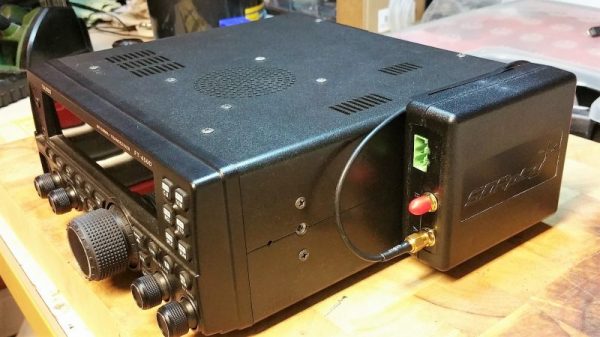
With both a rugged and reliable Yaesu FT-450D and the versatile SDRPlay in his shack, UK ham [Dave (G7IYK)] looked for the best way to link the two devices. Using two separate antennas was possible but inelegant, and switching the RF path between the two devices seemed clumsy. So he settled on tapping into the RF stage of the transceiver with a high-impedance low-noise amplifier (LNA) and feeding the output to the SDRPlay. The simple LNA was built on a milled PCB. A little sleuthing with the Yaesu manual — ham radio gear almost always includes schematics — led him to the right tap point in the RF path, just before the bandpass filter network. This lets the SDRPlay see the signal before the IF stage. He also identified likely points to source power for the LNA only when the radio is not transmitting. With the LNA inside the radio and the SDRPlay outside, he now has a waterfall display and thanks to Omni-Rig remote control software, he can tune the Yaesu at the click of a mouse.

If you need to learn more about SDRPlay, [Al Williams]’ guide to GNU Radio and SDRPlay is a great place to start.

Continue reading “Tapping Into A Ham Radio’s Potential With SDRPlay”

Measuring HF Signal Speeds In A DIY Coaxial Collinear Antenna

Air Traffic Controllers use Automatic Dependent Surveillance-Broadcast (ADS-B) as an alternative to secondary radar to track aircraft. The ADS-B is transmitted by the aircraft and contains information such as GPS position, pressure, altitude, and callsign among other things at a 1090 MHz frequency, which can be decoded using any of a number of software tools.

[Mike Field] lives near an airport, and decided he wanted to peek into the tracking signals for fun. He turned to an RTL-based TV Dongle. Since the stock antenna was not cutting it, he decided to make one specifically for the 1090 MHz signal. His design is based on Coaxial Collinear Antenna for ADS-B Receiver by [Dusan Balara] which uses pieces of the coaxial cable cut to the right length. There are a number of calculations involved in determining the size of the cable, however, the hack in this design is the way he uses a USB based oscilloscope to measure the speed of RF waves inside the line in question.

We reached out to [Mike], and this is what he had to say. The idea is to use a cable of half the size of the wavelength which is calculated as

lambda = c/f

For the best reception, the sections of coax need to be half a wavelength long – but the wavelength of the signal inside the coax, which is shorter than the wavelength in free space. As this was a generic cable he had no idea of the dielectric that separates the core from the shield, so the ‘velocity factor’ could be anything depending on the exact composition.

To determine the speed of the signal in the cable, his approach omits the more expensive equipment. A length of coax acts as a stub – any energy that is sent into the cable reaches the far end of the transmission line and is then reflected back to the source. When the cable is 1/4th of the wavelength long, the reflected signal arrives back at the start of the signal 180 degrees out of phase – in a perfect world it would completely null out the input signal. Continue reading “Measuring HF Signal Speeds In A DIY Coaxial Collinear Antenna”

Start Tracking Satellites With This Low-Cost Azimuth-Elevation Positioner

Tracking satellites and the ISS is pretty easy. All you really need is an SDR dongle or a handheld transceiver, a simple homebrew antenna, and a clear view of the sky. Point the antenna at the passing satellite and you’re ready to listen, or if you’re a licensed amateur, talk. But the tedious bit is the pointing. Standing in a field or on top of a tall building waving an antenna around gets tiring, and unless you’re looking for a good arm workout, limits the size of your antenna. Which is where this two-axis antenna positioner could come in handy.

While not quite up to the job it was originally intended for — positioning a 1.2-meter dish antenna — [Manuel] did manage to create a pretty capable azimuth-elevation positioner for lightweight antennas. What’s more, he did it on the cheap — only about €150. His design seemed like it was going in the right direction, with a sturdy aluminum extrusion frame and NEMA23 steppers. But the 3D-printed parts turned out to be the Achille’s heel. At the 1:40 mark in the video below (in German with English subtitles), the hefty dish antenna is putting way too much torque on the bearings, delaminating the bearing mount. But with a slender carbon-fiber Yagi, the positioner shines. The Arduino running the motion control talks GS232, so it can get tracking data directly from the web to control the antenna in real time.

Here’s hoping [Manuel] solves some of the mechanical issues with his build. Maybe he can check out this hefty dish positioner for weather satellite tracking for inspiration.

Continue reading “Start Tracking Satellites With This Low-Cost Azimuth-Elevation Positioner”