Air Freshener Hacking

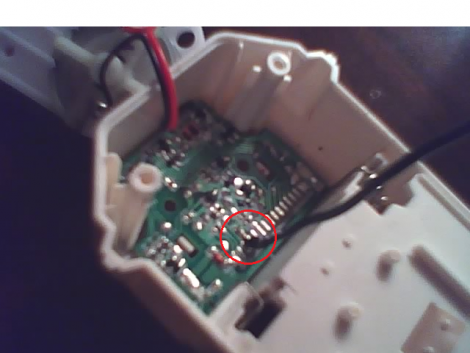
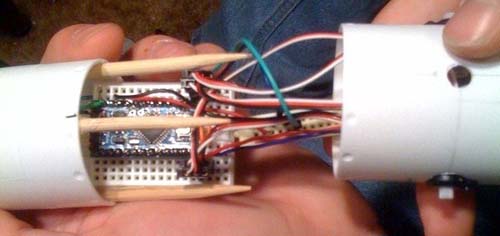
In an effort to improve his marital standing [Tech B] hacked an air freshener to make it Internet controllable. The main component here is a Glade Sense and Spray. It cost him $7 and is meant to spray out some sweet smells when it senses motion in the room. The unit also has a manual spray button which he patched into with the help of a relay. From there some Arduino code and an IRC bot take over, letting him unleash freshness from anywhere he has IRC access.

When reading about this we were also thinking: “motion sensing circuitry available at local stores for just $7?”. We may have to conduct an investigation into the alternative usefulness of that package.

If you have another brand of automatic freshener around it should be just as easy to hack as this one was.

Mouse Controlled Manipulator Arm

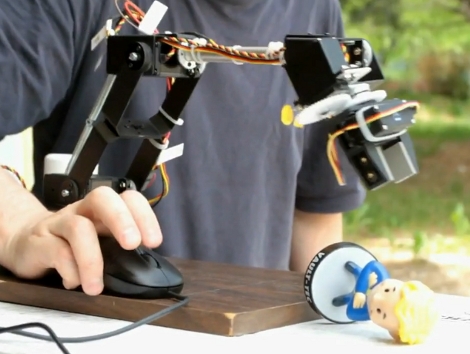
[Oleg] worked out a way to use his USB mouse to control this manipulator arm. Using a Lynxmotion AL5D (we’ve seen the AL5A previously) he drives the six servos with an Arduino servo shield. A USB host shield handles the HID end for connecting the mouse. The video after the break says it all, [Oleg] has no problem picking up that figurine quickly and accurately. Sliding the mouse controls horizontal movement in all directions. The scroll wheel moves the claw up and down. And holding the left or right buttons what using the control wheel closes or rotates the claw. All we can say is: Bigger, BIGGER!

Continue reading “Mouse Controlled Manipulator Arm”

CNC Hardware: Stream G-code To An Arduino

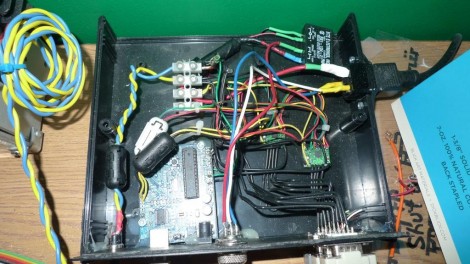
[Reza Naima] has been using an Arduino as the center of his CNC setup for quite some time now. It handles three stepper motors, limiting switches, e-stop, and spindle control. The sketch he’s using allows him to stream g-code to the popular prototyping platform, freeing him from needing a dedicated PC. It’s worked so well that he’s decided to clean up the code and develop a shield to help others get up and running. If you want to see his progress or lend a hand, check out the google group he started for the schematics, code, and forum discussions. There is already a CNC project for Arduino called Grbl but [Reza’s] approach uses the Arduino libraries in an effort to make the sketch more customizable for the average user.

LED Matrix With A Gross Of Pixels

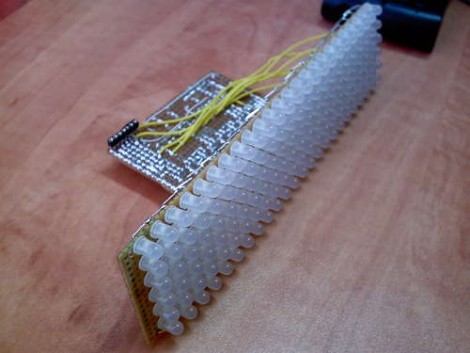
This LED matrix is arranged in a 24×6 pattern for message scrolling. There’s no etched boards here, making us wonder where [Syst3mX] found protoboard this long. He’s using an Arduino to drive the demonstration (clip after the break) but you can use any microcontroller with this setup. That’s because he’s using three shift registers for column data and a decade counter for row scanning, requiring just five control pins.

While you’re going to the trouble of ordering components, maybe you should try your hand at building a touch sensitive LED matrix too.

Continue reading “LED Matrix With A Gross Of Pixels”

Lolo’s (perfect Moment) Alarm Clock

[youtube http://www.youtube.com/watch?v=CphsgESZGcE&feature=player_embedded%5D

It seems everybody has a different interpretation of the perfect alarm clock. [Loic Royer’s] alarm clock is not the loudest, or the smartest, but does have some interesting features. By monitoring several environmental factors like temperature, air quality, humidity, dew point, and your own sleep patterns, this alarm clock can determine the best moment in the morning to wake you up.

The main sensor is a wireless accelerometer with the theory being: the more you move in your sleep, the closer you are to a conscious state. The other sensors assist in picking the perfect moment, and awaken you with the sound of birds chirping.

For now all we have is the source code and the list of hardware, but for anyone wanting to try, a circuit diagram wouldn’t be too hard to figure out on your own. Check after the rift for some more videos. Continue reading “Lolo’s (perfect Moment) Alarm Clock”

Panoramic And Spheric Tripod Rig

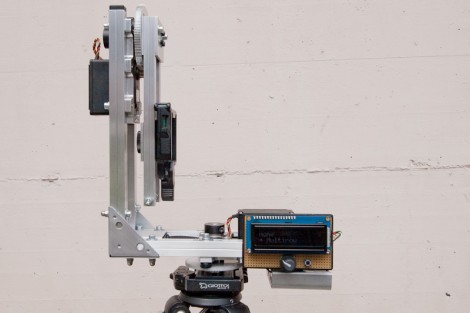
This simple yet precise build takes your camera for a spin in order to take spherical and multi-row panorama photographs. The rig mounts to a tripod, using two servo motors for motion, producing images that can be stitched together perfectly. An Arduino handles the hardware with an LCD interface for dialing in the settings.It’s not the cheapest way to get 360 degree shots but the example images are amazing.

[Thanks Juan]

Electric Mountainboard With Wireless Control

[youtube=http://www.youtube.com/watch?v=AkhjeEDaagQ]

[Andres Guzman] is chauffuering himself around the University of Illinois campus thanks to his wirelessly controlled mountainboard. He added a brushless motor to drive the rear axel with the help of a chain. Power is provided by a Lithium Iron Phosphate battery which we’ve seen used in other electric vehicles due to its lightweight properties. A wireless PlayStation 2 controller operates the motor but steering remains a lean-to-turn system.