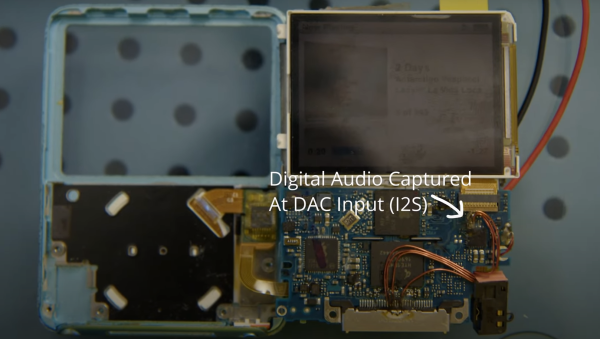
The iPod Nano was one of Apple’s masterworks, but it’s really tied down by its dependence on wired headphones. At least, that’s what [Tucker Osman] must have thought, as he spent an unreasonable amount of time designing a Bluetooth mod for the 3rd gen Nano. And it’s a thing of beauty — temperamental, brutally difficult to build, and fragile in use, but still beautiful. And while some purists try to keep their signal analog, [Tucker]’s coup d’etat is to intercept the iPod’s audio signal before the DAC chip, keeping the entire signal path digital to the Bluetooth speaker. Oh, and he also managed to make the volume and track skip buttons work, back across the wireless void.
bluetooth602 Articles
A Simple Web Configured BLE To GPIO Bridge
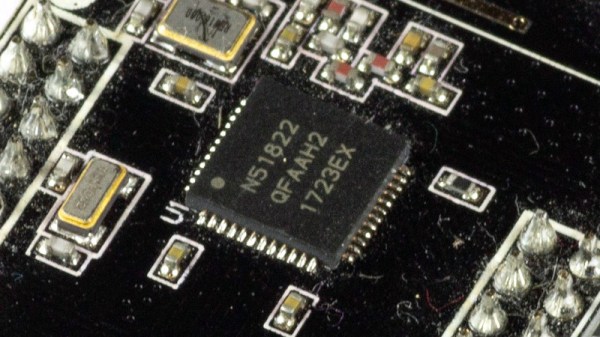
[Daniel Dakhno] kept ending up in a situation where the ability to read the status of, or control a few digital IO pins with minimal effort, would be terribly useful. Not wanting to keep compiling code, for such simple needs, they instead used a nRF51-based module as a physical interface and produced a general purpose firmware that could be configured with a simple web interface. The NRF51-IO-module was born, whose job is to pair with whatever device you have in front of you, provided it supports BLE, and give direct access to those IO pins.
Rather than acting as a rather slow logic analyser, the firmware is intended for mostly static configurations. The web application sends a configuration packet over to the nRF51 board, which then programs it into FLASH and restarts, reading the updated configuration and applying it to the IO pins. These outputs then persist as long as there is power. The read-side of the equation can also be performed via the web page, but we didn’t have a chance to verify that. The code implements the Bluetooth automation IO service as well as the binary sensor service so if you have access to applications that talk these services, then you should be able to fire it up and go with it, although we’ve not personally tested this due to lack of an nRF51 board. We noticed that the Home Assistant automation platform supports the BT binary sensor, which might be a big help for some people with a need for some wireless control and sensing.
If you need a practical example of a use for remote sensing, here’s a physical mailbox status monitor, using the nRF51. Whilst we’re thinking of Bluetooth and sensors, here’s a custom firmware for some super cheap environment sensors that frees them from vendor lock-in.
Header image: Ubahnverleih, CC0.
Haptic Baby Monitor Gets The Wearer’s Attention
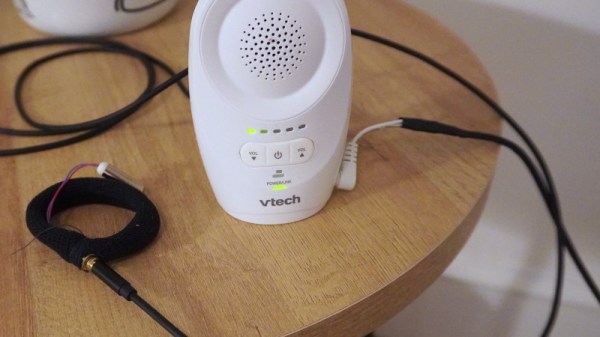
Anyone who’s ever slept through a morning’s alarm can tell you that sounds, even loud piercing ones, don’t always wake a person out of a deep sleep. Similarly, hearing a baby cry on the other side of the monitor might not always wake a parent up in the middle of the night. So what’s the solution? This haptic baby monitor created by [Guy Dupont] certainly looks like it has some promise.
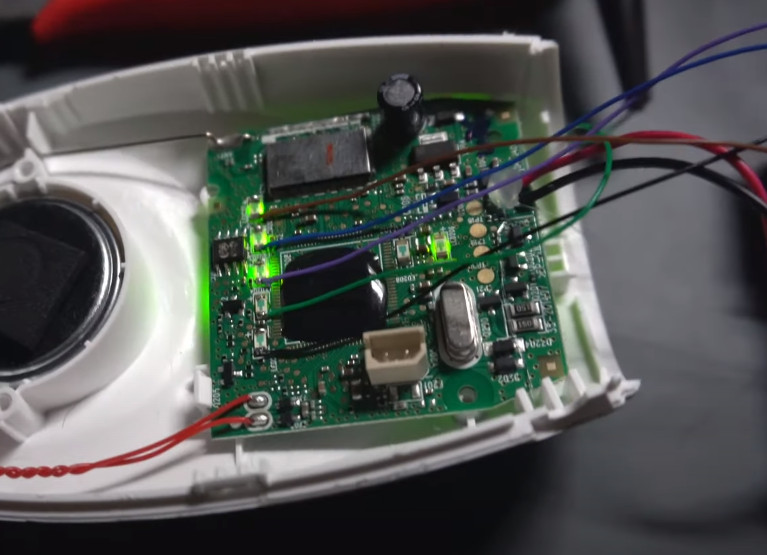
[Guy] picked up a fairly standard baby monitor from VTech and popped it open to see how he could tie a vibration motor into the original circuitry. He originally thought he’d have to do some signal processing magic to figure out the amplitude of the audio, but then he realized that the five LEDs on the front of the unit that light up to indicate the audio level were already doing the hard work for him.

So he wired each of the LEDs up to the pins of a Seeed Studio XIAO nRF52840 microcontroller, and wrote some code that would poll their status a few hundred times per second. Dividing the total number of LEDs by the count of how many are currently illuminated gives him a nice average that he can use to set the intensity of the vibration motor that he’s built into a stretchy armband.
For extra points, [Guy] is also using the Bluetooth capability of the XIAO to provide a rudimentary configuration service — just connect up to the MCU with a Bluetooth serial application on your computer or phone, and fire off a value between 0 and 10 to augment the motor’s intensity. There’s also a BLE characteristic which can be read from a client device to determine the currently detected audio amplitude, which could be used to chart how well the baby is sleeping over time. Alternately, as demonstrated at the end of the video, you could use it to play Flappy Bird.
It’s an elegant modification that could potentially hold promise for parent’s who need a bit of extra help keeping tabs on their miniature humans. This isn’t the first time we’ve seen hackers try to improve upon the classic baby monitor, but this is arguably the most approachable attempt we’ve seen to date.
Continue reading “Haptic Baby Monitor Gets The Wearer’s Attention”
Build Your Own 3D Printed Bluetooth Headphones
A few years back, [Shannon Ley] wondered how hard it would be to build a pair of Bluetooth headphones from scratch. Today, we have our answer. The Homebrew Headphones website is devoted to just one thing: explaining how you can use common components and some 3D printed parts to build an impressively comprehensive pair of wireless headphones for around $50 USD.
The headphones pair a CSR8645 Bluetooth audio receiver with a TP4056 USB-C charging module, a 500 mAh LiPo pouch battery, a pair of Dayton Audio CE38MB-32 drivers, and replacement ear covers designed for the Bose QuietComfort QC15. Some perfboard, a couple buttons, a resistor, and an LED round out the parts list.
All of the components fit nicely into the meticulously designed 3D printed frame, and assembly is made as simple as possible thanks to an excellent step-by-step guide. It’s all so well documented that anyone with even basic soldering experience should be able to piece it together without too much fuss.
Of course, these aren’t the first 3D printed headphones we’ve ever seen. But the quality of the documentation and attention to detail really make these stand out.
Nokia 5110 Gets Android Stowaway And A Keyboard
Even though Nokia is largely an afterthought in the phone market now, there was a time when their products represented the state-of-the-art in mobile devices. Some of the their handsets even featured slide-out keyboards and the ability to sent emails; largely unheard of for a device from the late 90s. [befinitiv] was a kid back then and couldn’t afford one of these revolutionary devices, so he built his own modern version that still looks and feels like the original.
To do this he borrowed the case and structure of a Nokia 5110 phone, but modified it to hold a small Android device in the old battery compartment along with a tiny Bluetooth keyboard (which was also built from scratch by [befinitiv]) that connects to the Android phone to mimic the old slide-out style. This isn’t just a case mod, though. He also reverse-engineered the original PCB of the phone and included a Bluetooth module there as well, which allows the phone’s screen and keypad to work mostly as originally intended.
This project goes pretty far to scratch the 90s phone nostalgia itch while still being largely usable as a real phone in the modern world. Assuming you aren’t too hung up on the literal phone aspect, the Notkia project is also an impressive effort to bring new life to these old handsets.
Continue reading “Nokia 5110 Gets Android Stowaway And A Keyboard”
Headphone Cable Trouble Inspires Bluetooth Conversion
[adblu] encountered the ever-present headphone problem with their Sennheiser Urbanite headphones – the cable broke. These headphones are decent, and despite the cable troubles, worth giving a new life to. Cable replacement is always an option, but [adblu] decided to see – what would it take to make these headphones wireless? And while they’re at it, just how much battery life could they get?
Armed with a CSR8635 Bluetooth audio receiver breakout module and a TP4056 charger, [adblu] went on rewiring the headphone internals. The CSR8635 already has a speaker amplifier inside, so connecting the headphones’ speakers didn’t require much effort – apart from general soldering difficulties, as [adblu]’s soldering iron was too large for the small pads on the BT module. They also found a 2400mAh battery, and fit it inside the headphone body after generous amounts of dremel work.
The result didn’t disappoint – not only does everything fit inside the headphone body, the headphones also provided 165 hours of music playback at varying volume. Electronics-wise, it really is that easy to retrofit your headphones with Bluetooth, but you can always go the extra mile and design an intricate set of custom PCBs! If firmware hacks are more to your liking, you can use a CSR8645 module for your build and then mod its firmware.
Bluetooth 8-Track Adapters Are A Thing
When it comes to classic cars, the entertainment options can be limited. You’re often stuck with an old cassette deck and AM/FM radio, or you can swap it out for some hideous flashy modern head unit. [Jim] had a working 8-track deck in his Corvette, and didn’t want to swap it out. Thus, he set about building himself a simple Bluetooth to 8-track adapter.
The hack is straightforward, with [Jim] grabbing a Bluetooth-to-cassette adapter off the shelf. These simply take in audio over Bluetooth, and pipe the analog audio out to a magnetic head, which is largely similar to the head that reads the cassette. Pumping the audio to the magnetic coils in the adapter’s head creates a changing magnetic field essentially the same as the audio tape moving past the cassette reader head. It doesn’t really matter whether you’re working with an 8-track player or a regular cassette. Get the magnetic field in the right spot, and it’ll work.
The electronics from the cassette adapter are simply placed inside an old 8-track tape, with holes cut in the chassis for the charge port and on switch. Then, all you need to do is pop the adapter into the 8-track deck, pair with it over Bluetooth, and you can get the tunes pumping.
Others have had success with hilarious Rube Goldberg methods, too. [Techmoan] took a classic cassette-to-8-track adapter, which is actually self-powered by the deck, and simply popped a Bluetooth cassette inside. That worked surprisingly well, and it was interesting to see how it all worked on the inside. We even saw a 3D-printed device on TikTok.
Thus, if you’ve got an old Corvette, particularly of that era with the Doug Nash 4+3 transmission, this might just be the hack for you. Alternatively, you can hack Bluetooth in to just about any classic stereo; we’ve got a guide on how to do just that. Video after the break.