Hacking Hearing With A Bone Conduction Bluetooth Speaker

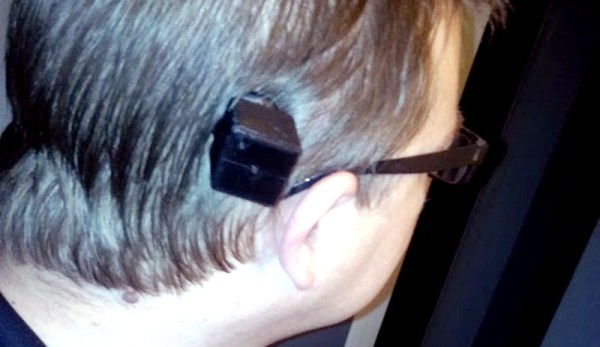
When a hacker finds himself with a metal disc and magnet surgically implanted in his skull, chances are pretty good that something interesting will come from it. [Eric Cherry]’s implant, designed to anchor a bone-conduction hear aid, turned out to be a great place to mount a low-cost Bluetooth speaker for his phone – at least when he’s not storing paperclips behind his ear.

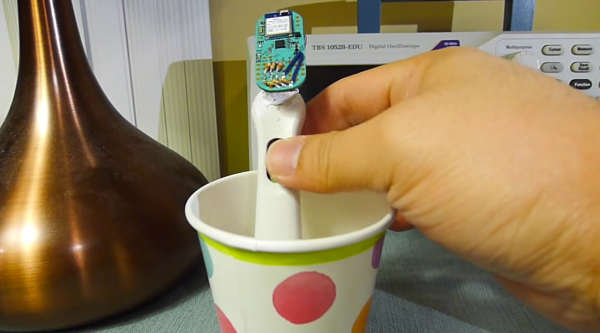
With single-sided deafness, [Eric]’s implant allows him to attach his bone-anchored hearing aid (BAHA), which actually uses the skull itself as a resonator to bypass the outer ear canal and the bones of the middle ear and send vibrations directly to the cochlea. As you can imagine, a BAHA device is a pretty pricey bit of gear, and being held on by just a magnet can be tense in some situations. [Eric] decided to hack a tiny Bluetooth speaker to attach to his implant and see if it would work with his phone. A quick teardown and replacement of the stock speaker with a bone-conduction transducer from Adafruit took care of the electronics, which were installed in a 3D printed enclosure compatible with the implant. After pairing with his phone he found that sound quality was more than good enough to enjoy music without risking his implant. And all for only $22 out-of-pocket. While only a Bluetooth speaker in its current form, we can see how the microphone in the speakerphone might be used to build a complete hearing aid on the cheap.

We think this is a great hack that really opens up some possibilities for the hearing impaired. Of course it’s not suitable for all types of hearing loss; for more traditional hearing aid users, this Bluetooth-enabled adapter might be a better choice for listening to music.

This Car Lets You Fistbump To Unlock

In the dark ages, you had to use a key to lock and unlock your car doors. Just about every car now has a remote control on the key that lets you unlock or lock with the push of a button. But many modern cars don’t even need that. They sense the key on your person and usually use a button to do the lock or unlock function. That button does nothing if the key isn’t nearby.

[Pierre Charlier] wanted that easy locking and unlocking, so he refitted his car with a Keyduino to allow entry with an NFC ring. What results is a very cool fistbump which convinces your car to unlock the door.

Keyduinio is [Pierre’s] NFC-enabled project, but you can also use a more conventional Arduino with an NFC and relay shield. The demo also works with a smartphone if you’re not one for wearing an NFC ring. Going this round, he even shows how to make it work with Bluetooth Low Energy (BLE).

Continue reading “This Car Lets You Fistbump To Unlock”

Learn Bluetooth Or Die Tryin

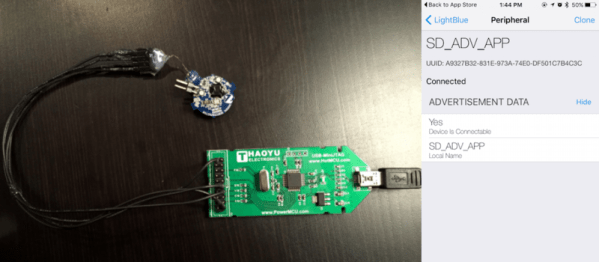
Implementing a Bluetooth Low Energy (BLE) device from scratch can be a daunting task. If you’re looking for an incredibly detailed walkthrough of developing a BLE project from essentially the ground up, you’ve now got a lot of reading to do: [Jocelyn Masserot] takes you through all the steps using the ARM-Cortex-M0-plus-BLE nRF51822 chip.

The blog does what blogs do: stacks up in reverse-chronological order. So it’s best that you roll on down to the first post at the bottom and start there. [Jocelyn] walks you through everything from setting up the ARM compiler toolchain through building up a linker script, blinking an LED, flashing the chip, and finally to advertising your device to your cell phone. It’s a lot of detail, but if you’re doing something like this yourself, you’re sure to appreciate it.

Of course, all the code is available for you to crib peruse on [Jocelyn]’s GitHub. And for yet more background reading on BLE, check out the Hackaday Dictionary.

Robotic Suitcase Follows You Around

I have something that follows me around all the time: my dog Jasper. His cargo-carrying capability is limited, though, and he requires occasional treats. Not so this robotic suitcase. All it needs, the designers claim, is an occasional charge and a Bluetooth device to follow.

Designed by NUA Robotics, this suitcase is equipped with powered wheels and a certain amount of smarts: enough to figure out the direction of a Bluetooth signal such as your cell phone and follow it. This is also accompanied by proximity sensors so it doesn’t bump into you or other people. When the built-in battery runs out, just pop put the handle and pull it yourself, and the regenerative motors will recharge the battery. There’s no indication on price, battery life or how much space is left to actually carry stuff yet, but the designers claim it could be out within the year. As someone who uses a walking stick, this sounds like a great idea. And if they can work out how to get it to walk the dog for me, that would be even better.

Now, who will be the first to build a clone of this in their basement? Bonus points if it’s a two-wheeled self-balancer.

Continue reading “Robotic Suitcase Follows You Around”

The Stork Looks Different Than We Thought

What the Internet of Things really needs is more things, and the more ridiculous the better. At least, that’s the opinion of [Eric] who has created a tongue-in-cheek gadget to add to the growing list of connected devices. It’s a Bluetooth-enabled pregnancy test that automatically releases the results to the world. Feeling lucky?

The theory of operation is fairly straightforward. A Bluetooth low-energy module is integrated into the end of a digital pregnancy test. These tests have a set of photo detectors to read the chemical strip after the test is conducted. If the test is positive, the module sends a signal to a Raspberry Pi which tweets the results out for the world to see. It also has an option to send a text message to your mom right away!

[Eric]’s project to live-tweet a pregnancy test also resulted in a detailed teardown of a digital pregnancy test, so if you need any technical specifications for pregnancy tests (for whatever reason) his project site has a wealth of information. He does note that his device can be used on other similar devices with directly driven LCD screens, too. The fun doesn’t end there, though! Once the pregnancy is a little further along you’ll be able to get the baby on Twitter, too.

Continue reading “The Stork Looks Different Than We Thought”

PIC32 Smart Watch For Less Than A Benjamin

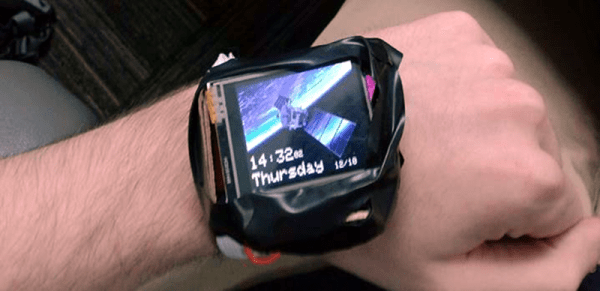
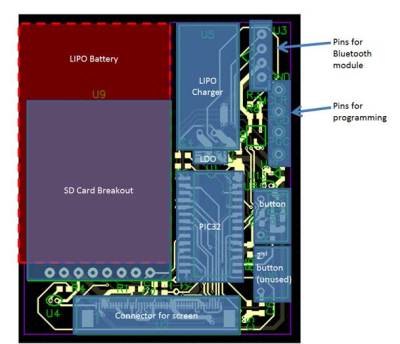
[Matthew Filipek] likes smart watches, but wanted to build one for under $100, so he did. The watch has a 1.7 inch LCD touchscreen, a rechargeable LiPo battery, an SD card, and Bluetooth. The watch is a little large since [Matthew] had only a month to complete the project that drove him to use some pre-made modules image004and meant one shot at getting his custom PCB right.

The watch sports three applications: a settings app, a simple game, and a sketch program (you can see a demo in the video below). Power management is a primary goal, of course, although the clock rate is held high enough to make the game playable. To simplify the software, [Matthew] uses protothreads–a lightweight thread abstraction for embedded systems.

We’ve seen several DIY smartwatches in the past including one entry for the Hackaday Prize. It is hard to roll your own watch that has the same small size and style as a commercial offering. However, there is something to be said for having a homebrew watch for boosting your hacker cred.

Continue reading “PIC32 Smart Watch For Less Than A Benjamin”

The ESP32 Beta Units Arrive

A little more than a year ago, the ESP8266 WiFi module showed up uneventfully in Seeed Studio’s store. Since then, the documentation has been translated to English, a proper development environment for this chip was created, and everybody is using this cheap but powerful chip for the latest Internet of Things things.

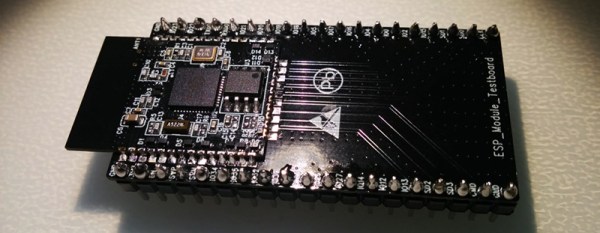
The company behind the ESP8266, Espressif, is not one to rest on their laurels, and for several months they’ve been working on the next generation of powerful WiFi-enabled tiny, cheap systems. They have their silicon, and already 200 lucky people have their hands on the very first test units of the ESP32, the next generation of Espressif’s WiFi chips. The teardowns have begun, and [LadyAda] streamed her initial experiments with the chip to the Intertubes (available below). [Martin] is also one of the guys who received these early beta chips, and he was kind enough to post his thoughts on Espressif’s newest chip.

A little bit of information on the ESP32 has dribbled out, and [LadyAda] and [Martin]’s demo unit confirm all we’ve suspected. There are two Tensilica L108 processors running at up to 160MHz, a lot of peripherals including ADCs, DACs, I2C, SPI, I2S, and PWM, more RAM, AES and SSL for security, and Bluetooth Low Energy. WiFi has also been upgraded, and the ESP32 will support speeds up to 150 Mbps.

Continue reading “The ESP32 Beta Units Arrive”