AVR RFID Tag

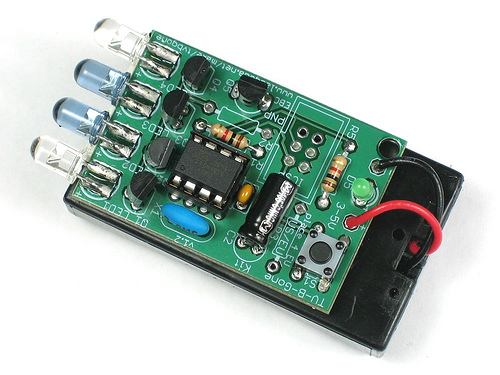
[pc486] sent in his hack that uses an ATtiny85 to act like an EM4102, a chip used for RFID tags. Minimally, all that is needed is the AVR and a coil, but he recommends some filtering capacitors. Depending on the size of the coil, different frequencies and ranges can be achieved. This project actually includes several hacks, such as using the coil for not only power, but a clock signal. The coil is actually able to power the chip without being connected to the power pins due to clamping diodes on the connected pins. The firmware is short but available on subversion.

Related: Scratch-built RFID tags

Home Made Solder Pot

solder pot

Our reader [Damir] built a home made soldering pot. It can be used to solder and desolder components. To remove a through hole component, the solder side is placed in the bath. Then the component is removed with pliers. It is also possible to solder components, by placing the leads in the molten solder; similar to wave soldering. Another common use is tinning self stripping wire. The insulation of the wire is designed to burn off, allowing the strip and tin phase to be single step. This solder pot would be a nice addition to the hacker’s soldering station we had covered in 2008. For more pictures, check out the photo gallery. In the video embedded below, a transformer is easily removed from a modem.

Continue reading “Home Made Solder Pot”

Wireless Arduino Cat Food Dispenser

catfooddispenser

Reader, [Andres Leon], has two adorable cats with very specific dietary needs. Instead of altering his schedule, he donned his hacking hat and designed a very solid cat food dispenser. The dispenser consists of a rotating drum with a slot in it and a PVC pipe Y-fitting to distribute the food evenly. The brains of the machine is an Arduino Deumillanove and an XBee module. The unit can be controlled by a web interface or it can run completely standalone. [Andres] ran into a problem where the drum’s resistance to turning varied based on how much food was inside. He solved this with a clever laser position indicator. A piece of plywood is lined up with the slot at the top so that whenever the slot is facing up it keeps the laser from shining on a photoresistor. The cats were afraid of the servo noise at first, but now they run to their bowls whenever they hear it.

The Holy Toaster Kit

456124655_30491edce5_m

The holy toaster is an open source kit to put Jesus on your toast, complete with cost breakdown and engineering data files. A laser machined stainless steel Jesus blocks a pattern of radiation from browning the toast. Installation is quite simple. Use a pair of pliers to bend a few tabs for support, and then insert the pattern in the toaster. Browning adjustments may be required to obtain adequate contrast. Best results appear to come from Honey Bran Country Bread. Their Flickr page contains more photos and a video of the prototype being cut. Let everyone know about your divine toast with the twittering toaster we had covered in 2008. Below is the instructional video.

Continue reading “The Holy Toaster Kit”

How-to: Build Your Own Spot Welder

Spot welders are used in the fabrication of automobiles, PC cases, power supplies, microwave ovens, electrical junction boxes, Faraday cages, and various electronics. A spot welder is used because it produces a highly defined point of contact weld. The materials are welded without excessive heating, so working pieces are handled easily. The weld is also highly controlled and repeatable. In this how-to we cover the basics of a spot welder, and then show you how to build one from a microwave oven transformer.

Continue reading “How-to: Build Your Own Spot Welder”

Repair A Malfunctioning LCD

When most people encounter dead pixels on an LCD text display, they figure that the display is dead and they decide to scrap it. However when the LCD display on one of [Joe]’s cordless phones started to show dead rows and columns of pixels, [Joe] decided that he could fix it. With only a pencil eraser, a hot air gun, and a screwdriver (for disassembly), [Joe] was able to fix his phone’s screen in just under 10 minutes. His process involves heating the glue holding the LCD’s ribbon cable to the phones PCB with a hot air gun and using a pencil eraser to reattach segments of the ribbon cable to the PCB. If anyone here has a problem similar to [Joe]’s, be sure to check out his detailed how-to complete with step-by-step pictures.

USB Reader For SNES Game Carts

[youtube=http://www.youtube.com/watch?v=Pwq6vRM8U7k]

Reader, [Matthias_H], sent in a video about his USB adapter for SNES game carts. All you have to do is plug in the SNES game cartridge and USB cable, then a ROM file of the game shows up as an external storage device on your computer. After that, you can play the ROM with your choice of emulator. We emailed [Matthias] asking for more information, and he quickly replied with a very nice writeup about the hack that is pasted below.

Update: [Matthias] launched a site for the “snega2usb” with updates on the development of the board and a FAQ.

Continue reading “USB Reader For SNES Game Carts”