The Carbon Fiber Construction Of Large Propellers

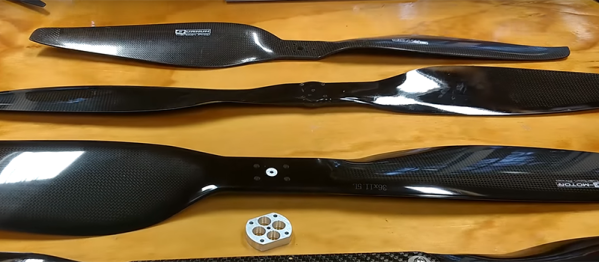
Props for your little RC airplane or drone are effectively consumables. They’re made of plastic, they’re cheap, and you’re going to break a lot of them. When you start swinging something larger than 12 inches or so, things start getting expensive. If you’re building gigantic octocopters or big RC planes, those props start adding up. You might not think you can build your own gigantic carbon fiber propellers, but [Tech Ingredients] is here to prove you wrong with an incredible video demonstration of the construction of large propellers

The key ideas behind the build are laid out in a video demonstration for building a single prop. The base begins with a CNC wire cut foam air foil. This foam airfoil is first modified for the attachment point by cutting a plug out of the root of the airfoil which is filled with epoxy.

With the skeleton of the airfoil complete, the build then moves on to laminating the foam core with carbon fiber. The epoxy itself is West Systems Pro-Set laminating epoxy, although we suspect the ubiquitous West Systems epoxy used for all those live-edge ‘river’ coffee tables will also work as well. This epoxy is spread out on a table, the carbon fiber laid over it, and a second layer of carbon fiber (check ‘yo biases!) laid over that. This is wrapped around the foam core, then cured with an electric heating pad.

Of course, this is only a demonstration of making a single blade for a prop. The next trick is turning that single blade into a propeller. This is done with a cleverly machined hub, attached through that epoxy plug placed in the foam core. The results are just as good as any large prop you could buy, and this has the added benefit of being something you made, not bought.

This is really a master class in composite construction, and well worth an hour’s of YouTube viewing. You can check out the intro video below.

Continue reading “The Carbon Fiber Construction Of Large Propellers”

Keep ‘Em Flying With This Monster DIY Battery

If you’ve spent an afternoon at the sticks of a remote-controlled aircraft, you’re probably well aware of the great limiter for such exploits: battery life. In the days when most RC aircraft were gas powered it was easy to cart along some extra fuel to keep the good times rolling, but now that everything except big scale models are using electric motors, RC pilots are looking for better ways to charge their batteries in the field.

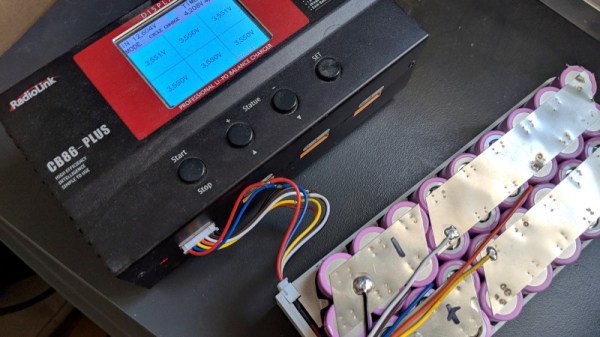
Though it might seem counter-intuitive, [Adam Pyschny] is of the opinion that the best way to keep his quadcopter batteries charged is to simply use another, much bigger, battery. Rather than mess around with inverters or generators, he can simply use a DC-to-DC battery charger and his huge custom-built battery pack to keep flying.

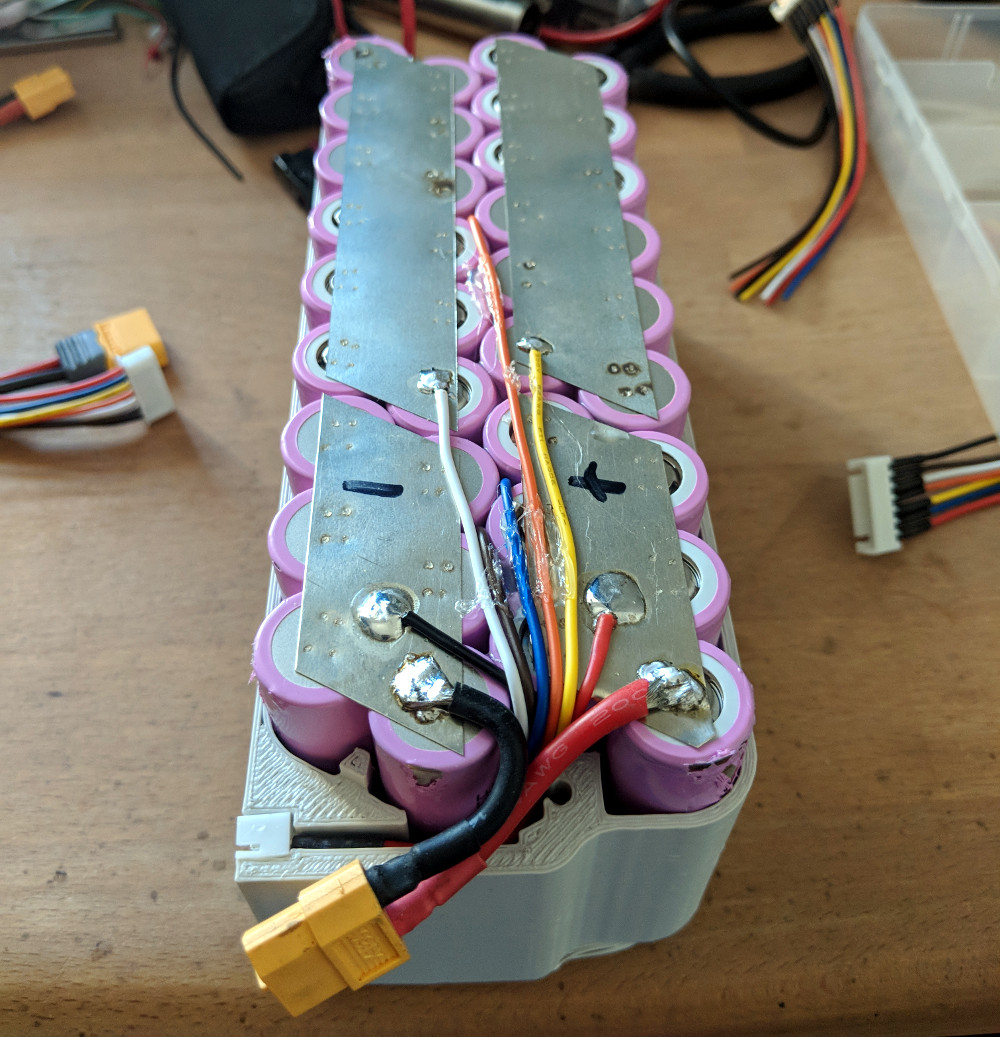
The pack contains 36 Samsung INR18650-35E 3500mAh cells, which gives it a total capacity of 454Wh. At 1965 grams (4.3 lbs) the pack isn’t exactly a featherweight, but it’s significantly lighter than carting a small generator or even a lead-acid battery to the field.

[Adam] designed a slick case in FreeCAD and printed it in Minadax ASA-X filament, which is specifically designed for outdoor use. A particularly nice detail in the case is that the balance connector (used to charge the cells) is cleanly integrated into the side of the pack, rather than just flapping around in the breeze; which annoyingly seems the norm even on commercially produced batteries.

An interesting next step for this project would be the addition of a solar panel and charge controller to help recover in-between charges. Beyond an automated platform to swap the batteries for you, a DIY pack like this might be the easiest way to maximize the amount of time your RC aircraft are in the air where they belong.

Robotic Fruit Fly Won’t Eat Your Fruit

The DelFly project has been busy since the last time we checked in on them. The Dutch team started 13 years ago and produced the smallest camera-carrying drone, and an autonomous tiny ornithopter. However, that ornithopter — now five years old — had to use some traditional control surfaces and a tail like an airplane which was decidedly not fruit fly-like. Now they’ve solved those problems and have announced the DelFly Nimble, a 13 inch and 1-ounce ornithopter. You can see the Nimble in the video below.

The close emulation of a real fly means the thing looks distinctly insect-like in flight. The dual wings use Mylar and form an X configuration. They flap about 17 times per second. A fully charged battery  — remember, the whole thing weighs an ounce — lasts five minutes. With an efficient speed of 3 meters per second, the team claims a flight range of over 1 kilometer with a peak speed that can reach  7 meters per second. It can even take a payload, as long as that payload weighs 4 grams or less.

Continue reading “Robotic Fruit Fly Won’t Eat Your Fruit”

Single-Rotor Drone: A Thrust-Vectoring Monocopter

We’re not entirely sure what to call this one. It’s got the usual trappings of a drone, but with only a single rotor it clearly can’t be called by any of the standard multicopter names. Helicopter? Close, but not quite, since the rotor blades are fixed-pitch. We’ll just go with “monocopter” for now and sort out the details later for this ducted-fan, thrust-vectored UAV.

Whatever we choose to call it — builder [tesla500] dubbed it the simultaneously optimistic and fatalistic “Ikarus” — it’s really unique. The monocopter is built around a 90-mm electric ducted fan mounted vertically on a 3D-printed shroud. The shroud serves as a mounting point for the landing legs and for four servos that swivel vanes within the rotor wash. The vanes deflect the airstream and provide the thrust vectoring that gives this little machine its control.

Coming to the correct control method was not easy, though. Thanks mainly to the strong gyroscopic force exerted by the rotor, [tesla500] had a hard time getting the flight controller to cooperate. He built a gimballed test stand to work the problem through, and eventually rewrote LibrePilot to deal with the unique forces on the craft and tuned the PID loops accordingly. Check out the results in the video below.

Some attempts to reduce the number of rotors work better than others, of course, but this worked out great, and we’re looking forward to the promised improvements to come.

Continue reading “Single-Rotor Drone: A Thrust-Vectoring Monocopter”

The Best New Quad Is A Bicopter

RCExplorer, or [David], or just ‘The Swede’, has come up with a bicopter kit. Yes, there are a lot of people making frames and kits for quadcopter, multicopters, drones, and so forth, but [David] is really the leader in weird multicopters. Now, we have the weirdest multicopter imaginable as a kit, complete with firmware that works.

[David] is one of the great unsung heroes of the drone and multicopter world. He’s famous for rocket knives, even though that really doesn’t have anything to do with drones, he bought an airplane for his front yard (again, little to do with drones), he was one of the first to take a glider up to 100,000 feet with a balloon, and he’s been one of the main forces behind tricopters as a superior — or at least cooler — platform for aerial acrobatics and camera work. There’s a lot of work being done to the various firmwares to support tricopters, and we have [David] to thank for that.

Like [David]’s earlier tricopter kits, this frame is made entirely out of carbon fiber plate, square tube, and threaded standoffs. It also looks like batman’s drone. The firmware — the real trick for a bicopter — is stock betaflight, and there are a few problems with the stock firmware. The bicopter doesn’t like flying backwards, tuning is fiddly, and it’s harder to fly than a quad on rails. That’s to be expected with a platform as weird as a bicopter, but this kit does open the door to firmware developers hacking and making the bicopter features better.

This is what delivery drones will look like, once the people who think delivery drones are a good idea learn physics.

While pure bicopters are great, the release of what will surely be a popular bicopter with a good community of firmware developers means the door is open to a simple VTOL fixed wing, not unlike a V-22 Osprey.

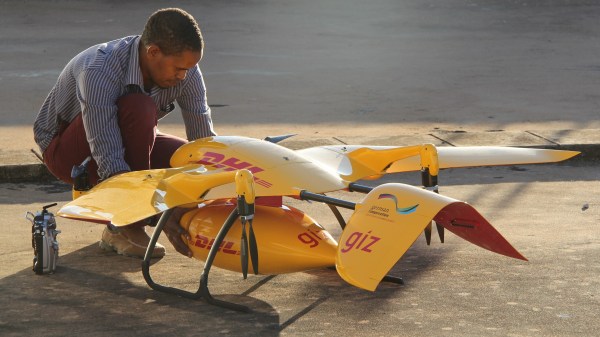
Remember, San Francisco tech bros, if you need a delivery drone, you need three things: long range, VTOL capability, and payload capacity. A quad or hexacopter will not get you there, and fixed wings will give you lift for free. There is no Moore’s Law for batteries, and right now if you want to ship a bottle of shampoo 20 miles in 30 minutes, the way to do that is with a drone that looks like a V-22 Osprey. Please, delivery drone bros, learn physics, use a tilt-rotor, and learn to put the battery in the wing. This is how you found a company that will get an easy $100M valuation.

Continue reading “The Best New Quad Is A Bicopter”

Quadcopter Ditches Batteries; Flies On Solar Power Alone

It seems kind of obvious when you think about it: why not just stick a solar panel on a quadcopter so it can fly on solar power? Unfortunately, physics is a cruel mistress, and it gets a bit more complex when you look at problems like weight to power ratios, panel efficiency, and similar tedious technical details. This group of National University of Singapore students has gone some way to overcome these technical issues, though: they just built a drone that is powered from solar power alone, with no batteries or other power source.

Their creation is a custom-built quadcopter made with carbon fiber that weighs just 2.6kg (about 5.7lbs), but which has about 4 square meters (about 43 square feet) of solar panels. By testing and hand-selecting the panels with the best efficiency, they were able to generate enough power to drive the four rotors, and have managed to achieve altitudes of up to 10 meters. The students have been working on prototypes of this since 2012, when their first version could only generate 45% of the power needed for flight. So, reaching 100% of flight power in the demo shown below is a significant step.

Continue reading “Quadcopter Ditches Batteries; Flies On Solar Power Alone”

High Tech Drone Scarecrows Can Make Airports Safer

If you pay attention to airplane news — or you watched the film Sully — you know planes have problems with birds. Sully was about US Airways flight 1549 which struck a flock of geese and ditched in the Hudson river.  Engineers at Caltech say that was the inspiration for them to develop a control algorithm that enables a single drone scarecrow to herd flocks of birds away from airports.

Airports have tried a lot of things to discourage birds ranging from trained falcons to manually-piloted drones. Apparently, herding birds is harder than you would think. If you fly the drone too far from a flock, it will ignore the threat. If you get too close, the flock will scatter making it both threaten a larger area and harder to control.

Continue reading “High Tech Drone Scarecrows Can Make Airports Safer”