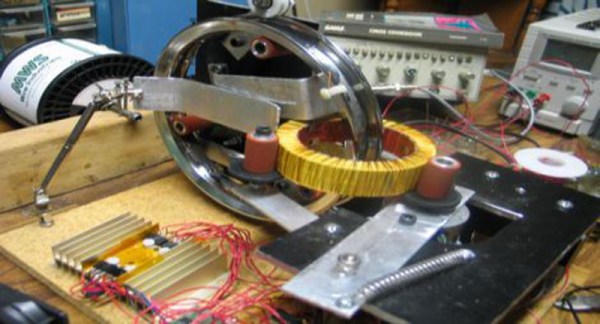
[eclipsed78], built an automatic toroid winder (Internet Archive). The drum splits in order to load the toroid. Then wire is wound on the drum, much like any other coil would be wound. The drum rotates as a slider pulls the wire off the drum, while revolving in and out of the toroid. A side tension keeps the slack out of the wire during operation. The winding coil is stepped as the drum rotates, in order to control the turns ratio. [eclipsed78] created a stepper driver from a schematic, so he could drive the motors. You can watch the winder in operation as a series of videos. The first of which is embedded below. If you have ever needed to wind a massive toroidal transformer, this is the project for you.
electronics177 Articles
USB Reader For SNES Game Carts
[youtube=http://www.youtube.com/watch?v=Pwq6vRM8U7k]
Reader, [Matthias_H], sent in a video about his USB adapter for SNES game carts. All you have to do is plug in the SNES game cartridge and USB cable, then a ROM file of the game shows up as an external storage device on your computer. After that, you can play the ROM with your choice of emulator. We emailed [Matthias] asking for more information, and he quickly replied with a very nice writeup about the hack that is pasted below.
Through-hole Bus Pirate Kit From Fundamental Logic

Fundamental Logic is selling a Bus Pirate kit and bare PCB based on our universal serial interface tool. They started with our serial port-based v1a hardware, and modified it to use all through-hole parts. 8pin DIP LP2951ACN/-3.3 switchable voltage regulators replace the surface mount TPS79650/33 that we used. The PIC is pre-programmed with our latest firmware, version 0f, which includes a bootloader for easy firmware updates through the serial port. Documentation includes illustrated assembly instructions.
Speaking of Bus Pirate goodness, we’re busy working on hardware V2. As astute readers may have already noticed, the final version of the Bus Pirate incorporates an FTDI USB->serial chip, and draws its power from the USB port. We also tackled the software-controlled pull-up resistor feature, and reduced the overall part count and cost. Best of all, we’re working to make assembled PCBs available with world-wide shipping. The how-to should be ready in a few weeks.

Tools: Smart Tweezers
We’re big fans of surface mount parts. SMD components are cheaper, take less board space, and don’t require drilling; all the coolest new parts are only available in SMD packages.
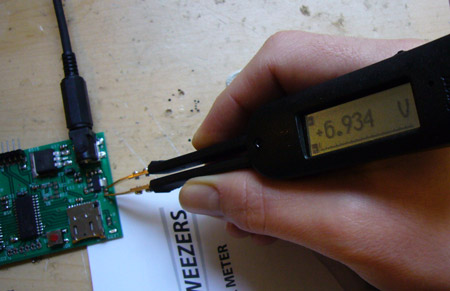
Smart Tweezers are an advanced multimeter tool specifically designed to test and troubleshoot SMD circuits. It automatically identifies resistors, capacitors, and inductors, and displays the relevant measurements. Advanced Devices sent us a pair of Smart Tweezers to review. We used them while building our last few SMD projects, read about our experience with this tool after the break.
Parts: LTC2631A I2C Digital To Analog Converter

Linear Technology’s LTC2631A-LZ8 is an 8bit digital to analog converter (DAC) with an I2C interface. This DAC can output 255 different voltages, spaced evenly between 0 and 2.5volts. We previously demonstrated the LTC2640 with a three-wire SPI interface, but this version is controlled with only two signal wires.
Continue reading “Parts: LTC2631A I2C Digital To Analog Converter”
How-to: Bus Pirate V1, Improved Universal Serial Interface

We use the Bus Pirate to interface a new chip without writing code or designing a PCB. Based on your feedback, and our experience using the original Bus Pirate to demonstrate various parts, we updated the design with new features and cheaper components.
There’s also a firmware update for both Bus Pirate hardware versions, with bug fixes, and a PC AT keyboard decoder. Check out the new Hack a Day Bus Pirate page, and browse the Bus Pirate source code in our Google code SVN repository.
We cover the design updates and interface a digital to analog converter below.
Continue reading “How-to: Bus Pirate V1, Improved Universal Serial Interface”
How-to: Prepare Your Eagle Designs For Manufacture

Cadsoft Eagle is a multi-platform freeware circuit layout program. Lots of open source hardware is designed in Eagle, and it’s become a hobbyist favorite. We use it for all of our hardware designs.
There are several ways to turn an Eagle design into an actual printed circuit board (PCB). We’ll show you how to save Eagle designs as industry-standard gerber files that are accepted by any PCB manufacturer. You can use the gerbers to order a single prototype, or a full panel.
Continue reading “How-to: Prepare Your Eagle Designs For Manufacture”