Balloon Guitar Is An Absolute Gas, Helium Or Not

Guitars are most typically built out of wood. Whether it’s an acoustic guitar with a big open cavity, or a solid-body electric, there’s generally a whole lot of wood used in the construction. However, [Mattias Krantz] shows us that alternative construction methods are entirely possible, by building his own balloon guitar.

The balloon guitar still has a neck, bridge, and strings just like any other. However, in place of the resonant cavity of an acoustic guitar, there is provision to install a large balloon instead. It’s actually quite interesting to watch — with the balloon installed, the guitar delivers much more volume than when played without a resonant cavity at all.

The guitar was actually built to test if swapping out air in the balloon for helium would shift the pitch of the sound. Of course, a guitar’s pitch comes from the tension on the vibrating strings, so changing the gas in the resonant cavity doesn’t directly affect it. Instead, much like inhaling helium to affect the human voice, the change is to the timbre of the sound, not the fundamental pitch itself. It sounds as if the guitar has been given a subtle treble boost.

It’s a fun build, and one that shows us that it’s possible to build musical instruments in many ways, not just using traditional techniques. If you want to further play with your guitar’s sound, though, consider turning to the world of machine learning.

Continue reading “Balloon Guitar Is An Absolute Gas, Helium Or Not”

About As Cold As It Gets: The Webb Telescope’s Cryocooler

If you were asked to name the coldest spot in the solar system, chances are pretty good you’d think it would be somewhere as far as possible from the ultimate source of all the system’s energy — the Sun. It stands to reason that the further away you get from something hot, the more the heat spreads out. And so Pluto, planet or not, might be a good guess for the record low temperature.

But, for as cold as Pluto gets — down to 40 Kelvin — there’s a place that much, much colder than that, and paradoxically, much closer to home. In fact, it’s only about a million miles away, and right now, sitting at a mere 6 Kelvin, the chunk of silicon at the focal plane of one of the main instruments aboard the James Webb Space telescope makes the surface of Pluto look downright balmy.

The depth of cold on Webb is all the more amazing given that mere meters away, the temperature is a sizzling 324 K (123 F, 51 C). The hows and whys of Webb’s cooling systems are chock full of interesting engineering tidbits and worth an in-depth look as the world’s newest space telescope gears up for observations.

Continue reading “About As Cold As It Gets: The Webb Telescope’s Cryocooler”

Indoor Blimp Sails Through The Air Using Ultrasonic Transducers

Quadcopter type drones can be flown indoors, but unless you have a lot of space, it usually just ends in a crash. The prospect of being hit in the face by the propellor blades, spinning at 10k RPM doesn’t bear thinking about, and then there’s the noise. So, as a solution for indoor photography, or operating in public spaces, they are not viable. Japanese mobile operator DOCOMO has a new take on an old idea; the blimp. But, surely even a helium filled vehicle needs blades to steer around the room, we hear you cry? Not so, if you use a pair of specialised ultrasonic transducer arrays to move the air instead! (Video, embedded below)

Three banks of thrusters provide a 180 degree steerable net force

Details are scarce, but DOCOMO have fitted a helium balloon with modules on either side that can produce a steerable thrust, allowing the vehicle to effect all the expected aerial manoeuvres with ease and grace. The module at the bottom contains the control electronics, an upwards facing RGB LED for some extra bling, and of course a video camera to capture those all-important video shots.

We’d love to find a source for those ultrasonic transducer devices, and can only guess at the physical arrangement that allows for air to pass in one direction only, to effect a net thrust. We can find a few research papers hinting at the ability to use ultrasound to propel through air, like this one (bah! IEEExplore Paywall!) but to our knowledge,  this technology is not quite in the hands of hackers just yet.

Blimps are by no means scarce on these fine pages, here is a Blimpduino, an Arduino controlled 3D printed blimp, an illuminated blimp art installation by Japanese artist [Kensho Miyoshi] and if using helium is just too darn safe for you (or if you want to help prevent this allegedly precious resource from being lost into space) you could just build a remote controlled blimp using hydrogen instead. Just don’t light a match.

Continue reading “Indoor Blimp Sails Through The Air Using Ultrasonic Transducers”

Exploring The Healing Power Of Cold Plasma

It probably won’t come as much surprise to find that a blast of hot plasma can be used to sterilize a surface. Unfortunately, said surface is likely going to look a bit worse for wear afterwards, which limits the usefulness of this particular technique. But as it turns out, it’s possible to generate a so-called “cold” plasma that offers the same cleansing properties in a much friendlier form.

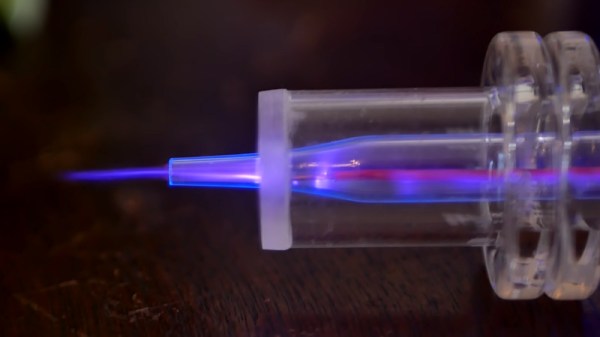
While it might sound like science fiction, prolific experimenter [Jay Bowles] was able to create a reliable source of nonthermal plasma for his latest Plasma Channel video with surprisingly little in the way of equipment. Assuming you’ve already got a device capable of pumping out high-voltage, all you really need to recreate this phenomenon is a tank of helium and some tubing.

Cold plasma stopped bacterial growth in the circled area.

[Jay] takes viewers through a few of the different approaches he tried before finally settling on the winning combination of a glass pipette with a copper wire run down the center. When connected to a party store helium tank and the compact Slayer Exciter coil he built last year, the setup produced a focused jet of plasma that was cool enough to touch.

It’s beautiful to look at, but is a pretty light show all you get for your helium? To see if his device was capable of sterilizing surfaces, he inoculated a set of growth plates with bacteria collected from his hands and exposed them to the cold plasma stream. Compared to the untreated control group the reduction in bacterial growth certainly looks compelling, although the narrow jet does have a very localized effect.

If you’re just looking to keep your hands clean, some soap and warm water are probably a safer bet. But this technology does appear to have some fascinating medical applications, and as [Jay] points out, the European Space Agency has been researching the concept for some time now. Who knows? In the not so distant future, you may see a similar looking gadget at your doctor’s office. It certainly wouldn’t be the first time space-tested tech came down to us Earthlings.

Continue reading “Exploring The Healing Power Of Cold Plasma”

Space Shuttle Model In A Hypersonic Wind Tunnel

Mach 20 In A Wind Tunnel: Yes, It’s Rocket Science

Hypersonic speeds are defined by those exceeding Mach 5, and lately there’s been a lot of buzz about unmanned hypersonic vehicles making test flights. Vehicles returning from orbital flight also travel at hypersonic speeds as they do their best to transition back to the terrestrial realm. Before anything leaves ground though, these machines are tested in wind tunnels. [Scott Manley]’s video “How Hypersonic Wind Tunnels Recreate Mach 20” (embedded below) does a wonderful job of explaining the engineering behind wind tunnels for testing hypersonic vehicles.

While the earliest wind tunnels such as that used by the Wright Brothers were powered by simple fans, it is not possible for any propeller to surpass subsonic speeds. This is evidenced by there not being any propeller driven aircraft that can exceed Mach 1. Since an aircraft can’t reach those speeds with a propeller, it follows that a wind tunnel cannot be driven by propellers, fans, or any such device, and exceed Mach 1 wind speed, either. So it begs the question: Just how do they do it?

You might think that the answer lays in Bernoulli’s law – but it does not. You might think it involves compressing the air into smaller and smaller tubes and pipes. It doesn’t. As [Scott Manley] so expertly explains in the video below the break, it has quite a lot in common with actual rocket science.

You may be interested to know that we’ve covered some DIY wind tunnel builds as well as a small desktop wind tunnel in the past. While not hypersonic, they’re exactly what you’d want to have if you’re an aerospace hacker of any kind.

Thanks [Zane Atkins] for the tip!

Continue reading “Mach 20 In A Wind Tunnel: Yes, It’s Rocket Science”

Solving Ultra High Vacuum Leaks Has An Elementary Solution

When we think of a vacuum leak we generally think of a car that just doesn’t want to run quite right. Most normally aspirated internal combustion engines rely on the vacuum created by the pistons to draw in the air fuel mixture that’s produced by the carburetor or fuel injection system. Identifying the leak usually involves spraying something combustible around common trouble areas while the engine is running. Changes to the engine speed indicate when the combustible gas enters the intake manifold and the leak can be found.

What if your vacuum leak is in a highly specialized piece of scientific equipment where the pressures are about 12 times orders of magnitude lower than atmospheric pressure, and the leak is so small it’s only letting a few atoms into the vacuum chamber at a time? [AlphaPhoenix] takes dives deep into this very subject in his video “Air-tight vs. Vacuum-tight.” which you can watch below the break.

Not only does [AlphaPhoenix] discuss how a perfect pressure vessel is sealed, he also explains the specialized troubleshooting methods used which turn out not to be all that different from troubleshooting an automotive vacuum leak- only in this case, several magnitudes more complex and elemental in nature.

We also enjoyed the comments section, where [AlphaPhoenix] addresses some of the most common questions surrounding the video: Torque patterns, the scarcity of the gasses used, and leaving well enough alone.

Does talking about vacuums get you pumped? Perhaps you’d enjoy such vacuum hacks as putting the toothpaste back in the tube in your homemade vacuum chamber.

Thank you [Morgan] for sending this one in. Be sure to send in your own hacks, projects, and fantastic finds through the Tip Line!

Continue reading “Solving Ultra High Vacuum Leaks Has An Elementary Solution”

Could Airships Make A Comeback With New Hybrid Designs?

Airships. Slow, difficult to land, and highly flammable when they’re full of hydrogen. These days, they’re considered more of a historical curiosity rather than a useful method of transport.

Hybrid Air Vehicles are a UK-based startup working to create a modern take on the airship concept. The goal is to create cleaner air transport for short-hop routes, while also solving many of the issues with the airship concept with a drastic redesign from the ground up. Their vehicle that will do all this goes by the name of Airlander 10. But is it enough to bring airships back to the skies?

A Hybrid Technology

Airlander 10 seen taking off during its first flight.

The Airlander 10 is not a lighter-than-air craft like traditional airships. Instead, the vehicle uses the buoyancy from its helium envelope to create only 60-80% of its lift. The rest of the left is generated aerodynamically by air passing over the eliptical shape of the airship’s body. This lift can also be further augmented by two diesel-powered ducted fans on the sides of the airship, which can pivot to assist with takeoff and landing. Two further fixed ducted fans on the rear provide the primary propulsion for the craft.

The hybrid approach brings several benefits over the traditional airship model. Chief among them is that as the Airlander 10 is heavier than air, it need not vent helium throughout flight to avoid becoming positively buoyant as fuel burns off, nor does it need to vent helium to land. However, it still maintains the capability to loiter for incredibly long periods in the sky as it needs to burn very little fuel to stay aloft. Reportedly, it is capable of five days when manned, and even longer durations if operated in an unmanned configuration. Using helium for lift instead of solely relying on engine thrust and wings means that it is much more fuel efficient than traditional fixed-wing airliners. The company’s own estimates suggest the Airlander 10 could slash emissions on short-haul air routes by up to 90%. The gentle take-off and landing characteristics also mean the vehicle doesn’t require traditional airport facilities, making it possible to operate more easily in remote areas, on grass, sand, or even water. Continue reading “Could Airships Make A Comeback With New Hybrid Designs?”