When it comes to seaborne propulsion, one simple layout has largely dominated over all others. You pair some kind of engine with some kind of basic propeller at the back of the ship, and then you throw on a rudder to handle the steering. This lets you push the ship forward, left, and right, and stopping is just a matter of turning the engine off and waiting… or reversing thrust if you’re really eager to slow down.
This basic system works for a grand majority of vessels out on the water. However, there is a more advanced design that offers not only forward propulsion, but also steering, all in the one package. It may look strange, but the Voith Schneider propeller offers some interesting benefits to watercraft looking for an edge in maneuverability.
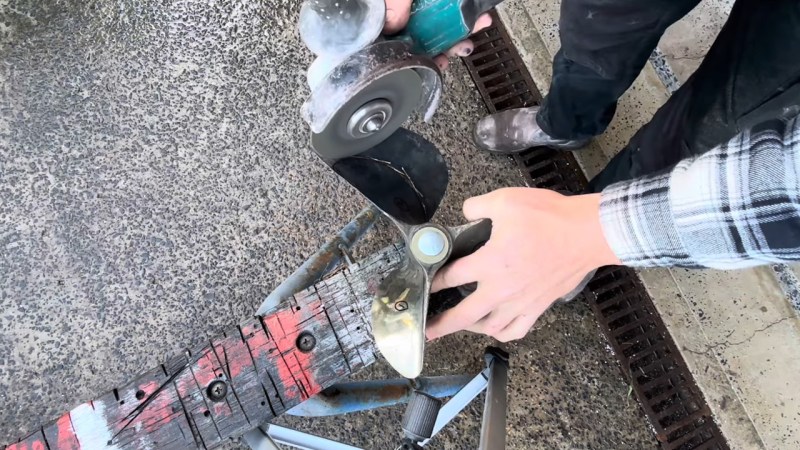
Whether you’re a landlubber or an old salt, you’ve got to appreciate the effort that [The Aussie boat guy] puts into cutting an old brass propeller down into a far smaller and sleeker specimen. Especially since he does the entire thing with hand tools, a couple different calipers, and that most valuable of natural resources: experience.
The whole process was made somewhat easier by the fact that [The Aussie boat guy] had a model to work from — his friend had a small propeller that was already known to perform well, it was just a matter of cutting the larger prop down to match its dimensions. Using what appears to be pieces of leather (presumably for its flexibility), a template was made to accurately map out the front face of the blade.
As Bob Ross would say — “Here comes your bravery test”
By measuring out from the hub of the prop with his calipers, [The Aussie boat guy] was able to make sure the template was properly positioned before scribing its shape into the larger prop. An angle grinder was used to cut the shape out of each blade, followed by a smoothing off with a flap wheel.
But there was still a problem — the blades were the right shape, but they were far too thick. So he took the angle grinder to the back of each one to start removing material, using another set of calipers to occasionally spot-check them to make sure they were thinning out at roughly the same rate.
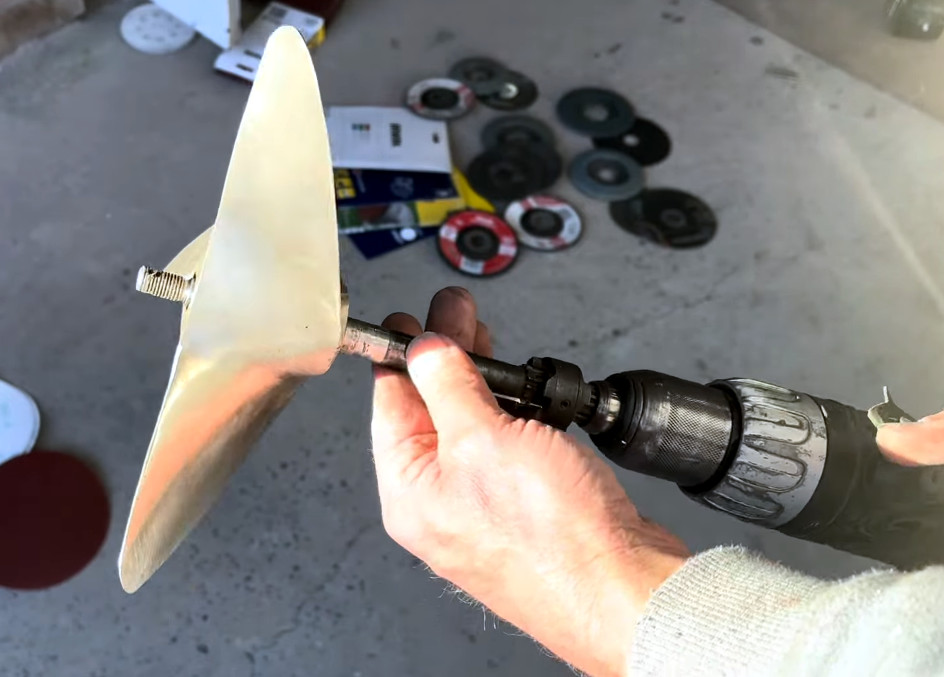
This thinning out process continued until the prop was brought into balance. How do you check that, you might be wondering? Well, if you’re a madman like [The Aussie boat guy], you chuck the thing into a power drill and spin er’ up to see how badly it shakes. But this only gives you a rough idea, so he has to move over to a somewhat more scientific apparatus that uses a set of parallel bars to help determine which blade is heavier than its peers.
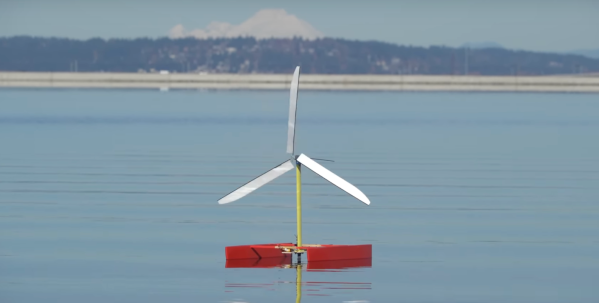
Humans have been sailing various seas and oceans for thousands of years, and using boats for potentially even longer than that. But as a species we wouldn’t have made it very far if it was only possible to sail in the same direction the wind is blowing. There are a number of methods for sailing upwind, but generally only up to a certain angle. [rctestflight] wondered if there was some way of sailing straight upwind instead and built this rotary sail craft to test the idea.
Normally a boat sailing upwind will sail approximately 45° into it, then “tack” 90° across the wind until they’re at another 45° angle from the wind, this time facing the opposite direction. This back-and-forth nature is not the most efficient path, so this vessel uses a few propellers to bypass the traditional sail. The first iteration, built on a sleek catamaran hull, uses a large propeller to catch the wind’s energy, then transfers it mechanically through a set of shafts to an underwater prop.
It took a few tries to get the size and pitch of both propellers narrowed down to where the boat would move forward into the wind, but move it does. A second major iteration of the build uses a single shaft with no gears, with the trade-off that neither propeller is facing an ideal direction, but this has the added benefit of the boat naturally pointing itself upwind.
While none of the designs are speed demons, the concept is sound enough. It’s just that, in most cases, performing multiple tacks to get upwind is acceptable compared to the extreme efficiency losses and drag from propeller-driven sailing crafts like these. A more effective way of propelling a boat upwind, at least using modern technology, might be to trade sails for solar panels.
Since sound is the primary sense used by most ocean life, disruptions to the natural noise levels in the ocean from human activities can be particularly problematic for marine life. [DW Planet A] has a video describing some of the ways we can mitigate these disruptions to our friends under the sea.
Being noisy neighbors isn’t just a problem for whales but for everything down to the plankton at the base of the food web. Underwater construction like offshore wind installations get flak for being noisy, but technologies like bubble curtains can reduce noise output by up to 90% to the surrounding waters while still getting those nice low carbon energy benefits that prevent further ocean acidification and warming. Continue reading “Keeping The Noise Down Under The Sea”→
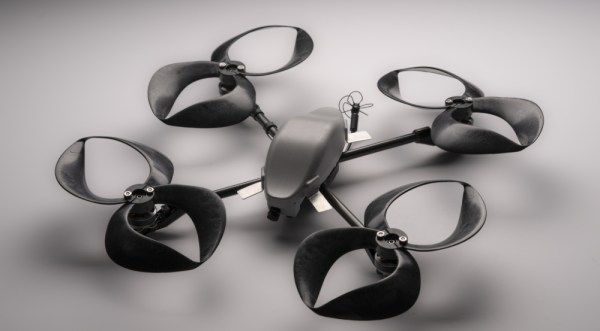
Despite being integral to aviation for more than a century, propellers have changed remarkably little since the Wright Brothers. A team at MIT’s Lincoln Lab has developed a new propeller shape that significantly reduces the noise associated with drones. [PDF via NewAtlas]
Inspired by some of the experiments with “ring wings” in the early 20th Century, researchers iterated on various toroidal propeller geometries until arriving at one that significantly reduces the sound produced by the rotors, particularly in the range of human hearing. The team suspects the reduction in noise is due to vortices being distributed over the whole propeller instead of just the tips.
Experiments show the drones can get twice as close before becoming a nuisance for human ears which should be great news for anyone hoping to launch Skynet commercial drone deliveries. Since the rotors are easily fabricated via 3D printing they should be easy to adapt to a number of different drones.
The toroidal propeller, one of the Lab's @RD100Awards winners, has a unique, closed-form propeller design that makes it a significantly quieter alternative to common multirotor propellers on commercial uncrewed aerial vehicles. https://t.co/hgda3NgYIzpic.twitter.com/5XkIxNVPHd
Fair warning for readers with a weak stomach, the video below graphically depicts an innocent rubber band airplane being obliterated in mid-air by a smug high-tech RC helicopter. It’s a shocking display of airborne class warfare, but the story does have a happy ending, as [Concrete Dog] was able to repair his old school flyer with some very modern technology: a set of 3D printed propeller blades.
Now under normal circumstances, 3D printed propellers are a dicey prospect. To avoid being torn apart by the incredible rotational forces they will be subjected to, they generally need to be bulked up to the point that they become too heavy, and performance suffers. The stepped outer surface of the printed blade doesn’t help, either.
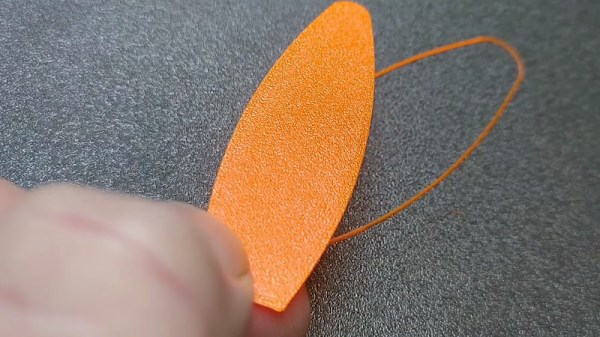
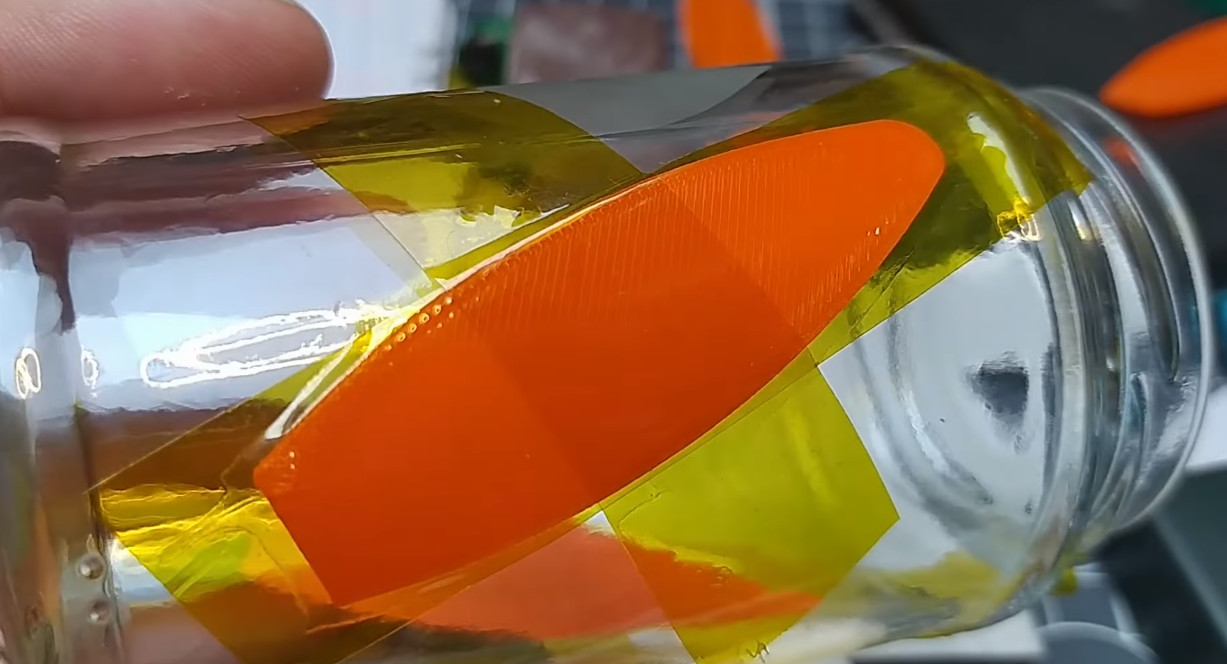
But in a lightweight aircraft powered by a rubber band, obviously things are a bit more relaxed. The thin blades [Concrete Dog] produced on his Prusa Mini appear to be just a layer or two thick, and were printed flat on the bed. He then attached them to the side of a jar using Kapton tape, and put them in the oven to anneal for about 10 minutes. This not only strengthened the printed blades, but put a permanent curve into them.
The results demonstrated at the end of the video are quite impressive. [Concrete Dog] says the new blades actually outperform the originals aluminum blades, so he’s has to trim the plane out again for the increased thrust. Hopefully the extra performance will help his spindly bird avoid future aerial altercations.
Surfing is a fun and exciting sport but a lot of beginners can get discouraged with how little time is spent actually riding waves while learning. Not only are balance and wave selection critical skills that take time to learn, but a majority of time in the water is spent battling crashing waves to get out past the breakers. Many people have attempted to solve this problem through other means than willpower alone, and one of the latest attempts is [Andrew W] with a completely DIY surfboard with custom impeller jet drives.
The surfboard is hand-made by [Andrew W] himself using a few blocks of styrofoam glued together and then cut into a generic surfboard shape. After the rough shaping is done, he cuts out a huge hole in the back of the board for the jet drive. This drive is almost completely built by [Andrew] as well including the impeller pumps themselves which he designed and 3D printed. The pair of impellers are driven by some beefy motors and a robust speed controller that connects wirelessly to a handheld waterproof throttle to hold while surfing. Once everything was secured in the motor box the surfboard was given a final shaping and then glassed. The final touch was an emergency disconnect attached to a leash so that if he falls off the board it doesn’t speed away without him.
The build is impressive not only for [Andrew]’s shaping skills but for his dedication to a custom jet drive for the surfboard. He spent over a year refining the build and actually encourages people not to do this as he thinks it took too much time and effort, but we’re going to have to disagree with him there. Even if you want to try to build something a lot simpler, builds like these look like a lot of fun once they’re finished. The build seems flawless and while he only tested it in a lake we’re excited to see if it holds up surfing real waves in an ocean.