Building A GPS Receiver From The Ground Up

One of the more interesting facets of GPS is that, at least from the receiver’s point-of-view, it’s a fairly passive system. All of the information beamed down from the satellites is out in the ether, all the time, free for anyone on the planet to receive and use as they see fit. Of course you need to go out and buy a receiver or, alternatively, possess a certain amount of knowledge to build a circuit that can take those signals and convert them into something usable. Luckily, [leaning_tower] has the required knowledge and demonstrates it with this DIY GPS receiver.

This receiver consists of five separate circuit boards, all performing their own function. The first, a mixer board, receives the signal via an active antenna and converts it to a lower frequency. From there it goes to a second mixer and correlation board to compare the signal to a local reference, then a signal processing board that looks at this intermediate frequency signal to make sense of the data its seeing. Finally, an FPGA interfacing board ties everything together and decodes the information into a usable form.

Dealing with weak signals like this has its own set of challenges, as [leaning_tower] found out. The crystal oscillator had to be decapped and modified to keep from interfering with the GPS radio since they operated on similar frequencies. Even after ironing out all the kinks, the circuit takes a little bit of time to lock on to a specific satellite but with a second GPS unit for checking and a few weeks of troubleshooting, the homebrew receiver is up and running. It’s an impressive and incredibly detailed piece of work which is usually the case with sensitive radio equipment like GPS. Here’s another one built on a Raspberry Pi with 12 channels and a pretty high accuracy.

Bluetooth As Proxy For Occupancy

During [Matt]’s first year of college, he found in a roundabout way that he could avoid crowds in the dining hall by accessing publicly available occupancy data that the dining hall collected. Presumably this was data for the dining hall to use internally, but with the right API calls anyone could use the information to figure out the best times to eat. But when the dining hall switched providers, this information feed disappeared. Instead of resigning himself to live in a world without real-time data on the state of the dining hall, he recreated the way the original provider counted occupancy: by using Bluetooth as a proxy for occupancy.

Bluetooth devices like smartphones, fitness sensors, and other peripherals often send out advertising packets into the aether, to alert other devices to their presence and help initiate connections between devices. By sniffing these advertising packets, it’s possible to get a rough estimate of the number of people in one particular place, assuming most people in the area will be carrying a smartphone or something of that nature. [Matt]’s Bluetooth-sniffing device is based on the ESP32 set up to simply count the number of unique devices it finds. He had some trouble with large crowds, though, as the first ESP32 device he chose didn’t have enough RAM to store more than a few hundred IDs and would crash once the memory filled. Switching to a more robust module seems to have solved that issue, and with a few rounds of testing he has a workable prototype that can run for long periods and log at least as many Bluetooth devices passing by as there are within its range.

While [Matt] hasn’t deployed this to the dining hall yet, with this framework in place most of the work has been done that, at least in theory, one of these modules could be easily placed anywhere someone was interested in collecting occupancy data. He has plans to submit his project to the university, to research the topic further, and potentially sell these to businesses interested in that kind of data. This isn’t an idea limited to the ESP32, either. We’ve seen similar projects built using the Raspberry Pi’s wireless capabilities that perform similar tasks as this one.

Thanks to [Adrian] for the tip!

The Trans-Harmonium Is A Strange Kind Of Radio-Musical Instrument

Pianos use little hammers striking taut strings to make tones. The Mellotron used lots of individual tape mechanisms. Meanwhile, the Trans-Harmonium from [Emily Francisco] uses an altogether more curious method of generating sound — each key on this keyboard instrument turns on a functional clock radio.

Electrically, there’s not a whole lot going on. The clock radios have their speaker lines cut, which are then rejoined by pressing their relevant key on the keyboard. As per [Emily]’s instructions for displaying the piece, it’s intended that the radio corresponding to C be tuned in to a local classical station. Keys A, B, D, E, F, and G are then to be tuned to other local stations, while the sharps and flats are to be tuned to the spaces in between, providing a dodgy mix of static and almost-there music and conversation.

It’s an interesting art piece that, no matter how well you play it, will probably not net you a Grammy Award. That would be missing the point, though, as it’s more a piece about “Collecting Fragments of Time,” a broader art project of which this piece is a part.

We do love a good art piece, especially those that repurpose old hardware to great aesthetic achievement.

Continue reading “The Trans-Harmonium Is A Strange Kind Of Radio-Musical Instrument”

A Ham Radio Answering Machine

For those who grew up with a cell phone in their hand, it might be difficult to imagine a time where the phone wasn’t fully integrated with voicemail. It sounds like a fantastical past, yet at one point a separate machine needed to be attached to the phone to record messages if no one was home to answer. Not only that, but a third device, a cassette tape, was generally needed as a storage device to hold the messages. In many ways we live in a much simpler world now, but in the amateur radio world one group is looking to bring this esoteric technology to the airwaves and [saveitforparts] is demonstrating one as part of a beta test.

The device is called the Boondock Echo, and while at its core it’s an ESP32 there’s a lot going on behind the scenes. It has an audio interface which is capable of connecting to a radio given the correct patch cable; in this case with a simple Baofeng handheld unit. The answering machine can record any sounds that come in. However, with a network connection the recordings are analyzed with an AI which can transcribe what it hears and even listen for specific call signs, then take actions such as sending emails when it hears triggers like that. Boondock also plans for this device to be capable of responding as well, but [saveitforparts] was not able to get this working during this beta test.

While an answering machine might seem like a step backwards technologically, an answering machine like this, especially when paired with Google Voice-like capabilities from an AI, has a lot of promise for ham radio operators. Even during this test, [saveitforparts] lost a radio and a kind stranger keyed it up when it was found, which was recorded by the Boondock Echo and used to eventually recover the radio. Certainly there are plenty of other applications as well, such as using AI instead of something like an Arduino to do Morse decoding.

Continue reading “A Ham Radio Answering Machine”

Pico-WSPR-tx Does It In Software

What do you need to make a radio transmitter? There are builds that work with just a couple of transistors. But how about a GPS-disciplined small signal beacon? You can actually get the job done for less than the cost of a fancy hamburger, thanks to [RPiks]’s pico-WSPR-tx and the Weak Signal Propagation Reporter Network (WSPR).

WSPR is a digital protocol where a beacon encodes its callsign, location, and transmitting power, and then sends it out to a network of receiving stations worldwide. The idea is to use the data coming from the beacons to determine whether radio propagation conditions are good or not; if you hear a quiet signal from afar, they’re good in that direction. [RPiks]’s beacon design simply includes a Raspberry Pi Pico and a GPS receiver. Everything else is software.

Of course, this means that it’s using the Pico’s GPIO pins for transmission. Maybe you want to add some filtering to take off the rough square-wave edges, and/or maybe you want to boost the power a little bit with an external amplifier. If so, check out our own $50 Ham column’s advice on the topic. But you don’t need to. Just a Pico and a GPS should get you working, if you want to test the WSPR waters.

Radio Emissions Over Sunspots Challenge Models Of Stellar Magnetism

Sustained radio emissions originating from high over a sunspot are getting researchers thinking in new directions. Unlike solar radio bursts — which typically last only minutes or hours — these have persisted for over a week. They resemble auroral radio emissions observed in planetary magnetospheres and some stars, but seeing them from about 40,000 km above a sunspot is something new. They don’t seem tied to solar flare activity, either.

The signals are thought to be the result of electron cyclotron maser (ECM) emissions, which involves how electrons act in converging geometries of magnetic fields. These prolonged emissions challenge existing models and ideas about how solar and stellar magnetic processes unfold, and understanding it better could lead to a re-evaluation of existing astrophysical models. Perhaps even leading to new insights into the behavior of magnetic fields and energetic particles.

This phenomenon was observed from our very own sun, but it has implications for better understanding distant stellar bodies. Speaking of our sun, did you know it is currently in it’s 25th Solar Cycle? Check out that link for a reminder of the things the awesome power of our local star is actually capable of under the right circumstances.

Mystery Signal! Are You Ready For Your Mystery Signal?

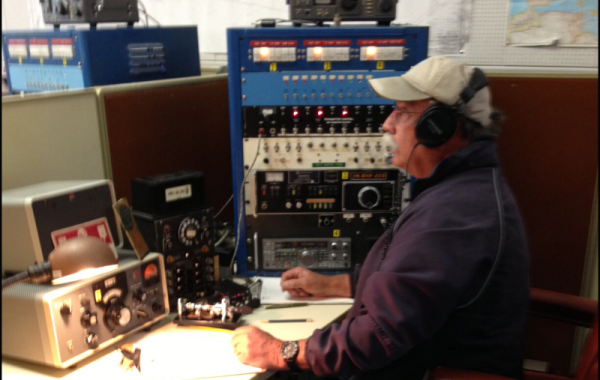
Like many people [Dan Greenall] spent a lot of time in the 1970s listening to shortwave radio. While you often think of that as a hobby involving listening to broadcast stations, some people like to listen to other communications such as airliners, ships, military, and even spy stations. These days, if you hear a strange signal you are probably only one internet search away from identifying what it is. But back then, you had to depend on word-of-mouth or magazines to figure things like that out. [Dan] found a recording of a mysterious military-like signal he made in 1971 on 14.85 MHz. He decided that maybe now, all these years later, he could finally identify it.

The operator in the recording is counting and mentions “Midway Island,” famous for a World War II battle and part of the Leeward Islands in the Pacific. Thanks to the internet and the law of six degrees of separation, [Dan] found [Chuck Kinzer] who was a Midway Navy vet.

Continue reading “Mystery Signal! Are You Ready For Your Mystery Signal?”