Inside America’s Last Morse Code Station

The Titanic famously (or infamously) used Morse code to call out in distress at the end of its final voyage. Ships at sea and the land-based stations that supported them used Morse code for decades, but with the growing use of satellites, maritime Morse code ended in 1999. With one notable exception. [Saahil Desai] writing in the Atlantic tells the story of  America’s last Morse code station, KPH just north of San Francisco.

In fact, KPH did shut down in 1997 as part of the wind down of Morse code in ocean vessels. But some radio enthusiasts, including [Tom Horsfall] and [Richard Dillman], have brought the venerable station back to life. The radio squirrels, as they call themselves, dutifully send news and weather every Saturday to anyone interested in listening. They also exchange radio traffic, primarily with the SS Jeremiah O’Brien, a World War II-era ship parked nearby. N2FQ visited the station and operated the station on video, which you can see below. Or, check out the tour in the second video, below.

Continue reading “Inside America’s Last Morse Code Station”

Internet Radio Built In Charming Cassette-Like Form Factor

You can listen to plenty of broadcast radio these days. There’s a lot of choice too, with stations on AM, FM, and digital broadcasts to boot. However, if you want the broadest possible choice, you want an internet radio. If that’s your bag, why not build a fun one like [indoorgeek’s] latest design?

The build is based around a PCB and 3D-printed components that roughly ape the design of a cassette tape. It even replicates the typical center window of a cassette tape by using a transparent OLED screen, which displays the user interface. In a neat way, the graphics on the display are designed to line up with those on the PCB, which looks excellent.

An ESP32 is the heart of the operation, which is responsible for streaming audio over the Internet via its WiFi connection. It’s powered by a small lithium-polymer battery, and hooked up with a MAX98357 Class D amplifier driven via the chip’s I2S hardware. Audio is played out over a small speaker salvaged from an old smartphone.

While it’s obviously possible to play whatever you like on a smartphone these days, sometimes it’s fun to have simple devices that just do a single job. Plus, we can’t deny this project looks really neat. Video after the break.

Continue reading “Internet Radio Built In Charming Cassette-Like Form Factor”

Hackaday Links Column Banner

Hackaday Links: February 11, 2024

Apple’s Vision Pro augmented reality goggles made a big splash in the news this week, and try as we might to resist the urge to dunk on them, early adopters spotted in the wild are making it way too easy. Granted, we’re not sure how many of these people are actually early adopters as opposed to paid influencers, but there was still quite a bit of silliness to be had, most of it on X/Twitter. We’d love to say that peak idiocy was achieved by those who showed themselves behind the wheels of their Teslas while wearing their goggles, with one aiming for an early adopter perfecta, but alas, most of these stories appear to be at least partially contrived. Some people were spotted doing their best to get themselves killed, others were content to just look foolish, especially since we’ve heard that the virtual keyboard is currently too slow for anything but hunt-and-peck typing, which Casey Niestat seemed to confirm with his field testing. After seeing all this, we’re still unsure why someone would strap $4,000 worth of peripheral-vision-restricting and easily fenced hardware to their heads, but hey — different strokes. And for those of you wondering why these things are so expensive, we’ve got you covered.

Continue reading “Hackaday Links: February 11, 2024”

HF In Small Spaces

Generally, the biggest problem a new ham radio operator will come across when starting out on the high frequency (HF) bands is finding physical space for the antennas. For a quick example, a dipole antenna for the 20 m band will need around 10 m of wire, and the lower frequencies like 80 m need about four times as much linear space. But if you’re willing to trade a large space requirement for a high voltage hazard instead, a magnetic loop antenna might be just the ticket.

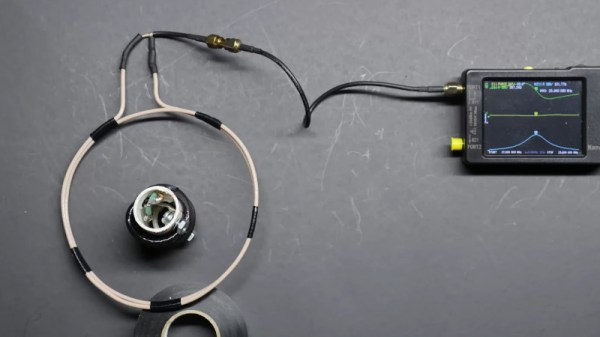
Loop antennas like these are typically used only for receiving, but in a pinch they can be used to transmit as well. To tune the antennas, which are much shorter than a standard vertical or dipole, a capacitor is soldered onto the ends, which electrically lengthens the antenna. [OM0ET] is using two loops of coax cable for the antenna, with each end soldered to one half of a dual variable capacitor which allows this antenna to tune from the 30 m bands to the 10 m bands, although he is using it mostly for WSPR on 20 m. His project also includes the use of an openWSPR module, meaning that he doesn’t have to dedicate an entire computer to run this mode.

The main downsides of antennas like these is that they are not omnidirectional, are not particularly good at transmitting, and develop a significantly high voltage across the capacitor as this similar mag loop antenna project demonstrated. But for those with extreme limitations on space or who, like [OM0ET] want a simple, small setup for running low-power applications like WSPR they can really excel. In fact, WSPR is a great mode for getting on the air at an absolute minimum of cost.

Continue reading “HF In Small Spaces”

FLOSS Weekly Episode 768: Open Source Radio

This week Jonathan Bennett and Doc Searls talk with Tony Zeoli about Netmix and the Radio Station WordPress plugin. The story starts with the Netmix startup, one of the first places doing Internet music in the 1990s. That business did well enough to get bought out just before the Dot Com bubble burst in 2000. Today, Tony runs the Radio Station plugin, which is all about putting a station’s show schedule on a WordPress site.

In the process, the trio covers Internet radio history, the licensing complications around radio and streaming, the state of local radio, and more. Is there a long term future for radio? Does Creative Commons solve the licensing mess? Is AI going to start eating radio, too? All this and more!

Continue reading “FLOSS Weekly Episode 768: Open Source Radio”

Simulating A Time-Keeping Radio Signal

As far as timekeeping goes, there’s nothing more accurate and precise than an atomic clock. Unfortunately, we can’t all have blocks of cesium in our basements, so various agencies around the world have maintained radio stations which, combined with an on-site atomic clock, send out timekeeping signals over the air. In the United States, this is the WWVB station located in Colorado which is generally receivable anywhere in the US but can be hard to hear on the East Coast. That’s why [JonMackey], who lives in northern New Hampshire, built this WWVB simulator.

Normally, clocks built to synchronize with the WWVB station include a small radio antenna to receive the 60 kHz signal and the 1-bit-per-second data transmission which is then decoded and used to update the time shown on the clock. Most of these clocks have internal (but much less precise) timekeeping circuitry to keep themselves going if they lose this signal, but [JonMackey] can go several days without his clocks hearing it. To make up for that he built a small transmitter that generates the proper timekeeping code for his clocks. The system is based on an STM32 which receives its time from GPS and broadcasts it on the correct frequency so that these clocks can get updates.

The small radio transmitter is built using one of the pins on the STM32 using PWM to get its frequency exactly at 60 kHz, which then can have the data modulated onto it. The radiating area is much less than a meter, so this isn’t likely to upset any neighbors, NIST, or the FCC, and the clocks need to be right beside it to update. Part of the reason why range is so limited is that very low frequency (VLF) radios typically require enormous antennas to be useful, so if you want to listen to more than timekeeping standards you’ll need a little bit of gear.

Pico-Sized Ham Radio

There are plenty of hobbies around with huge price tags, and ham radio can certainly be one of them. Experienced hams might have radios that cost thousands of dollars, with huge, steerable antennas on masts that can be similarly priced. But there’s also a side to the hobby that throws all of this out of the window in favor of the simplest, lowest-cost radios and antennas that still can get the job done. Software-defined radio (SDR) turned this practice up to 11 as well, and this radio module uses almost nothing more than a microcontroller to get on the air.

The design uses the capabilities of the Raspberry Pi Pico to handle almost all of the radio’s capabilities. The RF oscillator is driven by one of the Pico’s programmable I/O (PIO) pins, which takes some load off of the processor. For AM and SSB, where amplitude needs to be controlled as well, a PWM signal is generated on another PIO which is then mixed with the RF oscillator using an analog multiplexer. The design also includes a microphone with a preamplifier which can be fed into a third PIO; alternatively it can receive audio from a computer via the USB interface. More processor resources are needed when generating phase-modulated signals like RF, but the Pico is still quite capable of doing all of these tasks without jitter larger than a clock cycle.

Of course this only outputs a signal with a few milliwatts of power, so for making any useful radio contacts with this circuit an amplifier is almost certainly needed. With the heavy lifting done by the Pico, though, the amplifier doesn’t need to be complicated or expensive. While the design is simple and low-cost, it’s not the simplest radio possible. This transmitter sends out radio waves using only a single transistor but you will be limited to Morse code only.

Continue reading “Pico-Sized Ham Radio”