Software Defined Radio Hack Chat

Join us on Wednesday, September 18 at noon Pacific for the Software Defined Radio Hack Chat with Corrosive!

If you’ve been into hobby electronics for even a short time, chances are you’ve got at least one software-defined radio lying around. From the cheap dongles originally intended to watch digital TV on a laptop to the purpose-built transmit-capable radio playgrounds like HackRF, SDR has opened up tons of RF experimentation. Before SDR, every change of band or mode would need new hardware; today, spinning up a new project is as simple as dragging and dropping a few blocks around on a screen, and SDRs that can monitor huge swaths of radio spectrum for the tiniest signal have been a boon to reverse engineers everywhere.

Corrosive is the handle of Harold Giddings, amateur callsign KR0SIV, and he’s gotten into SDR in a big way. Between his blog, his YouTube channel, and his podcast, all flying under the Signals Everywhere banner, he’s got the SDR community covered. Whether it’s satellite communications, aircraft tracking, amateur radio, or even listening in on railway operations, Harold has tried it all, and has a wealth of SDR wisdom to share. Join us as we discuss the state of the SDR ecosystem, which SDR to buy for your application, and even how to transmit with an SDR (hint: you’ll probably want a ham license.)

join-hack-chatOur Hack Chats are live community events in the Hackaday.io Hack Chat group messaging. This week we’ll be sitting down on Wednesday, September 18 at 12:00 PM Pacific time. If time zones have got you down, we have a handy time zone converter.

Click that speech bubble to the right, and you’ll be taken directly to the Hack Chat group on Hackaday.io. You don’t have to wait until Wednesday; join whenever you want and you can see what the community is talking about.

A Radio Transceiver From A Cable Modem Chipset

It’s a staple of our community’s work, to make electronic devices do things their manufacturers never intended for them. Analogue synthesisers using CMOS logic chips for example, or microcontrollers that bitbang Ethernet packets without MAC hardware. One of the most fascinating corners of this field comes in the form of software defined radios (SDRs), with few of us not owning an RTL2832-based digital TV receiver repurposed as an SDR receiver.

The RTL SDR is not the only such example though, for there is an entire class of cable modem chipsets that contain the essential SDR building blocks. The Hermes-Lite is an HF amateur radio transceiver project that uses an AD9866 cable modem chip as the signal end for its 12-bit SDR transceiver hardware with an FPGA between it and an Ethernet interface. It covers frequencies from 0 to 38.4 MHz, has 384 kHz of bandwidth, and can muster up 5W of output power.

It’s a project that’s been on our radar for the past few years, though somewhat surprisingly this is the first mention of it here on Hackaday. Creator [Steve Haynal] has reminded us that version 2 is now a mature project on its 9th iteration, and says that over 100 “Hermes-Lite 2.0” units have been assembled to date. If you’d like a Hermes-Lite of your own it’s entirely open-source, and they organise group buys of the required components.

Of course, SDRs made from unexpected components don’t have to be exotic.

Steampunk Radio Looks The Business

Radios are, by and large, not powered by steam. One could make the argument that much of our municipal electricity supply does come via steam turbines, but that might be drawing a long bow. Regardless, steampunk remains a popular and attractive aesthetic, and it’s the one that [Christine] selected for her radio build.

The build cribs from [Christine’s] earlier work on a VFD alarm clock, using similar tubes and driver chips to run the display. FM radio and amplification are courtesy of convenient modules. Tubes are fitted for aesthetic purposes, artfully lit with a smattering of color-changing LEDs. Perhaps the neatest touch is the use of valve handles to control tuning and volume. A stepper motor turns a series of gears, as is mandatory for any true steampunk build, and there’s even an electromagnetic actuator to make the Morse key move. To run it all, a pair of Arduino Megas are charged with handling the I/O needs of all the various systems.

It’s a fancy build that shows how far the rabbit hole you can go when chasing a particular look and feel. It’s a radio that would make a great conversation piece on any hacker’s coffee table.  If that’s not enough, consider going for a whole laptop. Video after the break. Continue reading “Steampunk Radio Looks The Business”

1940s Portable Radio Is A Suitcase

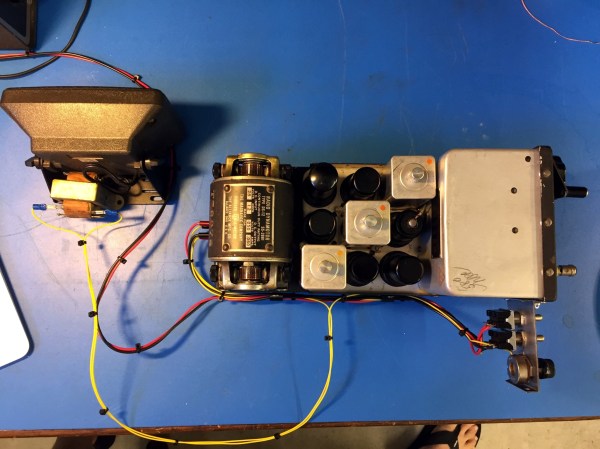
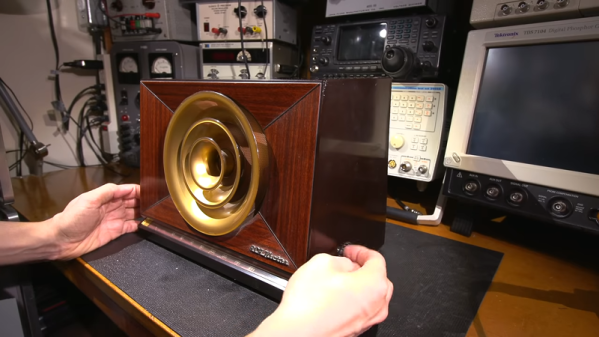
The meaning of the word portable has changed a bit over the years. These days something has to be pretty tiny to be considered truly portable, but in the 1940s, anything with a handle on it that you could lift with one hand might be counted as portable electronics. Zenith made a line of portable radios that were similar to their famous Transoceanic line but smaller, lighter, and only receiving AM to reduce their size and weight compared to their big brothers. If you want to see what passed for portable in those days, have a look at [Jeff Tranter’s] video (below) of a 6G601 — or maybe it is a GG601 as it says on the video page. But we think it is really a 6G601 which is a proper Zenith model number.

According to [Jeff], 225,350 of these radios were made, and you can see that it closes up like a suitcase. The initial 6 in the model number indicates there are 6 tubes and the G tells you that it can run with AC or batteries.

Continue reading “1940s Portable Radio Is A Suitcase”

3D Printing An Old-School Coherer

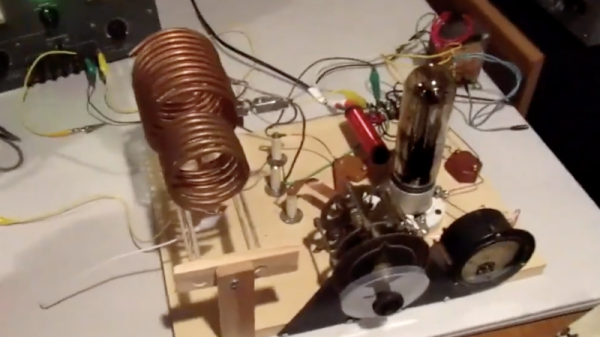
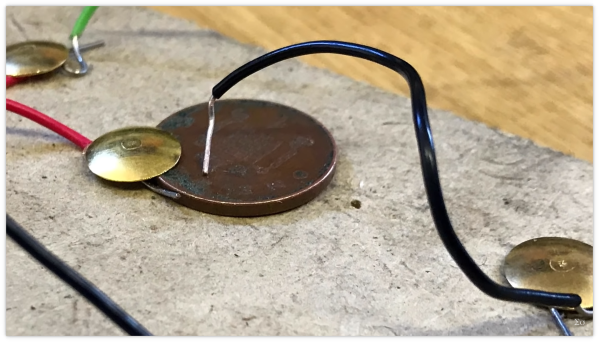
Coherers were devices used in some of the very earliest radio experiments in the 19th century. Consisting of a tube filled with metal filings with an electrode at each end, the coherer would begin to conduct when in the presence of radio frequency energy. Physically tapping the device would then loosen the filings again, and the device was once again ready to detect incoming signals. [hombremagnetico] has designed a basic 3D printed version of the device, and has been experimenting with it at home.

It’s a remarkably simple build, with the 3D printed components being a series of three brackets that combine to hold a small piece of plastic tube. This tube is filled with iron filings, and electrodes are inserted from either end. Super glue is used to seal the tube, and the coherer is complete.

The coherer can easily be tested by measuring the resistance between the two electrodes, and firing a piezo igniter near the tube. When the piezo igniter sparks, the coherer rapidly becomes conductive, and can be restored to a non-conductive state, or de-cohered, by tapping the tube.

Coherers and spark-gap sets are fun to experiment with, but be sure you have the proper approvals first. Video after the break.

Continue reading “3D Printing An Old-School Coherer”

Adding LoRa Long Range Radio To Smartphones And Connected Devices

Would you add another radio to your smartphone? No, not another WiFi or cellular radio; a smartphone already has that. I’m talking about something that provides connectivity through ISM bands, either 433 or 915 MHz. This can be used where you don’t have cell phone coverage, and it has a longer range than WiFi. This is the idea behind Skrypt, a messaging system that allows you to send off-the-grid messages.

Skrypt is an ESP32-based hardware modem that can communicate with a smartphone, or any other device for that matter, over Bluetooth or USB. Inside, there are two modules, an ESP32 WROOM module that provides the Bluetooth, WiFi, USB connectivity, and all of the important software configuration and web-based GUI. The LoRa module is the ubiquitous RFM95W that’s ready to drop into any circuit. Other than that, the entire circuit is just a battery and some power management ICs.

While LoRa is certinaly not the protocol you would use for forwarding pics up to Instagram, it is a remarkable protocol for short messages carried over a long range. That’s exactly what you want when you’re out of range of cell phone towers — those pics can wait, but you might really want to send a few words to your friends. That’s invaluable, and LoRa makes a lot of sense in that case.

Vintage Philco Radio Looks Stock, Contains Modern Secret: A Raspberry Pi

Antique radio receivers retain a significant charm, and though they do not carry huge value today they were often extremely high quality items that would have represented a significant investment for their original owners. [CodeMakesItGo] acquired just such a radio, a Philco 37-11 made in 1937, and since it was it a bit of a state he set about giving it some updated electronics. Vintage radio purists, look away from the video below the break.

Stripping away the original electronics, he gave it a modern amplifier with Bluetooth capabilities, and a Raspberry Pi. Vintage radio enthusiasts will wince at his treatment of those classic parts, but what else he’s put into it makes up for the laying waste to a bit of ’30s high-tech.The original tuning dial was degraded so he’s given it a reproduction version, and behind that is an optical encoder and two optical sensors. This is used to simulate “tuning” the radio between different period music “stations” being played by the PI, and for an authentic feel he’s filled the gaps with static. The result is a functional and unusual device, which is probably better suited than the original to a 2019 in which AM radio is in decline.

If you think of a high-end set like this Philco as being the ’30s equivalent of perhaps an 8K TV set, you can imagine the impact of AM radio in those early days of broadcasting. We recently took a look at some of the directional antenna tricks that made so many AM stations sharing the band a possibility.

Continue reading “Vintage Philco Radio Looks Stock, Contains Modern Secret: A Raspberry Pi”