Faster IPA Recycling For Your Resin Print Workflow

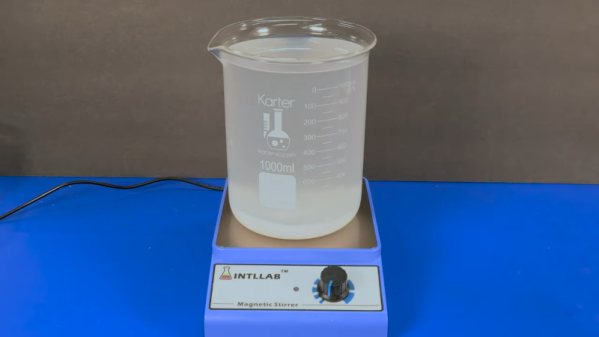
If you’ve printed with photopolymer resins, you know that you need alcohol. Lots of alcohol. It makes sense that people would like to reuse the alcohol both to be environmentally responsible and to save a little money. The problem is that the alcohol eventually becomes so dirty that you have to do something. Given time, the polymer residue will settle to the bottom and you can easily pour off most of the clean liquid. You can also use filters with some success. But [Makers Mashup] had a different idea. Borrowing inspiration from water treatment plants, he found a chemical that will hasten the settling process. You can see a video of his process below.

The experimentation started with fish tank clarifier, which is — apparently — mostly alum. Alum’s been used to treat wastewater for a long time. Even the ancient Romans used it for that purpose in the first century. Alum causes coagulation and flocculation so that particles in the water wind up sinking to the bottom.

Continue reading “Faster IPA Recycling For Your Resin Print Workflow”

The Metabolizer Is Turning Trash Into Treasure Even Faster Now

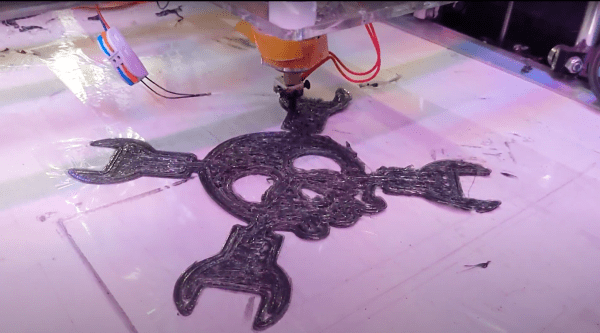
Do you remember [Sam Smith]’s Metabolizer from a few years back? In case you’ve forgotten, this baby takes trash and turns it into printed plastic objects, and it’s solar-powered to boot. Although the Metabolizer didn’t win the 2018 Hackaday Prize, [Sam] and his machine won many achievements that year, including the Open Hardware Challenge. It’s fantastic to see the project still improving.

To recap, the sun hits the solar panels and charge up the battery bank. Once there’s enough power to start the reaction, it gets dumped into a heating element that turns biomass into biochar. This smoke is cooled, collected, refined, and fed into a small gas generator, which produces DC power to run a 3/4-horsepower shredder and the trash printer.

[Sam] likens this beast to a Rube Goldberg machine in that it performs an overly-complicated chain reaction to do a simple task. We certainly see his point, but we think that this machine is worth so much more than those classic machines, which tend to do nothing useful at all and tend to consume many resources in the process.  On the contrary, the Metabolizer’s chain reaction starts with sunshine and ends with useful objects that keep plastic out of landfills. Honestly, it’s more akin to a compost heap with a PhD in Biology and a handful of steroids and a 3D printer attached.

Unfortunately, [Sam] couldn’t get a prototype working in time for the Prize, and he turned to Patreon to gain support after the $1,000 ran out. Three years and a ton of improvements later, [Sam] has a working prototype that’s cheaper, more efficient, and easier to build. But can it be built relatively easily by someone other than [Sam]? Consider the gauntlet thrown down.

Not happy with your standard-style compost pile? You need a DIY trommel to sift out the bad stuff.

Can We Repurpose Old Wind Turbine Blades?

Wind turbines are a fantastic, cheap, renewable source of energy. However, nothing lasts forever, and over time, the blades of wind turbines fatigue and must be replaced. This then raises the question of what to do with these giant waste blades. Thankfully, a variety of projects are exploring just those possibilities.

A Difficult Recycling Problem

Around 85% of a modern wind turbine is recyclable. The problem is that wind turbine blades currently aren’t. The blades last around 20 to 25 years, and are typically made of fiberglass or carbon fiber. Consisting of high-strength fibers set in a resin matrix, these composite materials are incredibly difficult to recycle, as we’ve discussed previously. Unlike metals or plastics, they can’t just be melted down to be recast as fresh material. Couple this with the fact that wind turbine blades are huge, often spanning up to 300 feet long, and the problem gets harder. They’re difficult and expensive to transport and tough to chop up as well.

Continue reading “Can We Repurpose Old Wind Turbine Blades?”

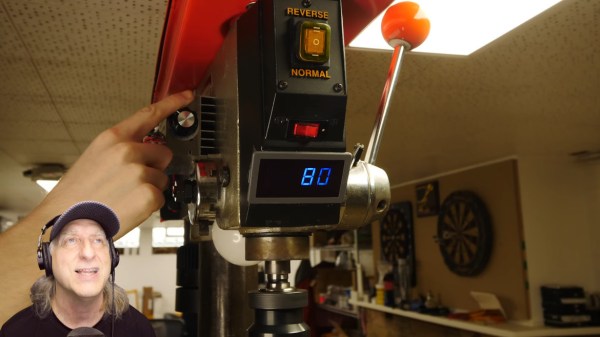
Drill press modded with a treadmill motor, speed controller, lights, and a tachometer.

Drill Press Runs Faster On A Treadmill Motor

Are you tired of the same old video style from your favorite content creators? We can’t say that we were, exactly. But nevertheless, we appreciate this creative departure from [Eric Strebel]’s regular fare as he soups up his drill press with an old treadmill motor and a few extra features.

First off, that commentator in the video is right — 2.6 horsepower is a crazy amount for a drill press. Fortunately, [Eric] also added a variable speed controller and a digital tachometer to keep things in check. As an added bonus, he no longer has to get under the hood and mess with the belts.

We like what [Eric] brings to the drill press motor mod, which is already well-documented on YouTube. We love the re-use of an office chair bracket as a new motor mount. It’s probably our favorite bit aside from the 2-color forward/reverse switch plate idea: print it in whatever letter color you want with proud lettering, paint the whole thing black, and sand off the letters so the color shows. Check it out after the break.

There are many ways to make your own drill press, and one of the easiest is to mount a hand drill.

Did you miss the Industrial Design Hack Chat with [Eric]? It’s okay, you can read the transcript over on IO.

Continue reading “Drill Press Runs Faster On A Treadmill Motor”

Light Bulb Plant Propagation Station Is A Bright Idea

We’ve always enjoyed having a few indoor plants around the Hackaday dungeon because they just make the days more cheerful. Apparently there’s a big craze for them right now, which has led to price increases of things like propagation stations — places where cuttings from mature plants go to grow a root system before getting planted in dirt. Many plants will root readily in water, and it’s better for them to start out this way because soil can come with a bunch of problems.

This goes really well with the older craze of Edison-style light bulbs. We’re glad we never bothered with those because [JGJMatt] says they don’t last long at all. The bulbs themselves are really nice looking, so [JGJMatt] decided to turn a few of them into hanging water propagation stations. After cleaning out the bulb and embiggening the opening, [JGJMatt] formed a holder by applying a torch to brass rod. This dulls the brass, so they shined it up with steel wool and some automotive polishing compound. Then it’s time for some simple macrame to hang it with, because it will soon be full of water.

Does the handle sound familiar? It ought to — [JGJMatt]’s elegant builds have graced these pages a few times before.

Recycling Will Be Key To The Electric Vehicle Future

Electric vehicles have become a mainstay in the global automotive marketplace, taking on their gasoline rivals and steadily chewing out their own slice of market share, year after year. Government mandates to end the sale of polluting internal combustion engine vehicles and subsidies on cleaner cars promise to conspire to create an electric vehicle boom.

The result should be much cleaner air, as generating electricity in even the dirtiest power plants is far cleaner and more efficient than millions of individual engines puttering about the place. However, if the electric car is to reign supreme, they’ll need to be built in ever greater numbers. To do that is going to take huge amounts of certain materials that can be expensive and sometimes in very limited supply. Thus, to help support the EV boom, recycling of these materials may come to play a very important role.

Continue reading “Recycling Will Be Key To The Electric Vehicle Future”

SV Seeker Is Recycling Batteries

SV Seeker is a home-made boat currently being built by [Doug Jackson] just north of Tulsa, Oklahoma. It’s a bit different than what you might imagine as a typical DIY boat, though. You see, Seeker is a 75 ft steel boat, intended to work as a research vessel. Doug and his crew proudly refer to Seeker as “The boat the internet built”, and he’s our kind of people. We’ve covered them before, the first time way back in 2013. Doug’s Youtube channel does double duty, both teaching the rest of us all the skills he’s learned while building, and also serving as the eventual user and repair manual for the boat.
Continue reading “SV Seeker Is Recycling Batteries”