The Modern Retrocomputer: An Arduino Driven 6845 CRT Controller

[MmmmFloorPie] revived an old project to create the retro mashup of a 6845 CRT controller and a modern Arduino Uno. When it comes to chips, the Motorola 6845 is the great granddaddy of Cathode Ray Tube (CRT) interfaces. It was used in the IBM Monochrome display adapter, the Hercules graphics controller, CGA, Apple II terminal cards, and a host of other microcomputer and terminal systems.
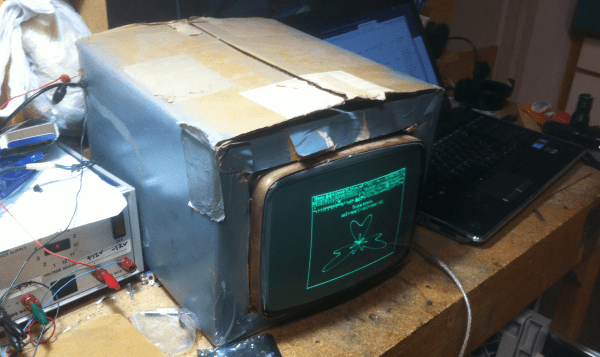
Way back in 1989, [MmmmFloorPie] was a senior in college. His capstone project was a 68000 based computer which could record and playback audio, as well as display waveforms on a CRT. The CRT in question was ordered from a classified add in Popular Science magazine. It was a bare tube, so the heavy cardboard box it shipped in was repurposed as a case.

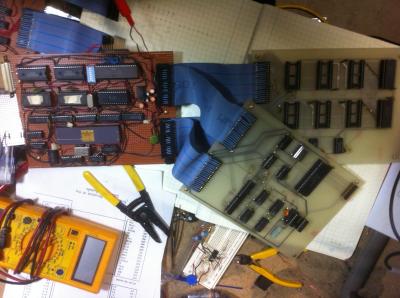
Fast forward to today, and  [MmmmFloorPie] wanted to power up his old project. The 68000 board was dead, and he wasn’t up to debugging the hundreds of point to point soldered connections. The CRT interface was a separate board including the 6845 and 32 KByte of RAM. It would only take a bit of hacking to bring that up. But what would replace the microprocessor?

Continue reading “The Modern Retrocomputer: An Arduino Driven 6845 CRT Controller”
Retro Teardown: Inside An 8-Track Stereo Player

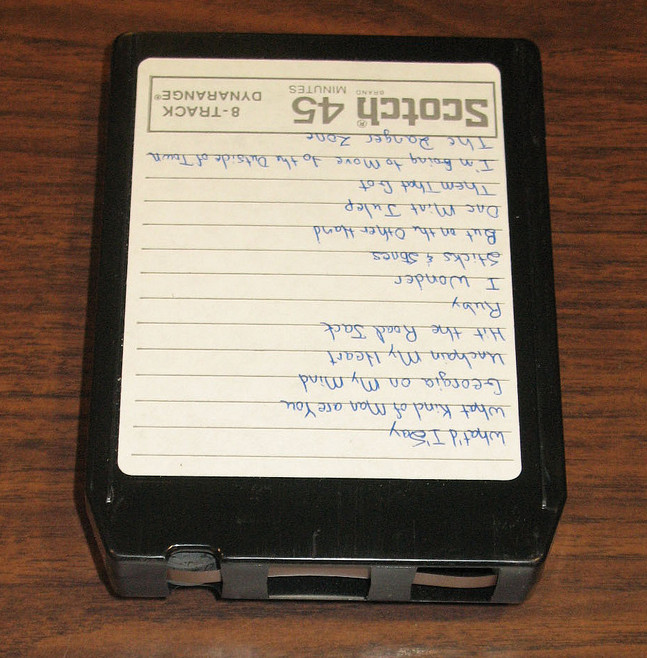
If you are a connoisseur of analogue audio, it’s probable you might have a turntable and a stack of records at home somewhere. If you are of a certain age you may even have a cassette deck, though you’re more likely to have abandoned that format some time in the 1990s. If you are old enough to have been around in the 1960s or 1970s though, you may have owned another analogue audio format. One of several that you might have found in a well-equipped home of that period was the 8-track stereo cartridge, a self-contained tape cassette format that fit four stereo tracks onto a single quarter-inch tape loop as eight parallel tracks, four each of left and right. A triumph of marketing, really, it should more accurately have been called 4-track stereo.

An 8-track stereo cartridge. Government & Heritage Library, State Library of NC (CC BY 2.0).

8-track cartridges were developed from earlier tape cartridge formats, largely to satisfy the demands of the automotive industry for interchangeable in-car entertainment. Thus if you owned an 8-track player it was most likely to have been found in your car, but it was not uncommon to find them also incorporated into home hi-fi systems. Thus we come to our subject today. Our retrotechtacular series usually highlights a video showing a bygone technology, but today we’re going to get a little more hands-on.

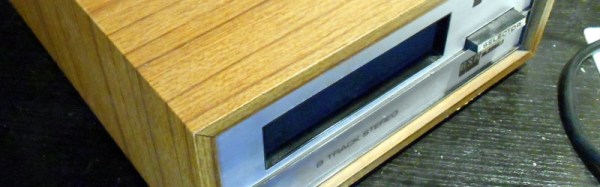
Some time in the early 1990s, I acquired an 8-track player, a BSR McDonald unit manufactured in the UK and dating from the early 1970s. BSR were much more well-known for their turntables, so this is something of an oddity. Where I found it has disappeared into the mists of time, but it was probably at a radio rally or junk sale. I certainly didn’t buy it because I wanted it to play 8-track tapes, instead I wanted a talking point for my hi-fi, something quirky to set it apart from everyone else’s. So every incarnation of listening enjoyment chez List for the last quarter century has had an 8-track player nestling within it, even if it has never played a tape while in my ownership. Thus we have a unique opportunity for this retro teardown.

Continue reading “Retro Teardown: Inside An 8-Track Stereo Player”

Command Alexa With A Completely Mechanical Vintage Remote Control

Anyone with grandparents already knows that in ye olden days, televisions did not have remote control. Your parents probably still complain about how, as children, they were forced to physically walk over to the TV in order to switch between the three available channels. In these modern times of technological wonder, we have voice control, programmable touch screen remotes, and streaming services that will automatically play an entire season of the show you’re binge watching. However, before these, and before the ubiquitous infrared remote, television manufacturers were experimenting with ways to keep kids from having to run across the living room every time the channel needed to be changed.

Early remote controls were simply wired affairs — nothing too surprising there. But, it wasn’t long before methods of wireless control were being introduced. One early effort called the Flashmatic would shine light onto a photoelectric cell on the television set to control it. Of course, it might also be controlled by unintended light sources, and users had to have good aim to hit the sensor. These issues soon led to the introduction of the Zenith Space Command remote control, which used ultrasonic frequencies to control the TV.

Continue reading “Command Alexa With A Completely Mechanical Vintage Remote Control”

Flappy Bird Is The New “Does It Run Doom?”

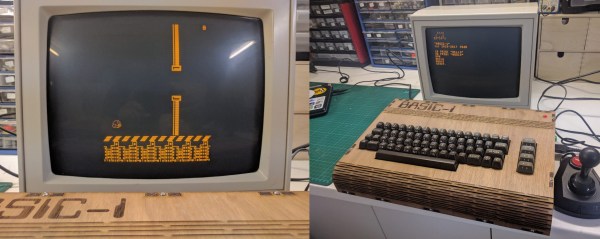
Back in 2014 [Johan] decided to celebrate BASIC’s 30 50 year anniversary by writing his own BASIC interpreter. Now, a few years later, he says he feels he has hit a certain milestone: he can play Flappy Bird, written in his own version of BASIC, running on his own home-built computer, the BASIC-1.

Inside the BASIC-1 is an Atmel XMega128A4, a keyboard from a broken Commodore 64, a joystick port, a serial to TV out adapter, and an SD card adapter for program storage. An attractively laser-cut enclosure with kerf bends houses the keyboard and hardware. The BASIC-1 boots into BASIC just like many of its home computer counterparts from the 80s.

Continue reading “Flappy Bird Is The New “Does It Run Doom?””

Walter Is The Slickest Retro-Futuristic Robot Arm

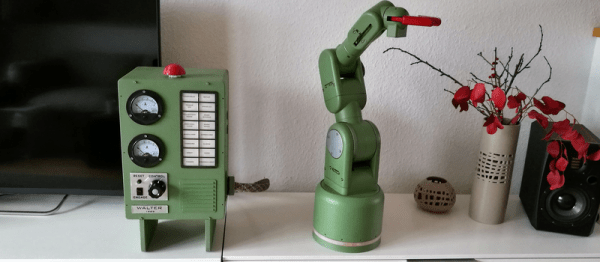
[Jochen Alt] is on a roll. We just covered his ball-balancing robot, Paul, only to find his phenomenal six-DOF robot arm in full retro style. Its name is “Walter” and it’s done up in DDR style (the former East Germany), in painted, 3D-printed plastic. The full design and build documents are an absolutely amazing resource if you’re into robot arm or legs.

In particular, the sections on trajectory planning and kinematics are fantastic. If you’re interested in robot motion planning by Bezier curves, you know where to go. (We’ve always wanted a Bezier-curve 3D printer slicer, but that’s another story.) The construction is also top-notch here, and the attention to detail that went into this arm is phenomenal. It’s all done with stepper motors and geared belts, which allow each of Walter’s joints to be driven by a motor that’s one joint further upstream than would be the case if it were designed with servos. [Jochen] even went so far as to expose the belt in some places to show off the gearing. Walter is worth checking out.

Even if you’ll never build such a fancy robot arm, you should read through the docs just to appreciate all of the thought and work that went into this very refined and simple-from-the-outside design. If you’d like to start out on the simple side of the spectrum, check out these robot arms made of office supplies or a desk lamp. Once you’re ready for your second arm project this short list, some of which [Jochen] mention in his writeup, should get you up and grasping. And do check out his balancing bot, Paul.

IPad Tossed Out For RetroPie Arcade Cabinet Redux

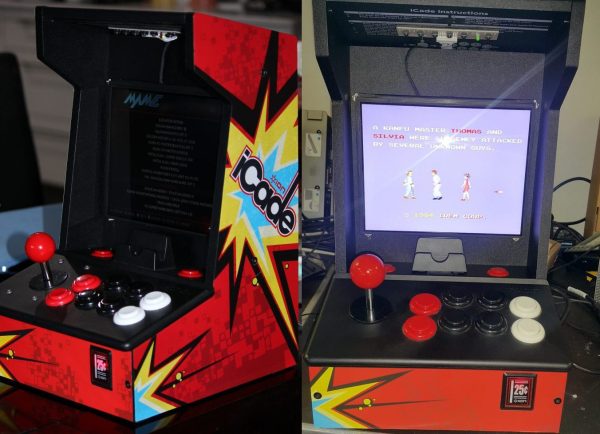
The naming and remixing in this project can get a little confusing to those unfamiliar with the different elements involved, but what [John Gerrard] has done is take a stylish mini arcade cabinet intended as a fancy peripheral for an iPad and turned it into an iPad-free retro arcade gaming cabinet. He also designed his own power controller for graceful startup and shutdown.

The project started with a peripheral called the iCade (originally conceived as a fake product for April Fool’s) and [John] observed it had good remix potential for use as a mini retro gaming cabinet. It was a good starting point: inexpensively purchased off eBay with suitable arcade-style joystick and buttons, a nice layout, and plenty of hacking potential. With a small variety of hardware from familiar sources like eBay and Aliexpress, [John] rounded up most of what he needed.

Continue reading “IPad Tossed Out For RetroPie Arcade Cabinet Redux”

Bring Saturday Mornings Back To Life With This Cartoon Server

It was an American ritual for over four decades: wake up early on Saturday morning, prepare a bowl of sugar, and occupy the couch for four glorious hours of cartoons. The only interruptions came when the least-significant sibling had to be commanded to get up to change the channel to one of the two other networks, or when your mom decided to vacuum the TV room. It was a beautiful ritual, but now it’s gone.

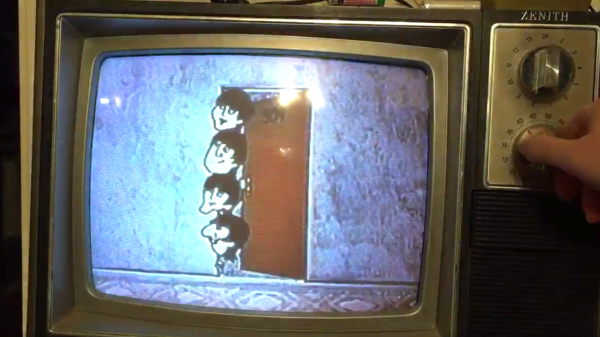
Or is it? If you really want to recapture your misspent youth, you can try this Raspberry Pi multi-channel cartoon server with retro TV display. [FozzTexx] started with a yard sale 13″ Zenith set, which languished in his shop for want of a mission. When he found a four-channel video modulator, he knew he had the makings of the full channel-changing Saturday morning experience.

Four Raspberry Pis were configured to serve up four separate streams of cartoons from his Plex server, and after a late Friday night of hacking the whole thing together, each stream was ready to go live at 7:00 AM on Saturday. [FozzTexx] thought of everything — from the pre-“broadcast day” test pattern to actual commercials spliced into the cartoons to the static between the channels, it’s all there in low-definition glory. He even printed up faux TV Guide pages! You can watch a brief demo on [FozzTexx]’ Twitter feed, or you can watch the entire 2-hour Periscope feed if you’re feeling nostalgic.

[FozzTexx] chose UHF channels for his “stations,” so if you want to replicate this build it may pay to bone up on analog TV tuner basics. Or if it’s just the retro look you’re going for, this custom case inspired by a 40s TV might be nice to check out.

Continue reading “Bring Saturday Mornings Back To Life With This Cartoon Server”