Developing An Open Source Bike Computer

While bicycles appear to have standardized around a relatively common shape and size, parts for these bikes are another story entirely. It seems as though most reputable bike manufacturers are currently racing against each other to see who can include the most planned obsolescence and force their customers to upgrade even when their old bikes might otherwise be perfectly fine. Luckily, the magic of open source components could solve some of this issue, and this open-source bike computer is something you’ll never have to worry about being forced to upgrade.

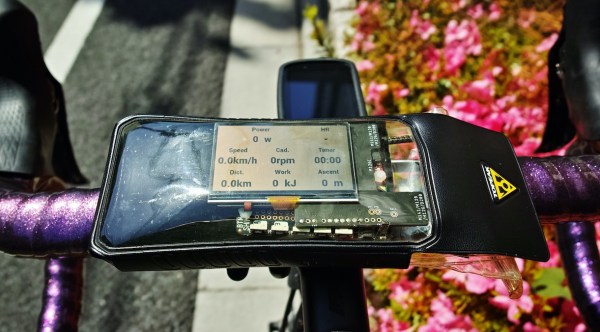
The build is based around a Raspberry Pi Zero in order to keep it compact, and it uses a small 2.7 inch LCD screen to display some common information about the current bike ride, including location, speed, and power input from the pedals. It also includes some I2C sensors including pressure and temperature as well as an accelerometer. The system can also be configured to display a map of the current ride as well thanks to the GPS equipment housed inside. It keeps a log in a .fit file format as well so that all rides can be archived.

When compared against a commercial offering it seems to hold up pretty well, and we especially like that it’s not behind a walled garden like other products which could, at any point, decide to charge for map upgrades (or not offer them at all). It’s a little more work to set up, of course, but worth it in the end. It might also be a good idea to pair it with other open source bicycle components as well.

Thanks to [Richard] for the tip!

Students Rebel Against Heat-Sensing Crotch Monitor Surveillance Devices

Surveillance has become a ubiquitous part of modern life. Public spaces are dotted with CCTV cameras inside and out. Recent years have seen the technology spread to the suburbs with porch cameras spreading the eye of big tech and law enforcement ever further.

Outside of mere cameras, companies are rushing to develop all manner of new devices to surveil individuals, too. One such device intended to track students quickly drew the ire of scholars at Northeastern University, and the cohort fought back.

Continue reading “Students Rebel Against Heat-Sensing Crotch Monitor Surveillance Devices”

Hackaday Prize 2022: DIY Landslide Warning System

Landslides can be highly dangerous to both people and property. As with most natural disasters, early warning can make all the difference. [Airpocket] has built a cheap, affordable system that hopes to offer just that.

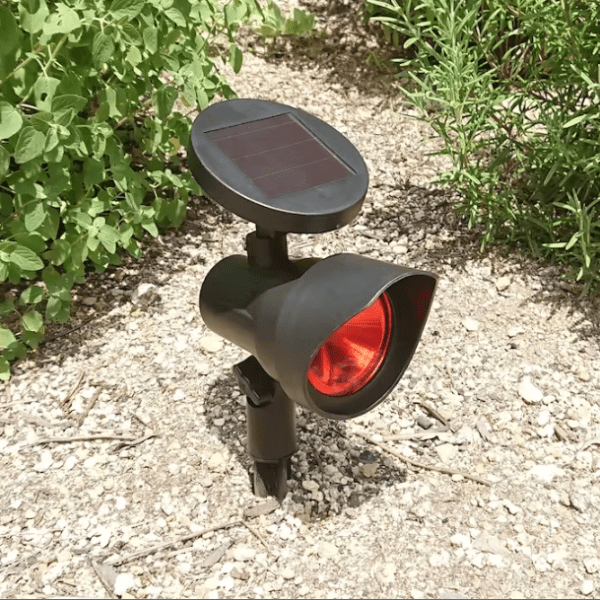
The system relies on a network of sensors built with Sony Spresense controllers, built into solar garden light enclosures which provide a watertight enclosure and a sustainable power supply. The controllers are paired with accelerometers to detect movement, and communicate over a WiSUN connection back to a Raspberry Pi 4B base station. When a deployed sensor station detects movement, it sends a message back to the base station, which sounds the alarm that a landslide may be imminent.

Early testing shows the concept works in theory. In practice, some improvements to reduce power draw and increase communication reliability are required. However, it’s a solid proof of concept for a simple landslide warning system.

Early warning is always key when it comes to things like landslides, tsunamis, and earthquakes. In fact, the US Geological Survey has done its own work on predicting earthquakes and providing early warning, too. Video after the break.

Continue reading “Hackaday Prize 2022: DIY Landslide Warning System”

Water Level Sensor Does Not Use Water Level Sensor

When interfacing with the real world, there are all kinds of sensors available which will readily communicate with your microcontroller of choice. Moisture, pH, humidity, temperature, location, light, and essentially every other physical phenomenon are readily measured with a matching sensor. But if you don’t have the exact sensor you need, it’s sometimes possible to use one sensor as a proxy for another.

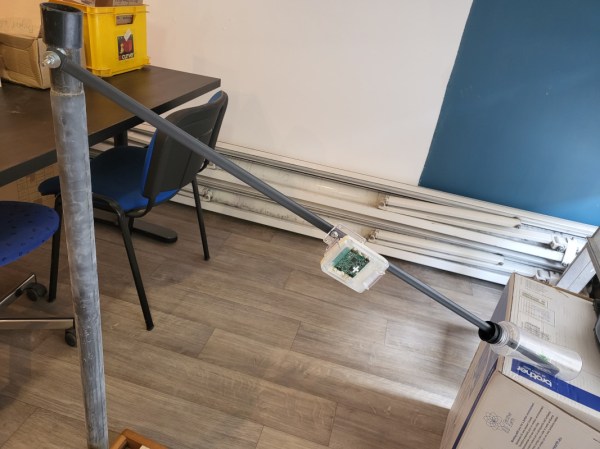
[Brian Wyld] needed a way to monitor the level of a remote body of water but couldn’t use a pressure or surface-level sensor, so he used a sensor typically intended for geolocation instead. This particular unit, an STM-type device with a built-in accelerometer, is attached to a rotating arm with a float at one end. As the arm pivots, the microcontroller reports its position and some software converts the change in position to a water level. It’s also paired with a LoRa radio, allowing it to operate off-grid.

Whether there is a design requirement to use an esoteric sensor to measure something more common, or a personal hardware limitation brought about by a shallow parts drawer, there’s often a workaround like this one that can accomplish the job. Whatever the situation, we do appreciate hacking sensors into other types of sensors just as much as anything else.

Tech In Plain Sight: Rain-Sensing Wipers

While it is definitely a first-world problem that you don’t want to manually turn on your windshield wipers when it starts raining, it is also one of those things that probably sounds easier to solve than it really is. After all, you can ask a four-year-old if it is raining and expect a reasonable answer. But how do you ask that question of a computer? Especially a tiny cheap computer that is operating pretty much on its own.

You might want to stop here and try to think of how you’d do it. Measure the conductivity of the glass? Maybe water on the glass affects its dielectric constant and you could measure the resulting capacitance? Modern cars don’t do either. The problem is complicated because you need a solution that works with the glass and isn’t prone to false positives due to dirt or debris.

Continue reading “Tech In Plain Sight: Rain-Sensing Wipers”

The Virtue Of Wires In The Age Of Wireless

We ran an article this week about RS-485, a noise resistant differential serial multidrop bus architecture. (Tell me where else you’re going to read articles like that!) I’ve had my fun with RS-485 in the past, and reading this piece reminded me of those days.

You see, RS-485 lets you connect a whole slew of devices up to a single bundle of Cat5 cable, and if you combine it with the Modbus protocol, you can have them work together in a network. Dedicate a couple of those Cat5 lines to power, and it’s the perfect recipe for a home, or hackerspace, small-device network — the kind of things that you, and I, would do with WiFi and an ESP8266 today.

Wired is more reliable, has fewer moving parts, and can solve the “how do I get power to these things” problem. It’s intrinsically simpler: no radios, just serial data running as voltage over wires. But nobody likes running cable, and there’s just so much more demo code out there for an ESP solution. There’s an undeniable ease of development and cross-device compatibility with WiFi. Your devices can speak directly to a computer, or to the whole Internet. And that’s been the death of wired.

Still, some part of me admires the purpose-built simplicity and the bombproof nature of the wired bus. It feels somehow retro, but maybe I’ll break out some old Cat5 and run it around the office just for old times’ sake.

An anemometer outside

DIY Anemometer For Projects Big And Small

When [Fab] needed an anemometer for his latest project, he was stymied by the limited range and relatively high prices of commercial options. Undeterred, his solution was an impressive DIY anemometer that rivals the off-the-shelf alternatives.

AnemoSens was designed from the ground up as a component for the ambitious WinDIY_2 Horizontal Axis Wind Turbine, however it’s just as suitable as part of your standard home weather station. The microcontroller unit uses RS485/Modbus connectivity, ensuring that data from the wind sensor is accessible across a variety of platforms. Serial-stream via USB and an SD cart slot are also available for recording data, the latter being particularly useful for long-term unsupervised monitoring. [Fab] also integrated an ESP32 for recording data over the air.

The MCU also features a location for the venerable BME280, which is a relatively accurate temperature, pressure and humidity sensor often deployed in DIY weather stations. This feels like a nice touch, as it means the anemometer package alone could feasibly serve as a rudimentary weather sensing station, or as a backup for more elaborate environmental monitoring.

The prototype currently uses a Hall effect sensor for measuring the wind speed, while a AS5048B magnetic rotary encoder does a decent job of measuring rotation (wind direction). Some calibration is likely necessary to improve the accuracy of this setup, but it’s a promising start.

[Fab] has already identified some shortcomings with the bearing, but has a plan for future iterations. He might want to check out this spare-parts anemometer that uses a bearing from an old hard drive.

Continue reading “DIY Anemometer For Projects Big And Small”