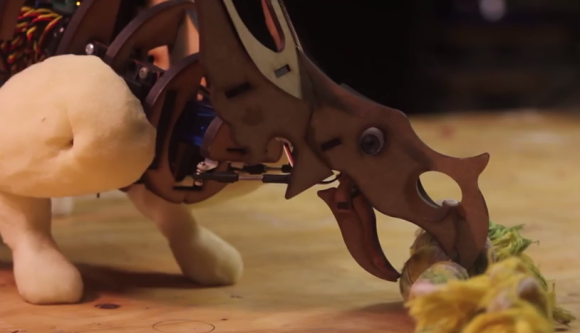
 Inspired by a childhood love of dinosaurs, [Robert] set out to build a robotic dinosaur from the Ceratopsian family. After about a year of design, building, and coding, he has sent us a video of Roboceratops moving around gracefully, chomping a rope, and smoothly wagging his tail.
Roboceratops is made from laser-cut MDF and aluminium bars in the legs. That’s not cookie dough on those legs, it’s upholstery foam, and we love the way [Robert] has shaped it. Roboceratops has servos in his jaw, neck, tail, and legs for a total of 14-DOF. You can see the servo specifics and more in the video description. [Robert] has full kinematic control of him through a custom controller and is working to achieve total quadrupedal locomotion.
Inside that custom controller is an Arduino Mega 2560, an LCD, and two 3-axis analog joysticks that control translation, height, yaw, pitch, and jaw articulation. For now, Roboceratops receives power and serial control through a tether, but [Robert] plans to add an on-board µC for autonomous movement as well as wireless, a battery, an IMU, and perhaps some pressure/contact detection in his feet.
The cherry on top of this build is the matching, latching custom carry case that has drawers to hold the controller, power supply, cable, tools, and spare parts. Check out Roboceratops after the break.
Continue reading “Roboceratops: A Robot Dinosaur That Defies Extinction”
 When you think of a robotic arm, you’re probably thinking about digital control, microcontrollers, motor drivers, and possibly a feedback loop. Anyone who was lucky enough to have an Armatron knows this isn’t the case, but you’d still be surprised
 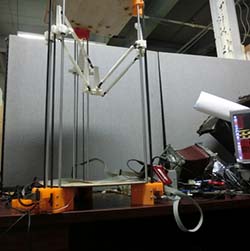 If you think about it, the RepRaps and other commercial 3D printers we have today are nothing like the printers that will be found in the workshops of the future. They’re more expensive than they need to be, and despite the RepRap project being around for a few years now, no one has cracked the nut of closed loop control yet. [mad hephaestus], [Alex], and [Will] over on the Hackaday Projects site are working on the future of 3D printing