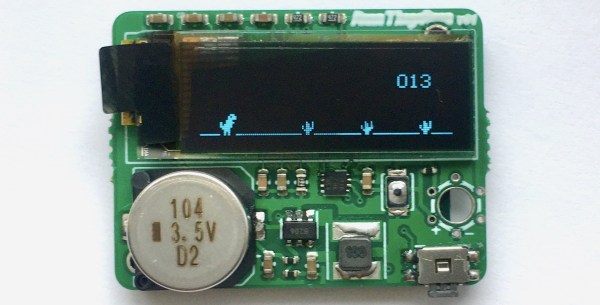
A small PCB with an OLED screen showing a Dinosaur Game

Hackaday Prize 2022: RunTinyRun Is A Fully Solar-Powered, Portable Dinosaur Game

Fully solar-powered handheld gadgets have so far mostly been limited to ultra-low power devices like clocks, thermometers and calculators. Anything more complicated than that will generally have a battery and some means to charge it. An entirely solar-powered video game console is surely out of reach. Or is it? As [ridoluc] shows, such a device is actually possible: the RunTinyRun gets all its power directly from the Sun.

To be fair, it’s not really a full-fledged game console. In fact it doesn’t even come close to the original Game Boy. But RunTinyRun is a portable video game with an OLED display that’s completely powered by a solar panel strapped to its back. It will run indefinitely if you’re playing outside on a sunny day, and if not, letting it charge for a minute or two should enable thirty seconds of play time.

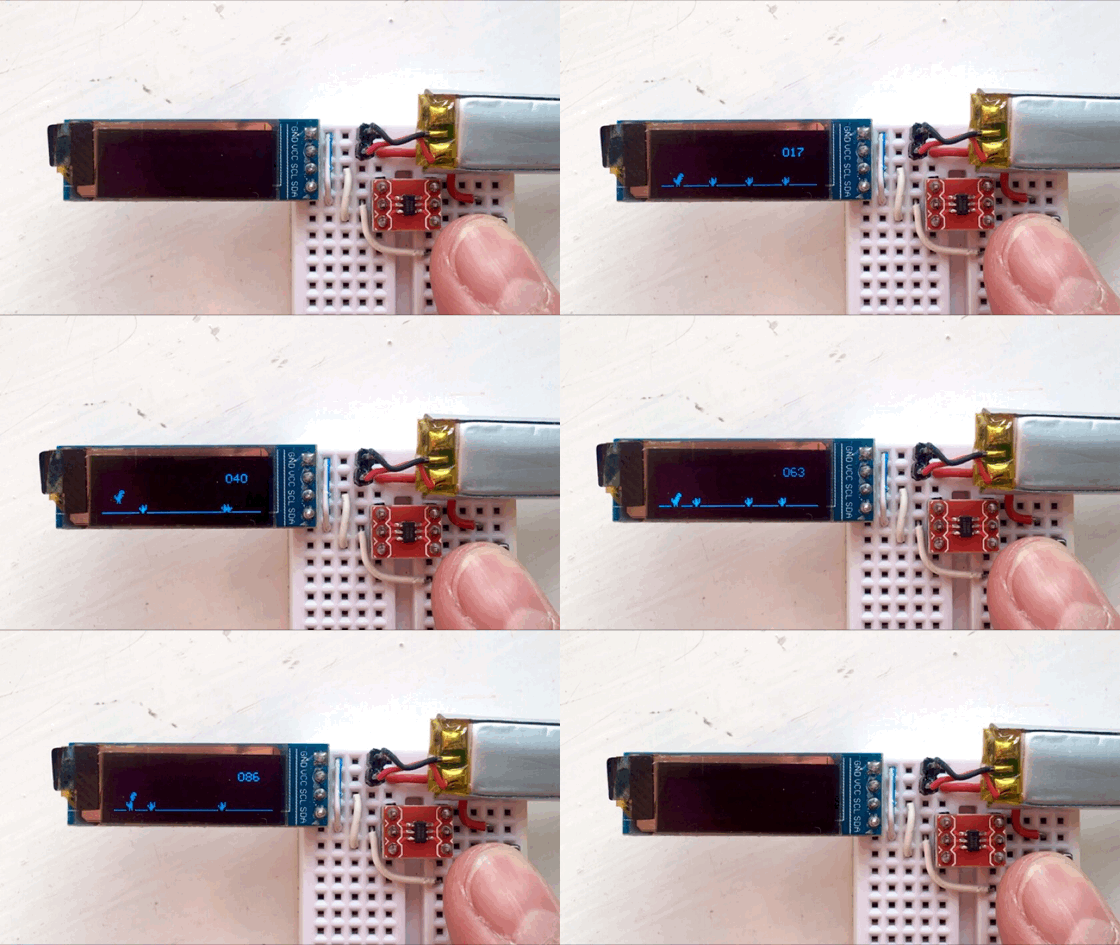
The game it runs is a clone of Google’s Dinosaur Game, where you time your button presses to make a T-Rex jump over cacti. As you might expect, the game runs on an extremely minimalist hardware platform: the main CPU is an ATtiny10 six-pin micro with just 1 kB of flash. The game is entirely written in hand-crafted assembly, and takes up a mere 780 bytes. A 0.1 farad supercap powers the whole system, and is charged by a 25 x 30 mm2 solar cell through a boost converter.

RunTinyRun is a beautiful example of systems design within strict constraints on power, code size and board area. If you’re looking for a more capable, though slightly less elegant portable gaming console, have a look at this solar-powered Game Boy.
A Dinosaur Game implementation running on a breadboard setup

Hackaday Prize 2022: Glass Tube Solar Thermionic Converters

Typically, if you want to convert solar energy into electrical energy, you use either photovoltaic (PV) cells, or you use the sunlight to create steam to turn a turbine. Both of these methods are well-established and used regularly in both small- and grid-scale applications. However, [Nick Poole] wanted to investigate an alternative method, using thermionic converters for solar power generation.

[Nick] has been gearing up to produce various styles of vacuum tubes, and noted that the thermionic effect that makes them work could also be used to generate electricity. They are highly inefficient and produce far less power than a photovoltaic solar cell, meaning they’re not in common use. However, as [Nick] notes, unlike PV cells etched in silicon, a thermionic converter can be built with basic glassworking tools, requiring little more than a torch, a vacuum pump, and a spot welder.

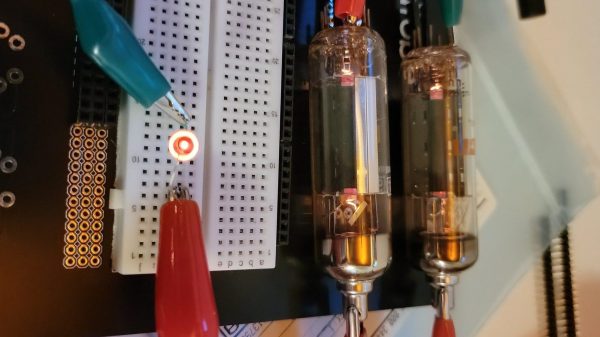
Experiments with a large lens to focus sunlight onto a 6V3A diode tube showed promise. [Nick] was able to generate half a volt, albeit at a tiny current, with the design not being optimized for thermionic conversion. Further experiments involved electrically heating a pair of diode tubes, which was able to just barely light an LED at 1.7 V and a current of 7.5 uA. The conversion efficiency was a lowly 0.00012%, around 5 orders of magnitude worse than a typical PV cell.

[Nick]’s hope is that he can produce a tube designed specifically to maximize thermionic conversion for energy generation purposes. It’s likely there is some low-hanging fruit in terms of gains to be made simply by optimizing the design for this purpose, even if the technique can’t compete with other solar generation methods.

In any case, we’re eager to see what [Nick] comes up with! We love to see makers building tubes in their own home workshops.

Continue reading “Hackaday Prize 2022: Glass Tube Solar Thermionic Converters”

Hackaday Prize 2022: Solar Harvesting Is Better With Big Capacitors

The sun is a great source of energy, delivering in the realm of 1000 watts per square meter on a nice clear day. [Jasper Sikken] has developed many projects that take advantage of this power over the years, and has just completed his latest solar harvesting module for powering microcontroller projects.

The concept is simple. A small solar panel is used to charge up a lithium ion capacitor (LIC), which can then be used to power other projects. We first saw this project last year, when it was one of the winners of Hackaday’s 2021 Earth Day contest. Back then, it was only capable of dishing out 80 mA at 2.2V.

However, the latest version ups the ante considerably, delivering up to 400 mA at 3.3V. This opens up new possibilities, allowing the module to power projects using technologies like Bluetooth, WiFi and LTE that require more current to operate. It relies on a giant 250 F capacitor to store energy, and a AEM10941 solar energy harvesting chip to get the most energy possible out of a panel using Maximum Power Point Tracking (MPPT).

It’s a useful thing to have for projects that you’d like to run off the sun, and you can score one off Tindie if you don’t want to build your own. We’ve seen [Jasper] pull off other neat solar-powered projects before, too. Video after the break.

Continue reading “Hackaday Prize 2022: Solar Harvesting Is Better With Big Capacitors”

Floating Solar Farms Are Taking The World’s Reservoirs By Storm

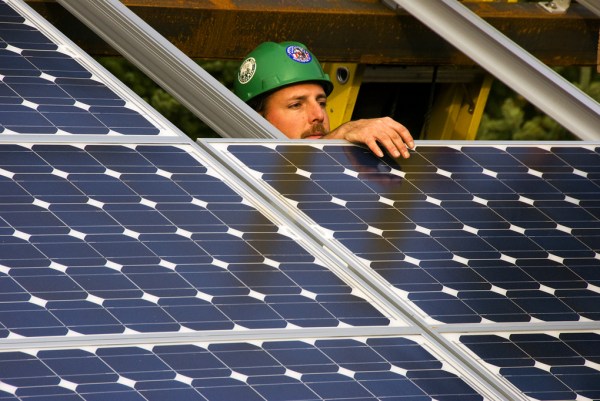
Photovoltaic solar panels are wonderful things, capable of capturing mere light and turning it into useful electricity. They’re often installed on residential and commercial rooftops for offsetting energy use at the source.

However, for grid-scale generation, they’re usually deployed in huge farms on tracts of land in areas that receive plenty of direct sunlight. These requirements can often put solar farms in conflict with farm-farms — the sunlight that is good for solar panels is also good for growing plants, specifically those we grow for food.

One of the more interesting ideas, however, is to create solar arrays that float on water. Unlike some of the wackier ideas out there, this one comes with some genuinely interesting engineering benefits, too!

Continue reading “Floating Solar Farms Are Taking The World’s Reservoirs By Storm”

Solar-powered pendant chirps like a bird.

BEAM Bird Pendant Really Chirps

[NanoRobotGeek] had a single glorious weekend between the end of the term and the start of exams. Did they buy a keg and party it up? No, in fact, quite the opposite — they probably gained a few brain cells by free-form soldering this beautiful chirping bird pendant at 0603 instead.

Three versions of basically the same circuit.The circuit is a standard BEAM project built around a 74HC14, but [NanoRobotGeek] made a few changes to achieve the ideal chirp sound. As you can see in the video after the break, it chirps for around 30 seconds and then shuts off for 1-2 minutes before starting up again.

What is better than a BEAM project? A portable one, we say. Although the chirping would probably get old pretty quickly, there’s just no substitute for working so small that you can carry it around your neck and show it off.

This one is kind of a long time coming, because [NanoRobotGeek] started by breadboarding the circuit and then made a PCB version way back in 2019, which they were attempting to miniaturize with this project. We think they did a fantastic job of it, and the documentation is stellar if you are crazy enough to attempt this one. You will need a lot of blu tack and patience, and pre-tinning is your friend. Be sure to check out the demo after the break.

The name checks out, and this isn’t [NanoRobotGeek]’s first foray into tiny circuit sculpture — just take a look at all we’ve covered.

Continue reading “BEAM Bird Pendant Really Chirps”

BFree Brings Intermittent Computing To Python

Generally speaking, we like our computing devices to remain on and active the whole time we’re using them. But there are situations, such as off-grid devices that run on small solar cells, where constant power is by no means a guarantee. That’s where the concept of intermittent computing comes into play, and now thanks to the BFree project, you can develop Python software that persists even when the hardware goes black.

Implemented as a shield that attaches to a Adafruit Metro M0 Express running a modified CircuitPython interpreter, BFree automatically makes “checkpoints” as the user’s code is running so that if the power is unexpectedly cut, it can return the environment to a known-good state instantaneously. The snapshot of the system, including everything from the variables stored in memory to the state of each individual peripheral, is stored on the non-volatile FRAM of the MSP430 microcontroller on the BFree board; meaning even if the power doesn’t come back on for weeks or months, the software will be ready to leap back into action.

In addition to the storage for system checkpoints, the BFree board also includes energy harvesting circuity and connections for a solar panel and large capacitor. Notably, the system has no provision for a traditional battery. You can keep the Metro M0 Express plugged in while developing your code, but once you’re ready to test in the field, the shield is in charge of powering up the system whenever it’s built up enough of a charge.

The product of a collaboration between teams at Northwestern University and Delft University of Technology, BFree is actually an evolution of the battery-free handheld game they developed around this time last year. While that project was used to raise awareness of how intermittent computing works, BFree is clearly a more flexible platform, and is better suited for wider experimentation.

We’ve seen a fair number of devices that store up small amounts of energy over the long term for quick bouts of activity, so we’re very interested to see what the community can come up with when that sort of hardware is combined with software that can be paused until its needed.

Green Roofs Could Help Improve Solar Panel Efficiency

There’s been a movement in architecture over the past couple of decades to help tie together large urban developments with plant life and greenery. We’ve seen a few buildings, and hundreds more renders, of tall skyscrapers and large buildings covered in vegetation.

The aesthetic is often a beautiful one, but the idea is done as much for its tangible benefits as for the sheer visual glory. Naturally, there’s the obvious boost from plants converting carbon dioxide into delicious, life-giving oxygen. However, greenery on the roofs of buildings could also help improve the output of solar installations, according to a recent study from Sydney, Australia.

Continue reading “Green Roofs Could Help Improve Solar Panel Efficiency”