IoT Solar Pool Heating

A backyard swimming pool can be a great place to take a refreshing dip on a summer’s day. It can also be a place to freeze your giblets off if the sun has been hiding for even a few hours. That can make pools an iffy proposition unless they’re heated, and that starts to get really expensive in terms of upfront costs and ongoing charges for fuel or power. Unless you put the sun and the IoT to work for pool-heating needs.

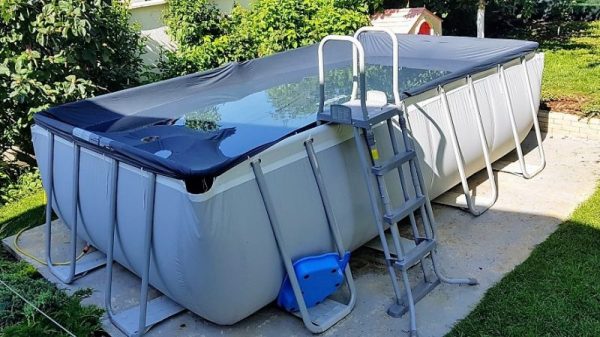
Preferences vary, of course, but [Martin Harizanov] and his family clearly like their swims on the warm side. With nobody using the pool when it was below 25°C (77°F), [Martin] picked up a few bits to harness the sun to warm the water. Loops of PVC lawn irrigation tubing were tossed onto a shed roof with a favorable solar aspect and connected to the pool with a length of garden hose. The black thin-wall tubing is perfect for capturing the sun’s energy, and 200 meters of the stuff can really heat things up fast. A small pump is controlled by a microcontroller — it’s not explicitly stated but we suspect it’s a Raspberry Pi — with a pair of temperature sensors to sample the water in the pool and in the heating loop. Metrics are gathered and logged by Emoncms, an open source energy monitoring app. [Martin] says he’s harvesting about 10 kW from the sun on a good day, and that the pool water in the heating loop has gotten up to a steamy 55°C (131°F) without any other energy inputs other than the pump.

Plenty of others have made the leap to solar for pool season extension, with designs from the simple to the more complex. And if you live where the sun doesn’t shine, there’s always a compost water heater.

Ultra-Low Power, Energy Harvesting Battery Charger

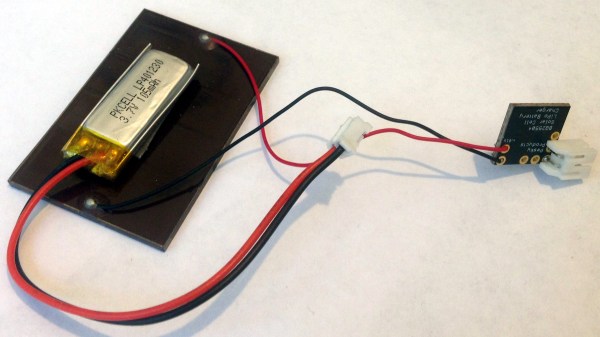
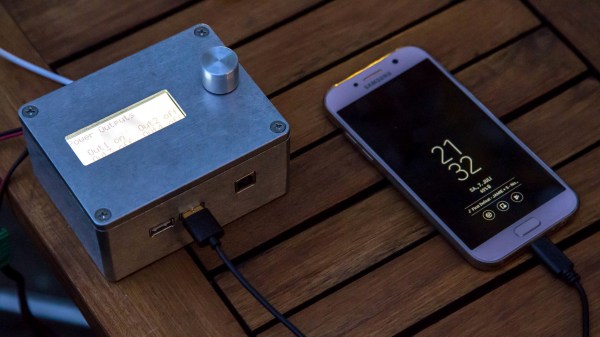
This half-inch square ultra-low power energy harvesting LiPo cell charger by [Kris Winer] uses a low voltage solar panel to top up a small lithium-polymer cell, which together can be used as the sole power source for projects. It’s handy enough that [Kris] uses them for his own projects and offers them for sale to fellow hackers. It’s also his entry into the Power Harvesting Challenge of the Hackaday Prize.

The board is essentially a breakout board for the Texas Instrument BQ25504, configured to charge and maintain a single lithium-polymer cell. The BQ25504 is an integrated part that takes care of most of the heavy lifting and has nifty features like battery health monitoring and undervoltage protection. [Kris] has been using the board along with a small 2.2 Volt solar panel and a 150 mAh LiPo cell to power another project of his: the SensorTile environmental data logger.

It’s a practical and useful way to test things; he says that an average of 6 hours of direct sunlight daily is just enough to keep the 1.8 mA SensorTile running indefinitely. These are small amounts of power, to be sure, but it’s free and self-sustaining which is just what a remote sensing unit needs.

Solar Pi Cluster Scours Internet For Nudes

There seems to be a universal truth on the Internet: if you open up a service to the world, eventually somebody will come in and try to mess it up. If you have a comment section, trolls will come in and fill it with pedantic complaints (so we’ve heard anyway, naturally we have no experience with such matters). If you have a service where people can upload files, then it’s a guarantee that something unsavory is eventually going to take up residence on your server.

Unfortunately, that’s exactly what [Christian Haschek] found while developing his open source image hosting platform, PictShare. He was alerted to some unsavory pictures on PictShare, and after he dealt with them he realized these could be the proverbial tip of the iceberg. But there were far too many pictures on the system to check manually. He decided to build a system that could search for NSFW images using a trained neural network.

The nude-sniffing cluster is made up of a trio of Raspberry Pi computers, each with its own Movidius neural compute stick to perform the heavy lifting. [Christian] explains how he installed the compute stick SDK and Yahoo’s open source learning module for identifying questionable images, the aptly named open_nsfw. The system can be scaled up by adding more Pis to the system, and since it’s all ARM processors and compute sticks, it’s energy efficient enough the whole system can run off a 10 watt solar panel.

After opening up the system with a public web interface where users can scan their own images, he offered his system’s services to a large image hosting provider to see what it would find. Shockingly, the system was able to find over 3,000 images that contained suspected child pornography. The appropriate authorities were notified, and [Christian] encourages anyone else looking to search their servers for this kind of content to drop him a line. Truly hacking for good.

This isn’t the first time we’ve seen Intel’s Movidius compute stick in the wild., and of course we’ve seen our fair share of Raspberry Pi clusters. From 750 node monsters down to builds which are far more show than go.

Next Weekend: Beginner Solar Workshop

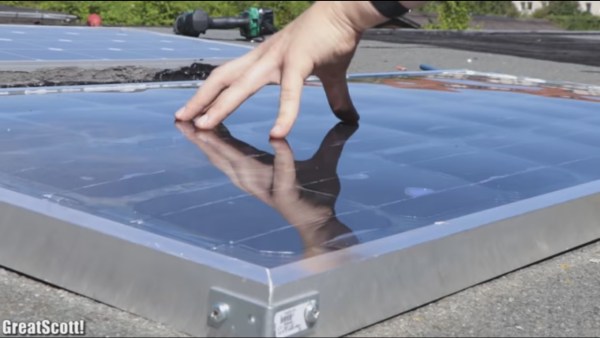
Next week, Hackaday is hosting a workshop for all you hackers ready to harness the power of the sun. We’re doing a Beginner Solar Workshop at Noisebridge in San Francisco. You’re invited to join us on July 7th, we’ll provide the soldering irons.

The instructor for this workshop will be [Matt Arcidy], avid Hackaday reader and member of Noisebridge. He’s contributed to the incredible Noisebridge Gaming Archivists Live Arcade Cabinet, given talks on electronic components for the Arduino ecosystem, and now he’s hosting a workshop on the basics of solar charging.

This workshop will cover the theory of solar charging, how solar cells convert light into electricity, when and where this technology is appropriate, and the safe handling of lithium-ion batteries. At the end of the workshop, every attendee will have built a system that captures power from the sun and charges a battery, ready to be used in any future projects.

This is a big deal. Right now, the Hackaday Prize is in the middle of its third challenge, the Power Harvesting Module Challenge. This is a big part of the prize, and already there are some fascinating projects which harvest electricity from stomach acid, and even the gravitational potential of the Earth. Of course, some of those are more practical than others, and we’re really interested to see where this Power Harvesting Challenge goes and what great projects will be created.

Battery-Powered Watering Timer Converted To Solar On The Cheap

Watering the garden or the lawn is one of those springtime chores that is way more appealing early in the season than later. As the growing season grinds along, a chore that seemed life-giving and satisfying becomes, well, just another chore, and plants often suffer for it.

Automating the watering task can be as simple as buying a little electronic timer valve that turns on the flow at the appointed times. [A1ronzo] converted his water hose timer to solar power. Most such timers are very similar, with a solenoid-operated pilot valve in line with the water supply and an electronic timer of some sort. The whole thing is quite capable of running on a pair of AA batteries, but rather than wasting money on new batteries several times a season, he slipped a LiPo pack and a charge controller into the battery case slot and connected a small solar panel to the top of the controller.

The LiPo is a nominal 3.7-volt pack, so he did a little testing to make sure the timer would be OK with the higher voltage. The solar panel sits on top of the case, and the whole thing should last for years. And bonus points for never having to replace a timer that you put away at the end of the season with batteries still in it, only to have them leak. Ask us how we know.

Like the best of hacks, this one is quick, easy and cheap — $15 in parts, aside from the timer. There are more complicated irrigation solutions, of course, one of which even won the Hackaday Prize once upon a time. But this one has us ordering parts to build our own right now.

Get Your Name On The Hottest List In The Solar System

How often does NASA name a spacecraft after a living person? How often do you get to launch your name into a star? How often does NASA send probes to explore the sun? If your answer to all these questions is NEVER, then you win the honor of adding your name to an SD card bound for the center of our solar system. We’re already on the list with [William Shatner] so we’ll see you there. Submissions for the hot list aboard the Parker Solar Probe close on April 27th, 2018 and it launches in May.

The Parker Solar probe honors living astrophysicist [Eugene Parker] who theorized a great deal about how the sun, and other stars, emit energy. His work has rightly earned him the honor of seeing his name on a sun-bound probe. We even owe the term, “solar wind” to [Parker].

To draw more attention, you can have a few bits aboard this probe dedicated to you or someone you care about by adding your name to their list. Or you can send the name of your greatest enemy into the hottest furnace for millions of miles. Your call.

Even though our sun is the most prominent heavenly body, NASA hasn’t sent a probe to explore it before. They are good about sharing their models and they really know how to write standards for workmanship.

Continue reading “Get Your Name On The Hottest List In The Solar System”

Rechargeable Robot Mows Lawns

Perhaps one day our robot overlords will look back on all of the trivial things that humans made them do and take retribution on us. Until then, though, there’s no problem having them perform all of our chores. [v.loschiavo] is also exploiting our future rulers and built a robot that mows his lawn automatically as his entry into the 2018 Hackaday Prize.

The robot uses a rechargeable battery system to drive a nylon blade for grass cutting. It also has an obstacle detection and avoidance system that allows it to find the borders of your yard and keep from getting stuck against shrubs and flower beds. And don’t worry about safety, either. There’s a built-in system of sensors that prevents any injuries from occurring. The robot also has a 10 Watt solar panel on the top that helps recharge the battery, but it can also recharge at a base station similar to a Roomba.

The whole robot was 3D printed with the exception of some parts like the cutting motor, solar panel, and gear motors. While nothing except for the pictures and a general overview of the robot has been posted to the project page yet, we hope [v.loschiavo] updates the project with the G-code files, code, and schematics so we can build our own.