DIY Ram Pump Obeys The Laws Of Physics

Despite the claims of “free energy” on the title of the video below, this is not yet another wacky perpetual motion story. We here at Hackaday fully support the laws of thermodynamics, and we think you should too. But you have to admit that a pump that works without any apparent energy inputs looks kind of shady at first glance.

The apparatus in question is a ram pump, a technology dating back all the way to the 18th century. The version that [Junkyard – Origin of Creativity] built uses commonly available materials like PVC pipes and fittings. About the only things on the BOM that might be hard to scratch up are the brass check valves, which should probably be flap valves rather than the easier to find spring valves. And the only custom part is an adapter to thread the plastic soda bottle that’s used as an air chamber to the PVC, which a 3D printer could take care of if you choose not to hack a bottle cap like [Junkyard] did. The video below shows the impressive lift achieved just by tapping the kinetic energy of the incoming flow.

There, the Second Law of Thermodynamics remains inviolate. But if you still think you can get something for nothing, check out our roundup of perpetual motion and Overunity quackery.

Continue reading “DIY Ram Pump Obeys The Laws Of Physics”

Hackaday Prize Entry: Collaborative Water Purification

Look over any description of a water treatment plant, and you’ll find a description that includes the words, ‘coagulation tanks’. What are these treatment plants coagulating? You don’t want to know. How are they doing it? With chemicals and minerals. Obviously, there’s something else that can be done.

For their Hackaday Prize entry, [Ryan], [designbybeck], [Clint], [Wanda] and [Maker Mark] are investigating electrocoagulation. It’s an alternative to a frothy brew of chemicals that uses electricity to pull pollutants out of the water.
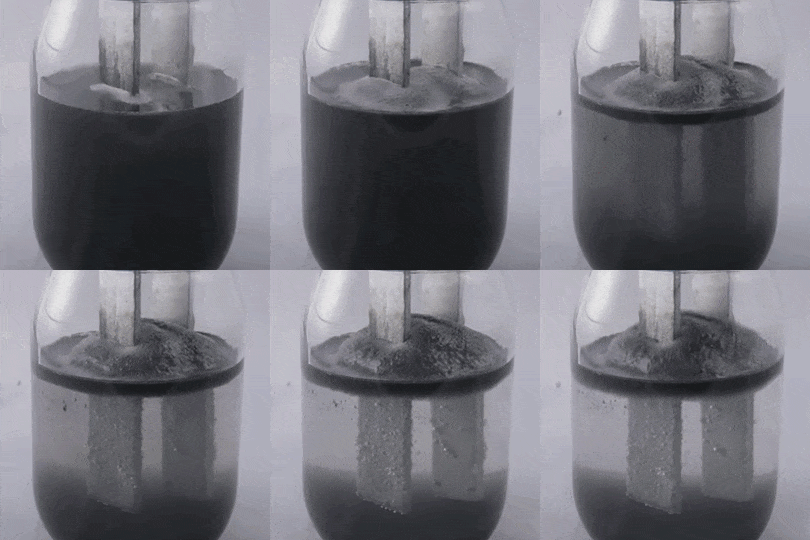
Right now, the tests are much smaller in scale than the tens of thousands of gallons you’d find at a water treatment plant. In fact, the test rig is only a 16-ounce mason jar. While this isn’t large enough to precipitate pollutants out of a household water supply, it is big enough for a proof of concept.

The team is using two electrodes for this build, one aluminum, and one iron. These electrodes are connected via alligator leads to the electronics board they’ve built. This electronics board is basically just an H-Bridge (used so they can reverse the polarity of the field emitter and prevent a buildup of gunk on the electrodes) and a few connectors to a power supply. The results are encouraging; they have a few time-lapse videos of a mason jar of dirty water clearing up with the power of electricity. It’s a great project with some great documentation. The team already has a bunch of updates on their project and instructions on how to replicate their hardware. You can check out those videos below.

Continue reading “Hackaday Prize Entry: Collaborative Water Purification”
Cordless Water Pump!

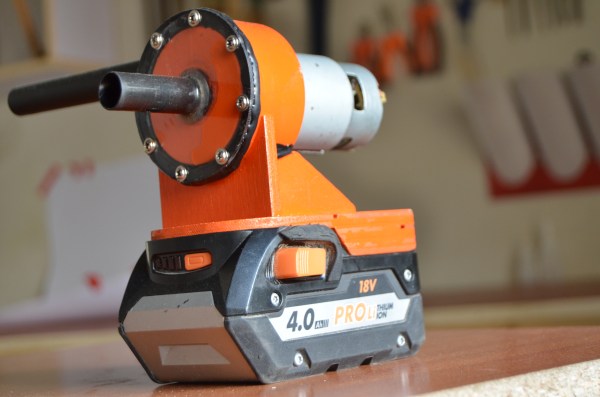
A water pump is one of those items that are uncommonly used, but invaluable when needed. Rarer still are cordless versions that can be deployed at speed. Enter [DIY King 00], who has shared his build of a cordless water pump!

The pump uses an 18 volt brushed motor and is powered by an AEG 18V LiPo battery. That’s the same battery as the rest of [DIY King]’s power tools, making it convenient to use. UPVC pipe was used for the impeller — with a pipe end cap for a housing. A window of plexiglass to view the pump in motion adds a nice touch.

A bit of woodworking resulted in the mount for the pump and battery pack, while a notch on the underside allows the battery to lock into place. Some simple alligator clips on the battery contacts and the motor connected through a switch are all one needs to get this thing running.

Continue reading “Cordless Water Pump!”

Tear Gun Transmutes Emotions Into Firepower

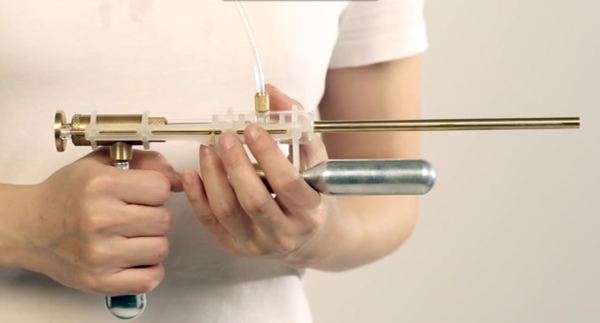
Frustration is tough to deal with. When driven to the point of tears it’s sometimes a short step to lashing out irrationally. Focus in these situations helps, channeling your frustration into something useful. [Yi-Fei Chen] has done that — quite literally — by designing a gun that fires her shed tears.

The gun’s design manifested following a strenuous midterm presentation. Her insistent tutor drove her to tears as frustration clashed with the deep cultural values of her native Taiwan which prevented her from speaking up against authority.

A silicone cup resting against her cheek collects the tears which flow into a chamber of the gun to be frozen. Removing the safety slide preps the round to be fired by the pressure plate trigger on the gun’s rear. It’s simple and it works — tutors beware.

Continue reading “Tear Gun Transmutes Emotions Into Firepower”

Detecting Water With And Without Headaches

In Texas — at least around Houston — we don’t have basements. We do, however, have bilges. Both of these are subject to taking on water when no one is paying attention. A friend of mine asked me what I thought of an Instructable that showed how to make a water sensor using a few discrete components. The circuit would probably work — it relied on the conductivity of most water to supply enough current to a bipolar transistor’s base to turn it on.

It is easy to overthink something like this, so I told my friend he should go with something a little more old-fashioned. I don’t know the origin of it, but it is older than I am. You can make a perfectly good water detector with things you probably already have around the house. My point isn’t that you should (or shouldn’t) construct a homemade water sensor. My point is that you don’t always need to go to the high-tech solution.

Continue reading “Detecting Water With And Without Headaches”

How Hot Is Your Faucet? What Color Is The Water?

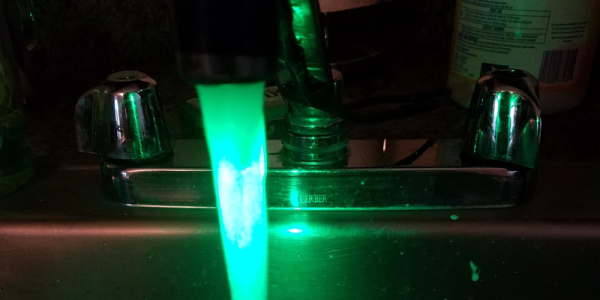
How hot is the water coming out of your tap? Knowing that the water in their apartment gets “crazy hot,” redditor [AEvans28] opted to whip up a visual water temperature display to warn them off when things get a bit spicy.

This neat little device is sequestered away inside an Altoids mint tin — an oft-used, multi-purpose case for makers. Inside sits an ATtiny85 microcontroller  — re-calibrated using an Arduino UNO to a more household temperature scale ranging from dark blue to flashing red — with additional room for a switch, while the 10k ohm NTC thermristor and RGB LED are functionally strapped to the kitchen faucet using electrical tape. The setup is responsive and clearly shows how quickly [AEvans28]’s water heats up.

Continue reading “How Hot Is Your Faucet? What Color Is The Water?”

Putting Sand, Water, And Metal Into A 3D Print

[Adam] over at Makefast Workshop writes about some of the tests they’ve been running on their 3D printer. They experimented with pausing a 3D print midway and inserting various materials into the print. In this case, sand, water, and metal BBs.

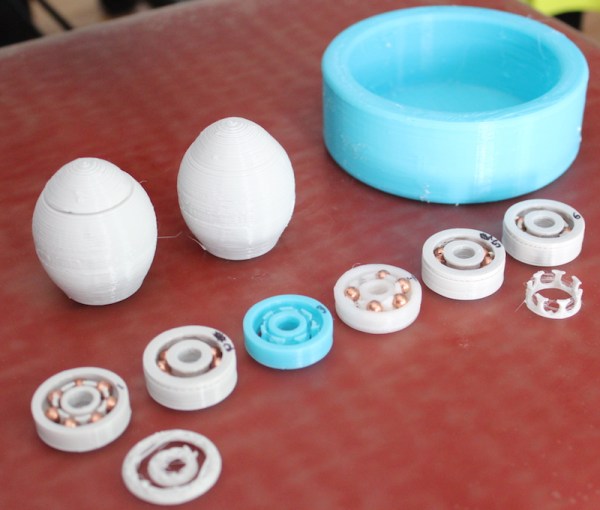
The first experiment was a mixture of salt and water used to make a can chiller for soda or beer (the blue thing in the upper right). It took some experimentation to get a print that didn’t leak and was strong. For example, if the water was too cold the print could come off the plate or delaminate. If there was too much water it would splash up while the printer was running and cause bad layer adhesion.

They used what they learned to build on their next experiment, which was filling the print with sand to give it more heft. This is actually a common manufacturing process — for instance, hollow-handled cutlery often has clay, sand, or cement for heft. They eventually found that they had to preheat the sand to get the results they wanted and managed to produce a fairly passable maraca.

The final experiment was a variation on the popular ball bearing prints. Rather than printing plastic balls they designed the print to be paused midway and then placed warmed copper BBs in the print. The printer finished its work and then they spun the BB. It worked pretty well! All in all an interesting read.