One of the driving principles of a lot of the projects we see is simplicity. Whether that’s a specific design goal or a result of having limited parts to work with, it often results in projects that are innovative solutions to problems. As far as simplicity goes, however, the latest project from [153armstrong] takes the cake. The build is able to detect lightning using a single piece of equipment that is almost guaranteed to be within a few feet of anyone reading this article.
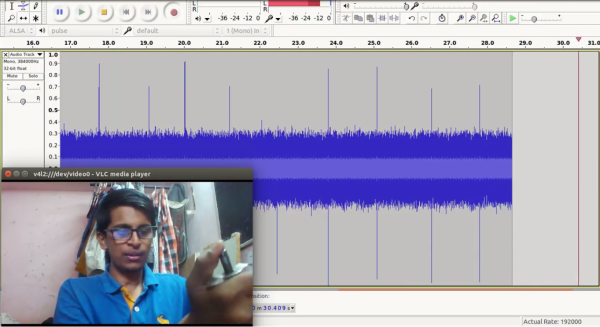
The part in question is a simple, unmodified headphone jack. Since lightning is so powerful and produces radio waves in many detectable ranges, it doesn’t take much to detecting a strike within a few kilometers. Besides the headphone jack, a computer with an audio recording program is also required to gather data. (Audio is often used as a stand-in for storing other types of data; in this case, RF information.) [153armstrong] uses a gas torch igniter as a stand-in for a lightning strike, but the RF generated is similar enough to test this proof-of-concept. The video of their tests is after the break.
Audacity is a great tool for processing audio, or for that matter any other data that you happen to be gathering using a sound card. It’s open source and fairly powerful. As far as lightning goes, however, it’s possible to dive far down the rabbit hole. Detecting lightning is one thing, but locating it requires a larger number of weather stations.
Continue reading “Detect Lightning Strikes With Audio Equipment”

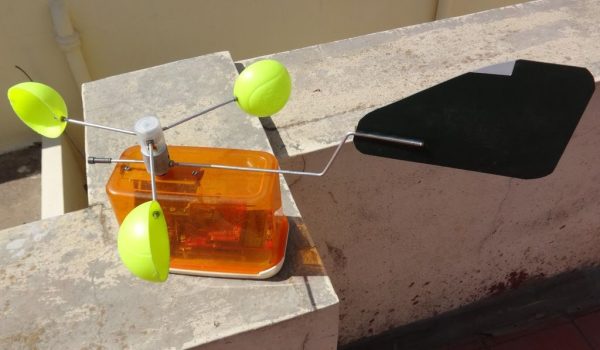
 We have to admit that when we first saw [Ajoy Raman]’s Instructables post, we figured that he used a universal motor to generate a voltage from the anemometer. But [Ajoy]’s solution to the coaxial shafts problem is far more interesting than that. A discarded universal motor donated its rotor and bearings. The windings were stripped off the assembly leaving nothing but the commutator. 1kΩ SMD resistors were soldered across adjacent commutator sections to form a series resistance of 22kΩ with taps every 1k, allowing 0 to 2.2V to be read to the ADC of a microcontroller depending on the angle of the vane.