Simple Shop-made Taps For Threading Wood

Wood can be the material of choice for many kinds of projects, but it often falls out of the running in favor of metal or plastic if it needs to take a threaded fastener. But with a little ingenuity you can make your own wood taps and cut threads that will perform great.

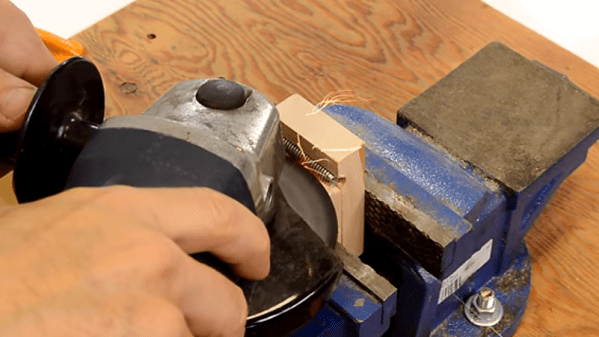
Making wood do things that wood isn’t supposed to do is [Matthias Wandel]’s thing. Hackers the world over know and use his wood gears designer to lay out gears for all kinds of projects from musical marble machines to a wooden Antikythera mechanism. Woodworkers have been threading wood for centuries , so making wood take a decent thread isn’t exactly something new. But doing it on the cheap and making the threads clean and solid has always been tricky. The video after the break shows [Matthias]’ method of cutting a tap out of an ordinary threaded rod or even off-the-shelf lag screws. He uses a simple jig to hold the blank so that flutes can be cut with an angle grinder. The taps work well in the materials he tested, and a little informal stress testing at the end of the video shows promise for long service life of the threads.

Wood threads aren’t suitable for every project, but knowing that you can do it might just open the path to a quick, easy build. This is a great tip to keep in mind.

Continue reading “Simple Shop-made Taps For Threading Wood”

Nominal Lumber Sizes Land Home Depot And Menards In Hot Water

Hard times indeed must have fallen upon the lawyers of the American mid-west, for news reaches us of a possible class-action lawsuit filed in Chicago that stretches the bounds of what people in more gainful employment might consider actionable. It seems our legal eagles have a concern over the insufficient dimensions of their wood, and this in turn has caused them to apply for a class action against Home Depot and Menards with respect to their use of so-called nominal sizing in the sale of lumber.

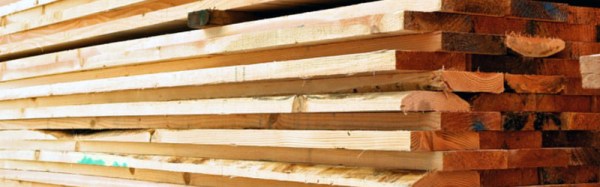
If you have ever bought commercial lumber you will no doubt understand where this is going. The sawmill takes a piece of green wood straight from the forest, and cuts it to a particular size. It is then seasoned, either left to dry out and mature in the open air or placed in a kiln to achieve the same effect at a more rapid pace. This renders it into the workable lumber you expect to use, but causes a shrinkage of the wood that since it depends on variables such as moisture can not be accurately quantified. Thus a piece of wood cut by the sawmill at 4 inches square could produce a piece of seasoned lumber somewhere near 3.5 inches square. It would thus be sold as having only a nominal size of 4 inches This has been the case as long as commercial lumber has been produced, we’d guess for something in the region of a couple of centuries, and is thus unlikely to be a surprise to anyone in the market for lumber.

So, back to the prospective lawsuit. Once the hoots of laughter from the entire lumber, building, and woodworking industries have died down, is their contention that a customer being sold a material of dimension 3.5 inches as 4 inches is being defrauded a valid one? We are not lawyers here at Hackaday, but we’d expect the long-established nature of nominal lumber sizing to present a tough obstacle to their claim, as well as the existence of other nominally sized products in the building industry such as rolled steel joists. Is it uncharitable of us to characterise the whole escapade as a frivolous fishing exercise with the sole purpose of securing cash payouts? Probably not, and we hope the judges in front of whom this is likely to land agree with us.

If you have any thoughts on this case, especially if you have a legal background, we’d love to hear from you in the comments.

Sawn lumber image: By Bureau of Land Management (Oregon_BLM_Forestry_10) [CC BY 2.0].

Summer Is Approaching. Are You Prepared To Relax?

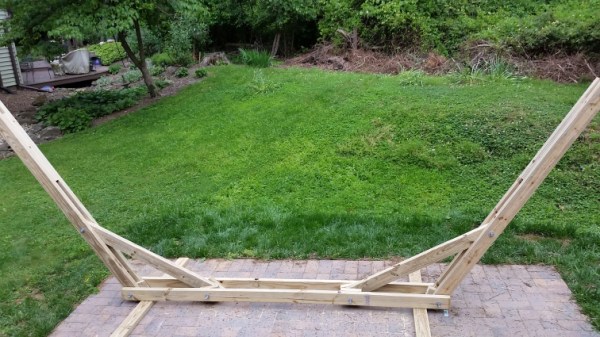
[Blake Schreurs] found himself in dire straights — there was a critical lack of available hammocks in his immediate vicinity, and he wanted one. Fast. So he built a hammock stand in half an afternoon.

Initially dismayed by the cost of store-bought models, [Schreurs]’ hammock stand is perfect for woodworking-newbies and yard-loungers on a budget alike, as the build requires only a few straight cuts and some basic tools to whip up.

After cutting and laying out the lumber to make sure that it will all fit together as intended, [Schreurs] aligned and drilled holes through the pieces — don’t worry, he’s included the measurements in his post. Playing a game of connect-the-boards-with-carriage-bolts-nuts-and-washers — with a minor pause in the action to attach the feet to the base — all but finished this quick build. All that’s missing now is a hammock in which to recline!

One final note: be sure to use galvanized hardware for this — or any — project that’s expected to spend time out in the elements. Rust is not usually your friend!

Lounging in your backyard beginning to feel a little cramped? Take you relaxation on the road.

Digital Clock Goes With The Grain

This good-looking clock appears to be made out of a block of wood with LED digits floating underneath. In reality, it is a block of PLA plastic covered with wood veneer (well, [androkavo] calls it veneer, but we think it might just be a contact paper or vinyl with a wood pattern). It makes for a striking effect, and we can think of other projects that might make use of the technique, especially since the wood surface looks much more finished than the usual 3D-printed part.

You can see a video of the clock in operation below. The clock circuit itself is nothing exceptional. Just a MAX7218 LED driver and a display along with an STM32 ARM processor. The clock has a DHT22 temperature and humidity sensor, as well as a speaker for an alarm.

Continue reading “Digital Clock Goes With The Grain”

Tiny Robot Clings To Leaves With Static Electricity

Flying is an energy-intensive activity. The birds and the bees don’t hover around incessantly like your little sister’s quadcopter. They flit to and fro, perching on branches and leaves while they plan their next move. Sure, a quadcopter can land on the ground, but then it has to spend more energy getting back to altitude. Researchers at Harvard decided to try to develop flying robots that can perch on various surfaces like insects can.

Perching on surfaces happens electrostatically. The team used an electrode patch with a foam mounting to the robot. This allows the patch to make contact with surfaces easily even if the approach is a few degrees off. This is particularly important for a tiny robot that is easily affected by even the slightest air draft. The robots were designed to be as light as possible — just 84mg — as the electrostatic force is not particularly strong.

It’s estimated that perching electrostatically for a robot of this size uses approximately 1000 times less power than during flight. This would be of great use for surveillance robots that could take up a vantage point at altitude without having to continually expend a great deal of energy to stay airborne. The abstract of the research paper notes that this method of perching was successful on wood, glass, and a leaf. It appears testing was done with tethers; it would be interesting to see if this technique would be powerful enough for a robot that carries its own power source. Makes us wonder if we ever ended up with tiny flyers that recharge from power lines?

We’re seeing more tiny flying robots every day now – the IMAV 2016 competition was a great example of the current state of the art.

Continue reading “Tiny Robot Clings To Leaves With Static Electricity”

How To Sharpen Your Woodworking Tools On A Budget

Wood may seem like a soft, weak material if you’re used to working with steel, but to do good work, you’ll quickly learn you need your tools sharp. Buying and maintaining a good set of tools can be expensive for the home gamer, so [shopbuilt] put together an Instructable on how to sharpen your woodworking tools on a budget.

The trick is to use sandpaper. It’s a good quality abrasive material and is readily available. You’ll want a selection of different grits – low grits to get started, higher grits when finishing. The reason this is cheaper is that you can get a selection of 5-10 different sandpapers for under $20. Getting even a couple of decent sharpening stones wouldn’t be possible at that price. In the long run, they’ll last longer but this is a budget option we’re talking about.

Obviously you can’t just sharpen something with sandpaper – [shopbuilt] suggests mounting the paper to the flattest surface you can find. The use of a tempered glass panel from a fridge shelf is, in our mind, an inspired choice here. 3D printer enthusiasts have been using similar techniques for heated beds for the best part of a decade now.

We love woodworking here at Hackaday, so get your feet wet with these woodworking basics for the hardware hacker.

Woodworking Basics For The Hardware Hacker

Hackaday is primarily a place for electronics hackers, but that’s not to say that we don’t see a fair number of projects where woodworking plays a key role. Magic mirror builds come to mind, as do restorations of antique radios, arcade machines built into coffee tables, and small cases for all manner of electronic and mechanical gadgets. In some of these projects, the woodworking really shines and makes the finished project pop. In others — well, let’s just say that some woodwork looks good from far, but is far from good.

Continue reading “Woodworking Basics For The Hardware Hacker”