Zork Running On 4-Bit Intel Computer

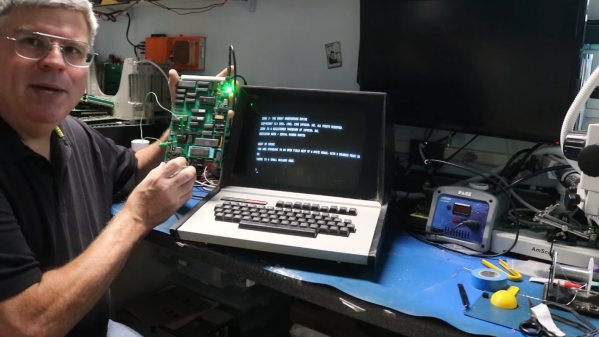
Before DOOM would run on any computing system ever produced, and indeed before it even ran on its first computer, the game that would run on any computer of the pre-DOOM era was Zork. This was a text-based adventure game first published in the late 70s that could run on a number of platforms thanks to a virtual machine that interpreted the game code. This let the programmers write a new VM for each platform rather than porting the game every time. [smbakeryt] wanted to see how far he could push this design and got the classic game running on one of the oldest computers ever produced.

The computer in question is the ubiquitous Intel 4004 processor, the first commercially available general-purpose microprocessor produced. This was a four-bit machine and predates the release of Zork by about eight years. As discussed earlier, though, the only thing needed to get Zork to run on any machine is the Z-machine for that platform, so [smbakeryt] got to work. He’s working on a Heathkit H9 terminal, and the main limitation here is the amount of RAM needed to run the game. He was able to extended the address bus to increase the available memory in hardware, but getting the Z-machine running in software took some effort as well. There’s a number of layers of software abstraction here that’s a bit surprising for 70s-era computing but which make it an extremely interesting challenge and project.

As far as [smbakeryt]’s goal of finding the “least amount of computer” that would play Zork, we’d have a hard time thinking of anything predating the 4004 that would have any reasonable user experience, but we’d always encourage others to challenge this thought and [smbakeryt]’s milestone. Similarly, DOOM has a history of running on machines far below the original recommended minimum system requirements, and one of our favorites was getting it to run on the NES.
Continue reading Zork Running On 4-Bit Intel Computer”

Microsoft Open Sources Zork I, II And III

The history of the game Zork is a long and winding one, starting with MUDs and kin on university mainframes – where students entertained themselves in between their studies – and ending with the game being ported to home computers. These being pathetically undersized compared to even a PDP-10 meant that Zork got put to the axe, producing Zork I through III. Originally distributed by Infocom, eventually the process of Microsoft gobbling up game distributors and studios alike meant that Microsoft came to hold the license to these games. Games which are now open source as explained on the Microsoft Open Source blog.

Although the source had found its way onto the Internet previously, it’s now officially distributed under the MIT license, along with accompanying developer documentation. The source code for the three games can be found on GitHub, in separate repositories for Zork I, Zork II and Zork III.

We previously covered Zork’s journey from large systems to home computers, which was helped immensely by the Z-machine platform that the game’s code was ported to. Sadly the original games’s MDL code was a bit much for 8-bit home computers. Regardless of whether you prefer the original PDP-10 or the Z-machine version on a home computer system, both versions are now open sourced, which is a marvelous thing indeed.

Walking And Talking Through The UK National Museum Of Computing

I found myself in Milton Keynes, UK, a little while ago, with a few hours to spare. What could I do but rock over to the National Museum of Computing and make a nuisance of myself? I have visited many times, but this time, I was armed with a voice recorder and a mission to talk to everybody who didn’t run away fast enough. There is so much to see and do, that what follows is a somewhat truncated whistle-stop tour to give you, the dear readers, a flavour of what other exhibits you can find once you’ve taken in the usual sights of the Colossus and the other famous early machines.

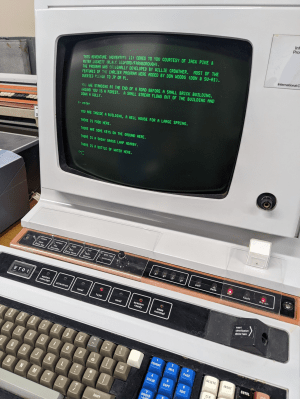
A VT01 terminal showing "the adventure" game running
Click this image to play in your browser.

We expect you’ve heard of the classic text adventure game Zork. Well before that, there was the ingeniously titled “Adventure”, which is reported to be the first ‘interactive fiction’ text adventure game. Created initially by [Will Crowther], who at the time was a keen cave explorer and D & D player, and also the guy responsible for the firmware of the original Arpanet routers, the game contains details of the cave systems of Mammoth and Flint Ridge in Kentucky.

The first version was a text-based simulation of moving around the cave system, and after a while of its release onto the fledgling internet, it was picked up and extended by [Don Woods], and the rest is history. If you want to read more, the excellent site by [Rick Adams] is a great resource that lets you play along in your browser. Just watch out for the dwarfs. (Editor’s note: “plugh“.) During my visit, I believe the software was running on the room-sized ICL2966 via a VT01 terminal, but feel free to correct me, as I can’t find any information to the contrary.

A little further around the same room as the ICL system, there is a real rarity: a Marconi TAC or Transistorised Automatic Computer. This four-cabinet minicomputer was designed in the late 1950s as a ‘fast real-time computer’, is one of only five made, and this example was initially installed at Wylfa nuclear power station in Anglesey, intended as a monitoring and alarm system controller. These two machines were spare units for the three built for the Swedish air defence system, which were no longer required. Commissioned in 1968, this TAC ran continuously until 2004, which could make it one the longest continuously running computers in the world. The TAC has 4 kwords of 20-bit core memory, a paper tape reader for program loading and a magnetic drum storage memory. Unusually, for this period, the TAC has a micro-coded CISC architecture, utilising a whole cabinet worth of diode-matrix ROM boards to code the instruction set. This enabled the TAC to have a customizable instruction set. As standard, the TAC  shipped with trigonometric and other transcendental functions as individual instructions. This strategy minimized the program size and allowed more complex programs to fit in the memory.

Continue reading “Walking And Talking Through The UK National Museum Of Computing”

Zork Zcode Interpreters Appear Out Of Nowhere

Some of our readers may know about Zork (and 1, 2, 3), the 1977 text adventure originally written for the PDP-10. The game has been public domain for a while now, but recently, the interpreters for several classic 1980s machines have also appeared on the internet.

What’s the difference? Zork is not a PDP-10 executable, it’s actually a virtual machine executable, which is in turn run by an interpreter written for the PDP-10. For example, Java compiles to Java bytecode, which runs on the Java virtual machine (but not directly on any CPU). In the same way, Zork was compiled to “Z-machine” program files, called ZIP (which was of course used in 1990 by the much more well known PKZIP). To date, the compiler, “Zilch” has not been released, but the language specification and ZIP specifications have, which has led some people to write custom ZIP compilers, though with a different input language.

For more on the VM, check out Maya’s Zork retrospective. (And dig the featured art. Subtle!)

Of course, that’s not the only type of interpreter. Some programming languages are interpreted directly from source, like this BASIC hidden in the ESP32’s ROM.

Apple Gets CP/M

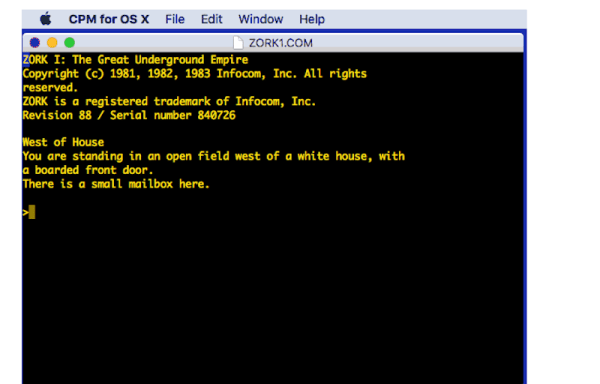
In case you wanted to run WordStar on your Mac, [Tom Harte] offers CP/M for OS/X, and it looks like it would be a lot of fun. Of course you might be happier running Zork or Turbo Pascal, and you can do that, too.

There are plenty of Z80 emulators that can run CP/M, but what we found most interesting about this one is that it is written in Objective C, a language with a deep history in the Mac and NeXT worlds.

Continue reading “Apple Gets CP/M”

Hackaday Podcast 067: Winking Out Of IoT, Seas Of LEDs, Stuffing PCBs, And Vectrex Is Awesome

Hackaday editors Mike Szczys and Elliot Williams explore the coolest hacks of the past 168 hours. The big news this week: will Wink customers pony up $5 a month to turn their lights on and off? There’s a new open source design for a pick and place machine. You may not have a Vectrex gaming console, but there’s a scratch-built board that can turn you oscilloscope into one. And you just can’t miss this LED sign technology that programs every pixel using projection mapping.

Take a look at the links below if you want to follow along, and as always, tell us what you think about this episode in the comments!

Direct download (60 MB or so.)

Continue reading “Hackaday Podcast 067: Winking Out Of IoT, Seas Of LEDs, Stuffing PCBs, And Vectrex Is Awesome”

Original Zork MDL Source Code Has Been Released

Though mostly known for its releases on countless 8-bit personal computers from the 1970s and 1980s, the game of Zork began its life on a PDP-10 mainframe. Recently, MIT released the original source code for this version of Zork. As we covered a while ago, the history of Zork is a long and lustrous one, a history that is based on this initial version written in MDL.

To recap, MDL is a LISP-derived language that excels at natural language processing. It was developed and used at MIT’s AI and LCS (now CSAIL) departments for a number of projects, and of course to develop games with. The use of MDL gave Zork as a text-based adventure a level of interaction that was far ahead of its time.

What MIT has made available is the source code from Zork as it existed around 1977, at a time when it was being distributed to universities around the US. For purely educational purposes, obviously. This means that it’s a version of Zork before it was commercialized (~1979), showing a rare glimpse of the game as it was still busily being expanded.

Running the game will take a bit of effort, however. These files were retrieved from an original MIT backup tape that was used with their PDP-10 machines. Ideally one would use a 1970s-era PDP-10 mainframe with an MDL compiler, but in a pinch one could run a PDP-10 emulator as well.

Let us know whether you got it to run. Screenshots (ASCII or not) are highly encouraged.