The Life-Changing Magic Of Buying Stuff To Hack

At the dawn of every new year, many people make resolutions of some sort. Some resolve to live a less materialistic life and trim their possessions, and in our year 2019 this school of thought has been turbocharged by Marie Kondo. Author of book The Life-Changing Magic Of Tidying Up and star of related Netflix show Tidying Up with Marie Kondo, her trend has been credited with a sharp rise in thrift store donations. To the point that some thrift stores are swamped with incoming inventory and struggling to keep up.

Hackers, this is our call to action. We can be the heroes these thrift stores need! New and exciting projects are on the shelves of our local thrift stores waiting for us. We can give a second life to something that no longer sparks joy in others. A child has abandoned their scooter? Give it some serious power. Someone’s heirloom jewel box? Nah, that’s a hard drive enclosure. Simple music instruments? Obviously it needs an Arduino twist. Innocent children’s toy? Fresh nightmare fuel. And that’s before we even get to the electronics section, featuring computers that have been gathering dust for decades and perfect for scratching a retrocomputing itch.

Of course, we recognize that some would choose to go in the other direction, to tidy up their collection of half-finished hacks. Say goodbye those that, if we were honest with ourselves, we are never going to finish. This is great, too, because the goal is to have everything in the hands of people who will appreciate them. If that should spark the next wave of joyous hacks, so much the better.
A Network Attached Radiation Monitor

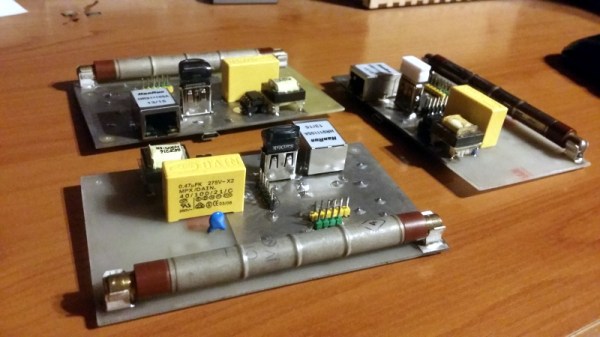
It started as a joke, as sometimes these things do. [Marek Więcek] thought building a personal radiation detector would not only give him something to work on, but it would be like having a gadget out of the Fallout games. He would check the data from time to time and have a bit of a laugh. But then things got real. When he started seeing rumors on social media that a nearby nuclear reactor had suffered some kind of radiation leak, his “joke” radiation detector suddenly became serious business.

With the realization that having his own source of detailed environmental data might not be such a bad idea after all, [Marek] has developed a more refined version of his original detector (Google Translate). This small device includes a Geiger counter as well as sensors for more mundane data points such as temperature and barometric pressure. Since it’s intended to be a stationary monitoring device, he even designed it to be directly plugged into an Ethernet network so that it can be polled over TCP/IP.

[Marek] based the design around a Soviet-era STS-5 Geiger tube, and outfitted his board with the high voltage electronics to provide it with the required 400 volts. Temperature, barometric pressure, and humidity are read with the popular Bosch BME280 sensor. If there’s no Ethernet network available, data from the sensors can be stored on either the built-in SPI flash chip or a standard USB flash drive.

The monitor is powered by a PIC32MX270F256B microcontroller with an Ethernet interface provided by the ENC28J60 chip. In practice, [Marek] has a central Raspberry Pi that’s polling the monitors over the network and collecting their data and putting it into a web-based dashboard. He’s happy with this setup, but mentions he has plans to add an LCD display to the board so the values can be read directly off of the device. He also says that a future version might add WiFi for easier deployment in remote areas.

Over the years we’ve seen a fair number of radiation monitors, from solar-powered WiFi-connected units to the incredible work [Radu Motisan] has done building his global network of radiation detectors. It seems hackers would rather not take somebody else’s word for it when it comes to the dangers of radiation.

This Light-Up Sorter Is A Bright Idea

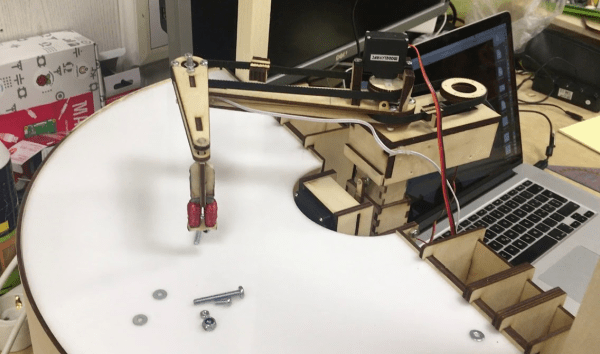
Sorting out a mountain of screws and other workbench detritus by hand is a task that only appeals to a select few of us. [AdrienR] is not one of those people. He believes the job is better suited to a robot, so he built an intelligent and good-looking machine that does just that.

[Adrien]’s sorting bot is capable of organizing a hodgepodge of parts quickly and effectively. He simply scatters the parts on the light box work surface, illuminates it, and takes a picture with a downward-facing web cam. An algorithm studies the parts and their positions using OpenCV image processing, and sends the triangulation back to the arm so it can pick and place the parts into laser cut boxes using a home brew electromagnet.

[Adrien] calls this a work in progress. He plans to control it with a Raspberry Pi so it can be a standalone unit, and will probably move the parts boxes to the outside curve. Drop yourself past the break to see it sort.

If delta robots are more your sort, this one has balls. Colored balls.

Continue reading “This Light-Up Sorter Is A Bright Idea”

Love Songs To The Microphone

A biographer of Frank Sinatra once commented that for singers like Sinatra, their instrument is the microphone. We tend to think of microphones as ideal transducers, picking up sound faithfully. But like most electronic components, microphones are imperfect. They have a varying frequency response. They pick up popping noises when we say words like “popcorn” that are normally lost to someone listening live.

[Cheddar] has an interesting video (see below) that covers how performers like Sinatra, Bing Crosby, and Billie Holiday learned to use the microphone to their advantage. They suggest that the microphone changed the way humans sing, and they are right.

Continue reading “Love Songs To The Microphone”

Freeform Wire Frame Tulip Blooms To The Touch

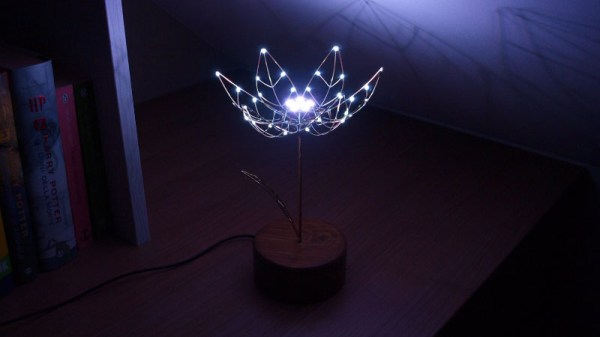
Holidays are always good for setting a deadline for finishing fun projects, and every Valentine’s Day we see projects delivering special one-of-a-kind gifts. Why buy a perishable bulk-grown biological commodity shipped with a large carbon footprint when we can build something special of our own? [Jiří Praus] certainly seemed to think so, his wife will receive a circuit sculpture tulip that blooms when she touches it.

via @jipraus

This project drew from [Jiří]’s experience with aesthetic LED projects. His Arduino-powered snowflake, with LEDs mounted on a custom PCB, is a product available on Tindie. For our recent circuit sculpture contest, his entry is a wire frame variant on his snowflake. This tulip has 7 Adafruit NeoPixel in the center and 30 white SMD LEDs in the petals, which look great. But with the addition of mechanical articulation, this project has raised the bar for all that follow.

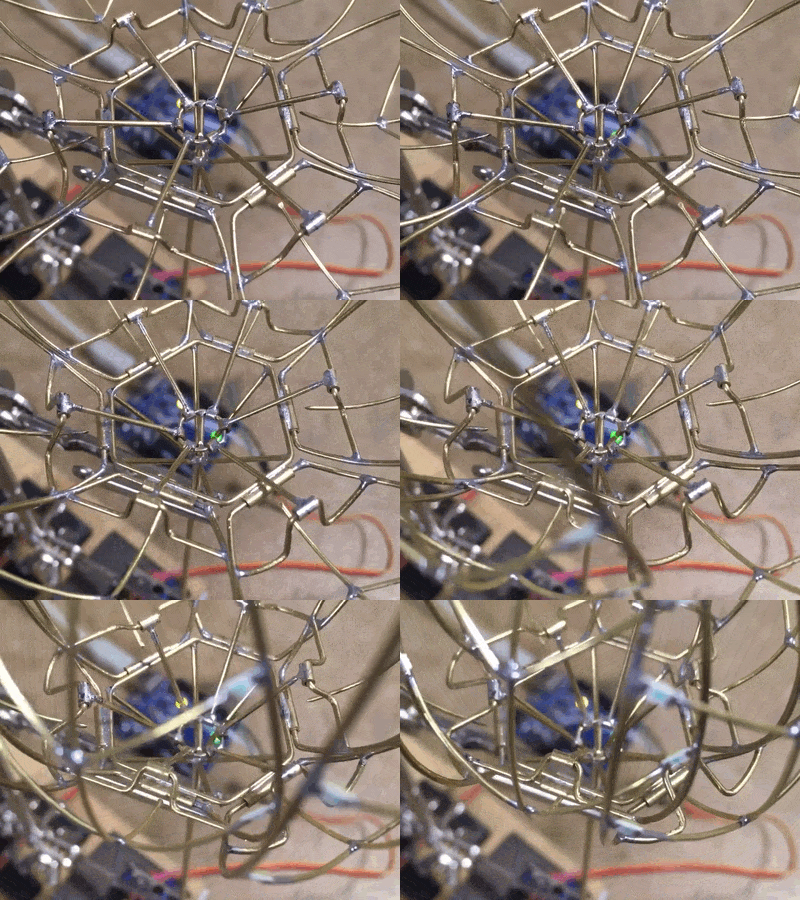
We hope [Jiří] will add more details for this project to his Hackaday.io profile. In the meantime, look over his recent Tweets for more details on how this mechanical tulip works. We could see pictures and short videos of details like the wire-and-tube mechanism that allowed all the petals to be actuated by a single servo, and the components that are tidily packaged inside that wooden base.

Need more digital expressions of love? We have no shortage of hearts. Animated LED hearts, illuminated acrylic hearts, and talking hearts. We’re a little short on flower projects, but we do have X-ray of a rose among others to accompany [Jiří]’s tulip.

Continue reading “Freeform Wire Frame Tulip Blooms To The Touch”

Every Digital Clock Is Made Of Analog Components

In 2008, an art studio out of Stockholm released the ClockClock, a digital clock with an analog heart. The ClockClock used 24 individual analog clocks — hour and minute hands and all — to display time digitally. The world went crazy, Pinterest blew up, and everyone wanted a digital analog clock until the next interesting project distracted the masses.

This was ten years ago, and for a project that’s neck deep in stepper motors, timekeeping, and 3D printed parts, we haven’t seen a DIY project that puts these tools together to build a clone of the ClockClock. Until now, that is. [Wojtek] was inspired by the ClockClock and decided to make his own.

For the plastic bits, each of the 24 analog clocks are printed out of PLA. So far, it’s exactly what we would expect. The trick to the ClockClock is moving the hour and minute hand of each analog clock independently. This is done with a double shaft — just like a real clock — and two stepper motors. Each of the stepper motors are controlled by a single PCB in each analog clock with two 360° stepper drivers, a dual motor driver, and an ATMega328pb microcontroller. As a group, the individual analog clocks are controlled over I2C, with a single ‘satellite’ board serving as the master.

While there are a few details missing from this build, specifically how to attach the hands to the stepper motors, this is an amazing project. Someone finally built a ClockClock, and it didn’t cost thousands of dollars as the original did. You can check out some videos of the Analog/Digital clock below.

Continue reading “Every Digital Clock Is Made Of Analog Components”

Toilet Seat Could Save Your Ass

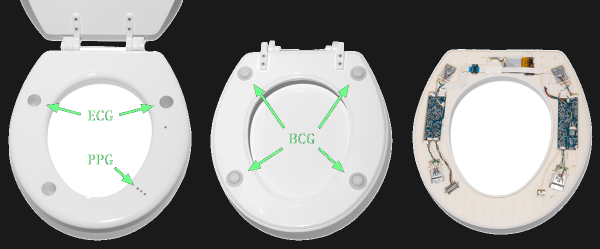
Our morning routine could be appended to something like “breakfast, stretching, sit on a medical examiner, shower, then commute.” If we are speaking seriously, we don’t always get to our morning stretches, but a quick medical exam could be on the morning agenda. We would wager that a portion of our readers are poised for that exam as they read this article. The examiner could come in the form of a toilet seat. This IoT throne is the next device you didn’t know you needed because it can take measurements to detect signs of heart failure every time you take a load off.

Tracking heart failure is not just one test, it is a buttload of tests. Continuous monitoring is difficult although tools exist for each test. It is unreasonable to expect all the at-risk people to sit at a blood pressure machine, inside a ballistocardiograph, with an oximeter on their fingers three times per day. Getting people to browse Hackaday on their phones after lunch is less of a struggle. When the robots overthrow us, this will definitely be held against us.

We are not sure if this particular hardware will be open-source, probably not, but there is a lesson here about putting sensors where people will use them. Despite the low rank on the glamorous scale, from a UX point of view, it is ingenious. How can we flush out our own projects to make them usable? After all, if you build a badass morning alarm, but it tries to kill you, it will need some work and if you make a gorgeous clock with the numbers all messed up…okay, we dig that particular one for different reasons.

Via IEEE Spectrum.