Whiteboard Plotter Rocks Three Colors And An Eraser

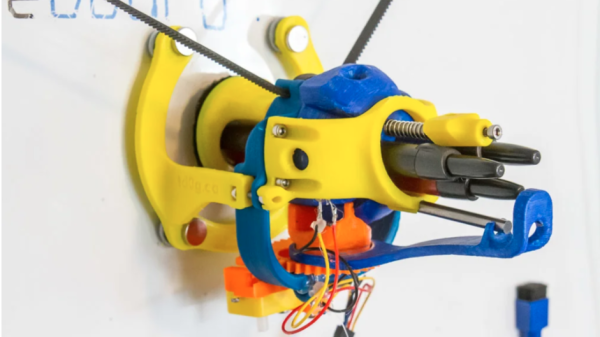
AutoWhiteboardBot’s business end, with three markers.

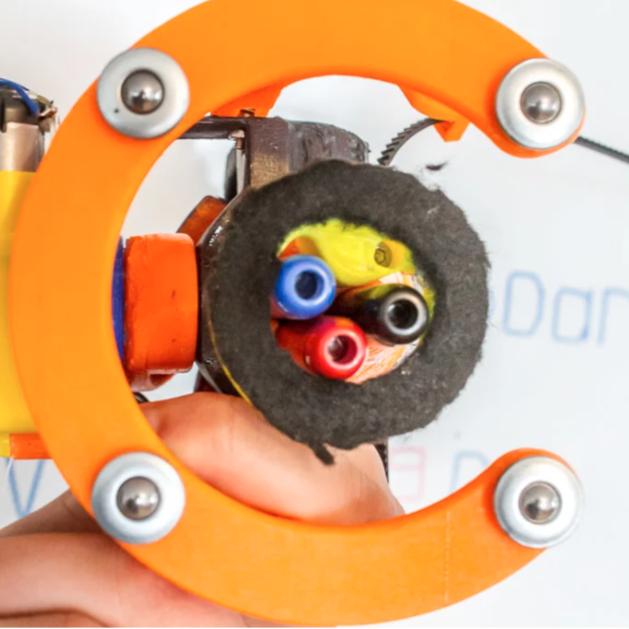
[td0g]’s AutoWhiteboardBot is not just any 3D printed whiteboard plotter, because it also sports a triple-marker carrier and on-board eraser! The device itself hangs from stepper motors, which take care of moving the plotter across the whiteboard, and the trick to making the three colors work was to incorporate retractable dry-erase markers. A spherical Geneva drive-based assembly on the plotter rotates the pen cartridge, and a plunger activates the chosen color. Erasing, arguably the easiest thing to do on a whiteboard, is done by a piece of felt. 3D printed parts are on Thingiverse and [td0g] says software is coming soon. It’s a clever device, especially the method of accommodating multiple colors with retractable markers.

AutoWhiteboardBot hangs from motors which pull it around, but we’ve also seen a SCARA-type robot writing away on a whiteboard. Watch the video embedded below, which begins with sped-up footage of AutoWhiteboardBot drawing in different colors as it slides across the board surface.

Continue reading “Whiteboard Plotter Rocks Three Colors And An Eraser”

Jumbo LED Matrix Brings Classic Sprites To Life

Despite all the incredible advancements made in video game technology over the last few decades, the 8-bit classics never seem to go out of style. Even if you weren’t old enough to experience these games when they were new, it’s impossible not to be impressed by what the early video game pioneers were able to do with such meager hardware. They’re a reminder of what can be accomplished with dedication and technical mastery.

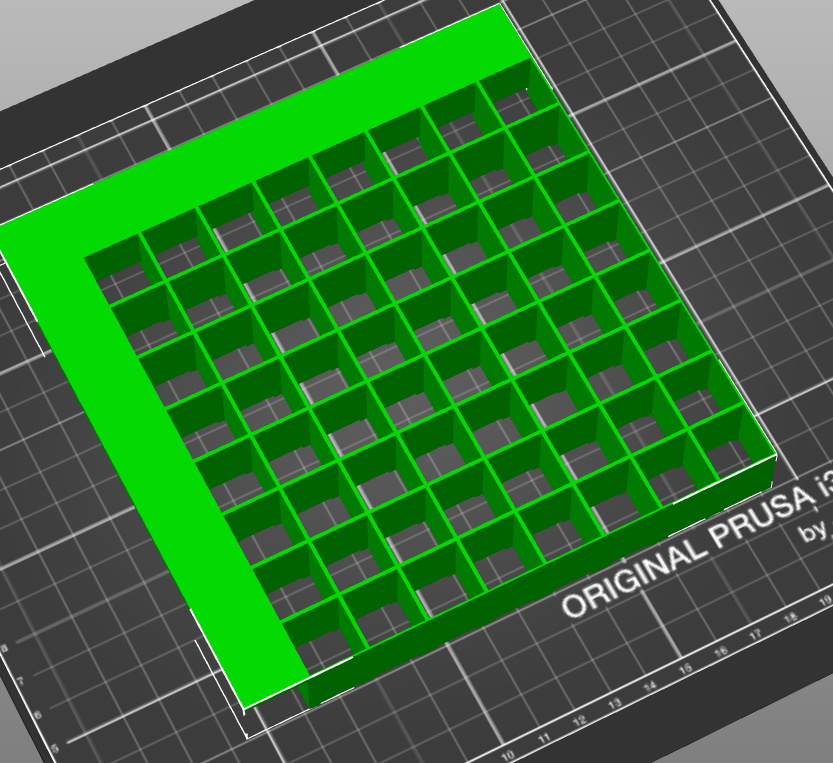
The grid has been split up for easier printing.

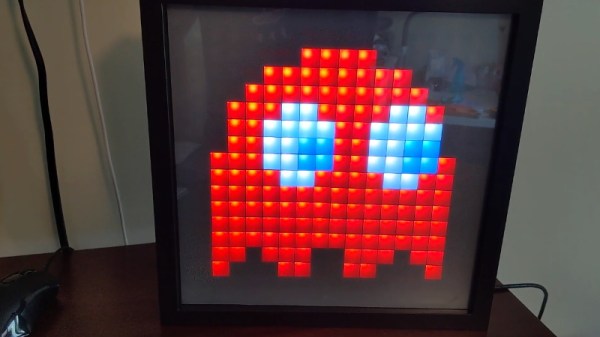
If you’d like to put a little retro inspiration on your desk, take a look at this fantastic 16 x 16 LED matrix put together by [Josh Gerdes]. While it’s obviously not the only thing you could use it for, the display certainly seems particularly adept at showing old school video game sprites in all their pixelated glory. There’s something about the internal 3D printed grid that gives the sprites a three dimensional look, while the diffused glow reminds us of nights spent hunched over a flickering CRT.

The best part might be how easy it is to put one of these together for yourself. You’ve probably got most of what you need in the parts bin; essentially it’s just a WS2812B strip long enough to liberate 256 LEDs from and a microcontroller to drive them. [Josh] used an Arduino Nano, but anything compatible with the FastLED library would be a drop-in replacement. You’ll also need a 3D printer to run off the grid, and something to put the whole thing into. The 12×12 shadowbox used here looks great, but we imagine clever folks such as yourselves could make do with whatever might be laying around if you can’t nip off to the arts and crafts store right now.

Beyond looking great, this project is a fantastic reminder of how incredibly handy WS2812 LEDs really are. Whether you’re recreating iconic game sprites or fashioning your own light-up sunglasses, it’s hard to imagine how we managed before these little wonders hit the scene.

Continue reading “Jumbo LED Matrix Brings Classic Sprites To Life”

A French Cleat Twist On Electronics Bench Organization

For some of us, our workbench is where organization goes to die. Getting ready to tackle a new project means sweeping away a pile of old projects, exposing exactly as much bench space needed to plop down the new parts. On the other end of the spectrum lie those for whom organization isn’t a means to an end, but an end itself. Their benches are spotless, ready to take on a new project at a moment’s notice.

[Eric Gunnerson]’s new French-cleat electronics bench is somewhere in between those two extremes, although nowhere near as over-organized as the woodworking organizer that inspired it. If you’ve never heard of a French cleat, Google around a bit and you’ll see some amazing shops where the system of wall-mounted, mitered cleats with mating parts on everything from shelves to cabinets are put to great use. A properly built French cleat can support tremendous loads; [Eric]’s system is scaled down a bit in deference to the lighter loads typically found in the electronics shop. His cleats are 2″ x 3″ pieces of pine, attached to a sheet of plywood that was then screwed to the wall. His first pass at fixtures for the cleats used a Shaper Origin CNC router, but when that proved to be slow he turned to laser-cut plywood. The summary video below shows a few of the fixtures he’s come up with so far; we particularly like the oscilloscope caddy, and the cable hangers are a neat trick too.

What we like about this is the flexibility it offers, since you can change things around as workflows develop or new instruments get added. Chalk one up for [Eric] for organization without overcomplication.

Continue reading “A French Cleat Twist On Electronics Bench Organization”

Old School Rotary Tools That Weren’t Made By Dremel

Albert Dremel developed the now famous rotary tool and started the company in 1932 to make blade sharpeners. It would be 1935 before the company produced the Moto-Tool which is mostly recognizable as an ancestor of the modern Dremel.

Dremel achieved such dominance that today the name is synonymous with rotary tools in the same way Xerox means photocopy and Crock-Pot is any slow cooker. Sure, there are knock offs you can get from the usual cheap tool outlets, but generally, people reach for a Dremel even when it isn’t really one. Today that tool might really be a Black and Decker or a Dewalt or even a cheap brand like Wen or Chicago Electric. But in the first half of the 20th century, you might have reached for a Handee.

A Whole Shop Full of Tools

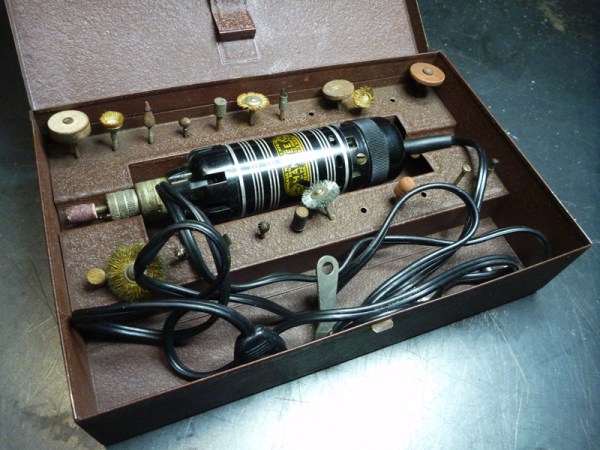
The Handee was a product of the Chicago Wheel and Manufacturing Company who, in 1937, billed it as “a whole shop full of tools in one,” as you can see in this ad. While $10.75 might sound like a price for a Harbor Freight cheapie tool, adjusted for inflation that’s around $200 in 2020 money. At least for that price you got three free accessories out of the over 200 available.

I didn’t remember the Handee and I wanted to see if I could figure out what happened to it and the company who made it. After all, with the Internet at your disposal, how hard could it be? Turns out, I did learn a lot, but in the end, tracing down a company like this from the old days isn’t always as easy as you might think.

Continue reading “Old School Rotary Tools That Weren’t Made By Dremel”

Animatronics Hack Chat

Join us on Wednesday, May 20 at noon Pacific for the Animatronics  Hack Chat with Will Cogley!

While robots have only a made a comparatively recent appearance on the technology timeline, people have been building mechanical simulations of living organisms for a long time indeed. For proof, one needs only to look back at the automatons built by clever craftsmen to amuse and delight their kings and queens. The clockwork mechanisms that powered fanciful birds and animals gave way to the sophisticated dolls and mannequins that could perform complex tasks like writing and performing music, all with the goal of creating something that looked and acted like it was alive.

Once the age of electronics came around, the springs that drove the early automatons and the cams that programmed their actions were replaced by motors and control circuits. New materials made once-clunky mechanisms finer and more precise, sensors and servos made movements more lifelike, and the age of animatronics was born.

Animatronics have since become a huge business, mostly in the entertainment industry. From robotic presidents to anachronistic dinosaurs to singing rodents designed to sell pizza, animatronics have been alternately entertaining and terrifying us for decades. The fact that they’re not “real” robots doesn’t make the melding of mechanical, electrical, and computer systems into a convincing representation of a real being any less challenging. Will Cogley has more than a few amazing animatronic designs under his belt, some of which we’ve featured on Hackaday. From hearts to hands to slightly terrifying mouths, Will puts a ton of work into his mechanisms, and he’ll stop by the Hack Chat to tell us all about designing and building animatronics.

join-hack-chatOur Hack Chats are live community events in the Hackaday.io Hack Chat group messaging. This week we’ll be sitting down on Wednesday, May 20 at 12:00 PM Pacific time. If time zones have got you down, we have a handy time zone converter.

Click that speech bubble to the right, and you’ll be taken directly to the Hack Chat group on Hackaday.io. You don’t have to wait until Wednesday; join whenever you want and you can see what the community is talking about.

Continue reading “Animatronics Hack Chat”

Take A 3D Printed Brushless Motor Demo For A Spin

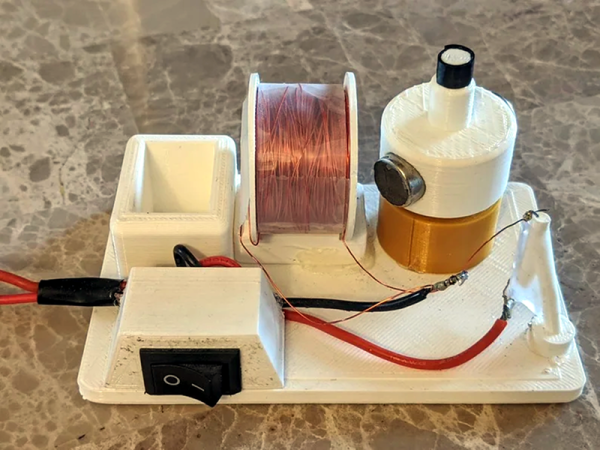
It used to be a staple of junior high physics class to build some sort of motor with paperclips or wire. A coil creates a magnetic field that makes the rotor move. In the process of moving, brushes that connect the coil to the rest of the circuit will reverse its polarity and change the magnetic field to keep the rotor turning. However, brushless motors work differently. The change in magnetic field comes from the drive controller, not from brushes. If you want to build that model, [Rishit] has you covered. You can see his 3D printed model brushless motor running in the video below.

Usually, you have a microcontroller determining how to drive the electromagnets. However, this model is simpler than that. There are two permanent magnets mounted to the shaft. One magnet closes a reed switch to energize the coil and the other magnet is in position for the coil to attract it, breaking the current. As the shaft turns, eventually the second magnet will trip the reed switch, and the coil will attract the first magnet. This process repeats over and over.

Continue reading “Take A 3D Printed Brushless Motor Demo For A Spin”

Plasma “Ghosts” May Help Keep Future Aircraft Safe

Air-to-air combat or “dogfighting” was once a very personal affair. Pilots of the First and Second World War had to get so close to land a hit with their guns that it wasn’t uncommon for altercations to end in a mid-air collision. But by the 1960s, guided missile technology had advanced to the point that a fighter could lock onto an enemy aircraft and fire before the target even came into visual range. The skill and experience of a pilot was no longer enough to guarantee the outcome of an engagement, and a new arms race was born.

An F-15 launching flare countermeasures.

Naturally, the move to guided weapons triggered the development of defensive countermeasures that could confuse them. If the missile is guided by radar, the target aircraft can eject a cloud of metallic strips known as chaff to overwhelm its targeting system. Heat-seeking missiles can be thrown off with a flare that burns hotter than the aircraft’s engine exhaust. Both techniques are simple, reliable, and have remained effective after more than a half-century of guided missile development.

But they aren’t perfect. The biggest problem is that both chaff and flares are a finite resource: once the aircraft has expended its stock, it’s left defenseless. They also only work for a limited amount of time, which makes timing their deployment absolutely critical. Automated dispensers can help ensure that the countermeasures are used as efficiently as possible, but sustained enemy fire could still deplete the aircraft’s defensive systems if given enough time.

In an effort to develop the ultimate in defensive countermeasures, the United States Navy has been working on a system that can project decoy aircraft in mid-air. Referred to as “Ghosts” in the recently published patent, several of these phantom aircraft could be generated for as long as the system has electrical power. History tells us that the proliferation of this technology will inevitably lead to the development of an even more sensitive guided missile, but in the meantime, it could give American aircraft a considerable advantage in any potential air-to-air engagements.

Continue reading “Plasma “Ghosts” May Help Keep Future Aircraft Safe”