Into The Belly Of The Beast With Placemon

No, no, at first we thought it was a Pokemon too, but Placemon monitors your place, your home, your domicile. Instead of a purpose-built device, like a CO detector or a burglar alarm, this is a generalized monitor that streams data to a central processor where machine learning algorithms notify you if something is awry. In a way, it is like a guard dog who texts you if your place is unusually cold, on fire, unlawfully occupied, or underwater.

[anfractuosity] is trying to make a hacker-friendly version based on inspiration from a scientific paper about general-purpose sensing, which will have less expensive components but will lose accuracy. For example, the article suggests thermopile arrays, like low-resolution heat-vision, but Placemon will have a thermometer, which seems like a prudent starting place.

The PCB is ready to start collecting sound, temperature, humidity, barometric pressure, illumination, and passive IR then report that telemetry via an onboard ESP32 using Wifi. A box utilizing Tensorflow receives the data from any number of locations and is training to recognize a few everyday household events’ sensor signatures. Training starts with events that are easy to repeat, like kitchen sounds and appliance operations. From there, [anfractuosity] hopes that he will be versed enough to teach it new sounds, so if a pet gets added to the mix, it doesn’t assume there is an avalanche every time Fluffy needs to go to the bathroom.

We have another outstanding example of sensing household events without directly interfacing with an appliance, and bringing a sensor suite to your car might be up your alley.


Underwater Datacenter Proves To Be A Success

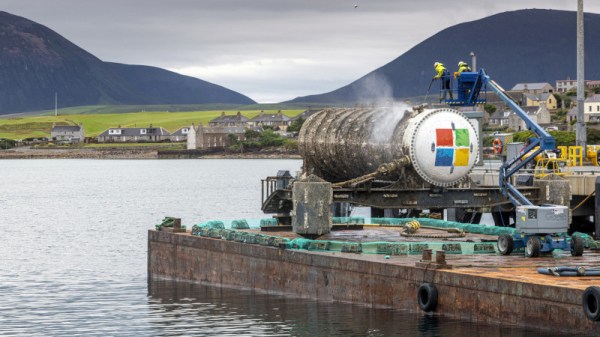
Back in 2018, Microsoft began Project Natick, deploying a custom-designed data center to the sea floor off the coast of Scotland. Aiming to determine whether the underwater environment would bring benefits to energy efficiency, reliability, and performance, the project was spawned during ThinkWeek in 2014, an event designed to share and explore unconventional ideas.

This week, Microsoft reported that the project had been a success. The Northern Isles data center was recently lifted from the ocean floor in a day-long operation, and teams swooped in to analyse the hardware, and the results coming out of the project are surprisingly impressive.

Continue reading “Underwater Datacenter Proves To Be A Success”

We’re Hiring: Come Join Us!

You wake up in the morning, and check Hackaday over breakfast. Then it’s off to work or school, where you’ve already had to explain the Jolly Wrencher to your shoulder-surfing colleagues. And then to a hackspace or back to your home lab, stopping by the skull-and-cross-wrenches while commuting, naturally. You don’t bleed red, but rather #F3BF10. It’s time we talked.

The Hackaday writing crew goes to great lengths to cover all that is interesting to engineers and enthusiasts. We find ourselves stretched a bit thin and it’s time to ask for help. Want to lend a hand while making some extra dough to plow back into your projects? We’re looking for contributors to write a few articles per week and keep the Hackaday flame burning.

Contributors are hired as private contractors and paid for each article. You should have the technical expertise to understand the projects you write about, and a passion for the wide range of topics we feature. You’ll have access to the Hackaday Tips Line, and we count on your judgement to help us find the juicy nuggets that you’d want to share with your hacker friends.

If you’re interested, please email our jobs line (jobs at hackaday dot com) and include:

  • One example article written in the voice of Hackaday. Include a banner image, at least 150 words, the link to the project, and any in-links to related and relevant Hackaday features. We need to know that you can write.
  • Details about your background (education, employment, interests) that make you a valuable addition to the team. What do you like, and what do you do?
  • Links to your blog/project posts/etc. that have been published on the Internet, if any.

What are you waiting for? Ladies and Gentlemen, start your applications!

Commodore 64 Mini Man Makes Matching Mini Monitor

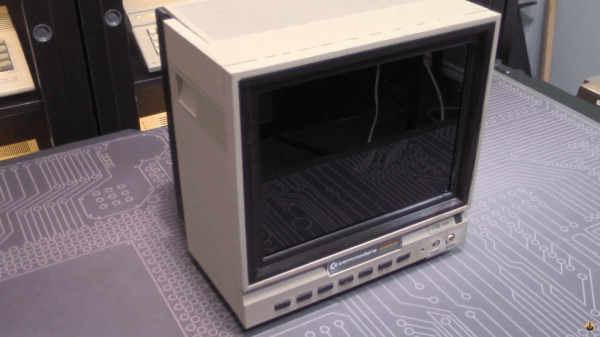
While putting together a retro computer is a great project and can teach a lot about the inner workings of electronics, hooking that 70s- or 80s-era machine up to a modern 144 Hz 1440p display tends to be a little bit anticlimactic. To really recreate the true 8-bit experience it’s important to get a CRT display of some sort, but those are in short supply now as most are in a landfill somewhere now. [Tony] decided to create a hybrid solution of sorts by 3D printing his own Commodore replica monitor for that true nostalgia feel.

This build is a matching mini scale replica of the Commodore 1702 monitor, a color monitor produced by Commodore specifically for their machines. At the time it was top-of-the-line and even included an early predecessor of the S-Video method of video signalling. This monitor was modeled in Fusion 360 and then sent to the 3D printer for assembly, then populated with a screen with a period-correct 4:3 aspect ratio, required electronics for handling the Commodore’s video signal, and even includes an upgrade over the original monitor: stereo speakers instead of the single-channel speaker that was featured in the 80s.

While this monitor doesn’t use a CRT, it’s an impressive replica nonetheless, right down to the Commodore serial number sticker on the back. If you need a Commodore 64 to go along with it, there are plenty of possibilities available to consider like this emulated C64 on a Raspberry Pi or these refurbished OEM Commodores.

Continue reading “Commodore 64 Mini Man Makes Matching Mini Monitor”

Targeting Rivers To Keep Plastic Pollution Out Of The Ocean

Since the widespread manufacture of plastics began in earnest in the early 1950s, plastic pollution in the environment has become a major global problem. Nowhere is this more evident than the Great Pacific Garbage Patch. A large ocean gyre that has become a swirling vortex full of slowly decaying plastic trash, it has become a primary target for ocean cleanup campaigns in recent years.

However, plastic just doesn’t magically appear in the middle of the ocean by magic. The vast majority of plastic in the ocean first passes through river systems around the globe. Thanks to new research, efforts are now beginning to turn to tackling the issue of plastic pollution before it gets out to the broader ocean, where it can be even harder to clean up.
Continue reading “Targeting Rivers To Keep Plastic Pollution Out Of The Ocean”

Cyberplotter Uses Multiple Tools To Great Success

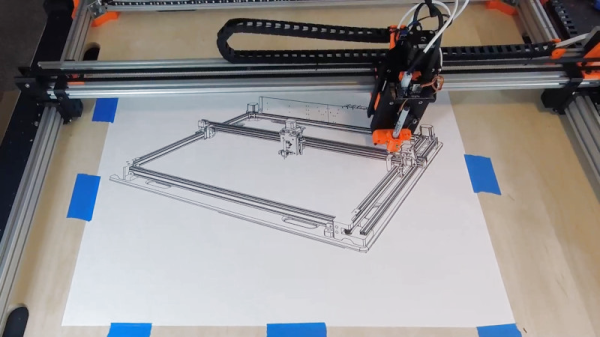
The CNC bug is a familiar ailment in these parts. Often, patients present with persistent obsession with computer controlled machinery, most commonly after initial contact with gateway hardware such as 3D printers or basic plotters. Once diagnosed, there is no cure – simply the desire to build, and build again. [Adam Haile] knows this all too well, and built the Cyberplotter in service to the affliction. 

The Cyberplotter is the culmination of [Adam]’s CNC wishlist – a two-axis build with a seriously large build area, and the capability to mount a whole bunch of different tools for different jobs. With a work area of up to 800mm x 750mm depending on what’s mounted, it can produce some seriously big output. With a Smoothieboard 5X running the show, [Adam] does all kinds of neat hacks to make the system play with different gadgets on the business end. There’s a laser for engraving, and a top-notch pen plotter featuring a high-quality linear rail for precise movement. But the fun doesn’t stop there – [Adam] goes so far as mounting a Z-axis, camera, and even a Sharpie-based airbrush which we’d never even contemplated before.

It’s not [Adam]’s first build, and past experience shines through here – armed with prior knowledge, the build does many things well without compromising on outright capability. You may find [Adam]’s name familiar – we’ve featured his Engravinator on these pages before. Video after the break.

Continue reading “Cyberplotter Uses Multiple Tools To Great Success”

Roll Your Own Heelys

Remember Heelys, the shoes with wheels in the heels? Just lift up your toes, and away you go. We were at least ten or fifteen years older than the target demographic, but got a pair anyway just to please our inner child and have some fun. Young kids would wear them everywhere and zip around inside stores to the annoyance of everyone but other young kids. We imagine some shopkeepers got to the point where they could spot the things as they walked in the door and nipped the skating party in the bud.

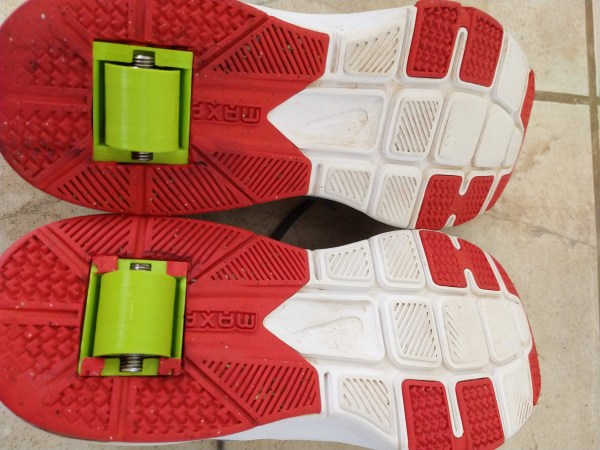
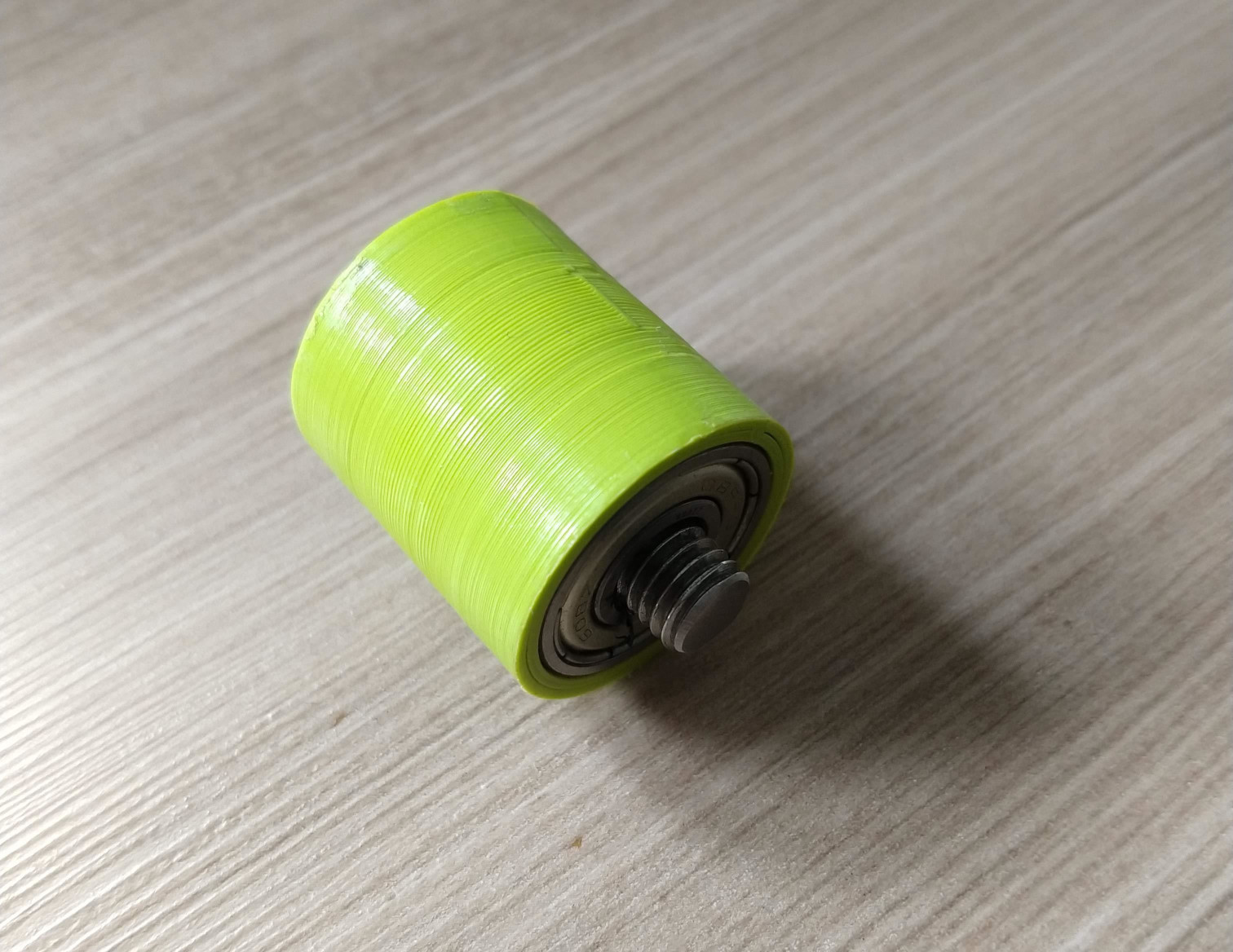
[DevNerd] has conceived of the ultimate plan: if you make your own Heelys, no one necessarily has to know unless you start rolling around. [DevNerd] started by cutting some large, 20mm-deep holes in the bottoms of a pair of Air Jordans and printed a sturdy wheel and a box frame for support.

Each wheel has a bearing on both ends that spin on a threaded rod. We’re not sure why [DevNerd] went with threaded rod, because it seems like that would prematurely wear out the frame box.

Don’t want to cut up your shoes, but want some sweet roller kicks for the daily commute down the hall? You could always make them out of pallet wood.