Hackaday Links Column Banner

Hackaday Links: July 31, 2022

Don’t look up! As of the time of this writing, there’s a decent chance that a Chinese Long March 5B booster has already completed its uncontrolled return to Earth, hopefully safely. The reentry prediction was continually tweaked over the last week or so, until the consensus closed in on 30 Jul 2022 at 17:08 UTC, give or take an hour either way. That two-hour window makes for a LOT of uncertainty about where the 25-ton piece of space debris will end up. Given the last prediction by The Aerospace Corporation, the likely surface paths cover a lot of open ocean, with only parts of Mexico and South America potentially in the crosshairs, along with parts of Indonesia. It’s expected that most of the material in the massive booster will burn up in the atmosphere, but with the size of the thing, even 20% making it to the ground could be catastrophic, as it nearly was in 2020.

[Update: US Space Command confirms that the booster splashed down in the Indian Ocean region at 16:45 UTC. No word yet on how much debris survived, or if any populated areas were impacted.]

Good news, everyone — thanks to 3D printing, we now know the maximum height of a dive into water that the average human can perform without injury. And it’s surprisingly small — 8 meters for head first, 12 meters if you break the water with your hands first, and 15 meters feet first. Bear in mind this is for the average person; the record for surviving a foot-first dive is almost 60 meters, but that was by a trained diver. Researchers from Cornell came up with these numbers by printing models of human divers in various poses, fitting them with accelerometers, and comparing the readings they got with known figures for deceleration injuries. There was no mention of the maximum survivable belly flop, but based on first-hand anecdotal experience, we’d say it’s not much more than a meter.

Humans have done a lot of spacefaring in the last sixty years or so, but almost all of it has been either in low Earth orbit or as flybys of our neighbors in the Sol system. Sure we’ve landed plenty of probes, but mostly on the Moon, Mars, and a few lucky asteroids. And Venus, which is sometimes easy to forget. We were reminded of that fact by this cool video of the 1982 Soviet landing of Venera 14, one of only a few attempts to land on our so-called sister planet. The video shows the few photographs Venera 14 managed to take before being destroyed by the heat and pressure on Venus, but the real treat is the sound recording the probe managed to make. Venera 14 captured the sounds of its own operations on the Venusian surface, including what sounds like a pneumatic drill being used to sample the regolith. It also captured, as the narrator put it, “the gentle blow of the Venusian wind” — as gentle as ultra-dense carbon dioxide hot enough to melt lead can be, anyway.
Continue reading “Hackaday Links: July 31, 2022”

Hackaday Prize 2022: An Eastern Bloc NES Clone

If Nintendo is known for anything outside of their characters and admittedly top-notch video games, it’s being merciless to fans when it comes to using their intellectual property. They take legal action against people just for showing non-Nintendo hardware emulating games of theirs, and have even attempted to shut down the competitive scene for games like Super Smash Bros. To get away from the prying eyes of the Nintendo legal team extreme measures need to be taken — like building your Nintendo console clone behind the Iron Curtain.

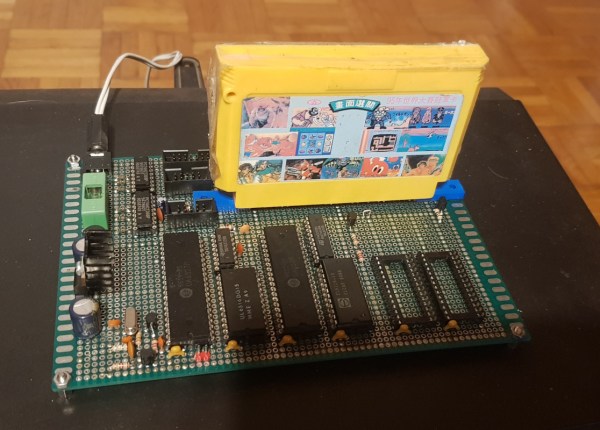
[Marek Więcek] grew up in just such a place, so the only way to play Famicom (a.k.a NES) games was to use a clone system like this one circulating in the Eastern Bloc at the time called the Pegasus which could get the job done with some tinkering. [Marek] recently came across CPU and GPU chips from this clone console and got to work building his own. Using perf board and wire he was able to test the chips and confirm they functioned properly, but had a problem with the video memory that took him a while to track down and fix.

After that, he has essentially a fully-functional Famicom that can play any cartridge around. While we hope that living in Eastern Europe still puts him far enough away to avoid getting hassled by Nintendo, we can never be too sure. Unless, of course, you use this device which lets you emulate SNES games legally.

Continue reading “Hackaday Prize 2022: An Eastern Bloc NES Clone”

Adding Perlin Noise To 3D Printed Parts, With Python

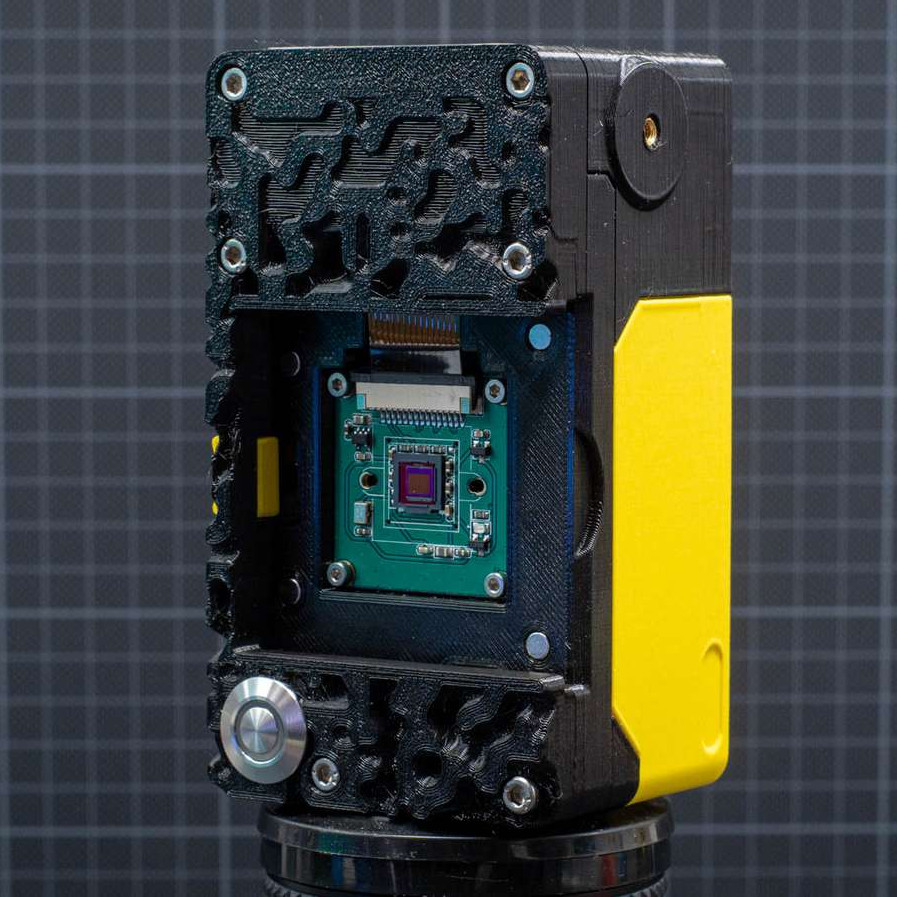
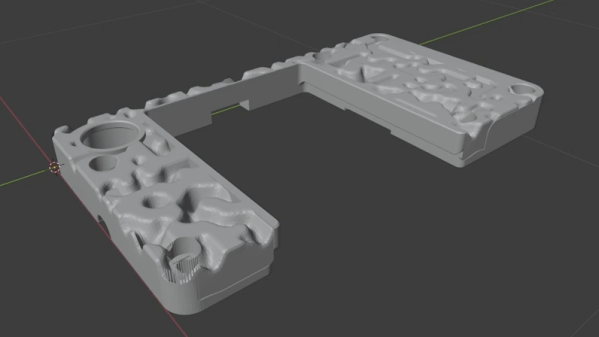
Want to add a bit of visual flair to 3D printed parts that goes maybe a little more than skin-deep? That’s exactly what [volzo] was after, which led him to create a Python script capable of generating a chunk of Perlin noise, rendered as an STL file. What does that look like? An unpredictably-random landscape of hills and valleys.

The script can give printed parts a more appealing finish.

The idea is to modify a 3D model with the results of the script, leaving one with something a bit more interesting than a boring, flat surface. [volzo] explains how to use OpenSCAD to do exactly that, but it’s also possible to import the STL file the script creates into the CAD program of one’s choice and make the modifications there with some boolean operations.

If the effect looks a bit bit familiar, it’s likely because he used the method to design part of the 3D printed “toy” camera that we featured recently.

[volzo]’s method isn’t entirely plug and play, but it could still be a handy thing to keep in your back pocket when designing your next part. There are also other ways to modify the surfaces of prints for better aesthetics; we’ve previously covered velocity painting (also known as ‘tattooing’ in some slicers) and also fuzzy skin.

Perlin noise was created by [Ken Perlin] in the early 80s while working on the original Tron movie as a way to help generate more realistic-looking textures. It still fulfills that artistic function in a variety of ways, even today.

Cool Face Mask Turns Into Over-Engineered Headache

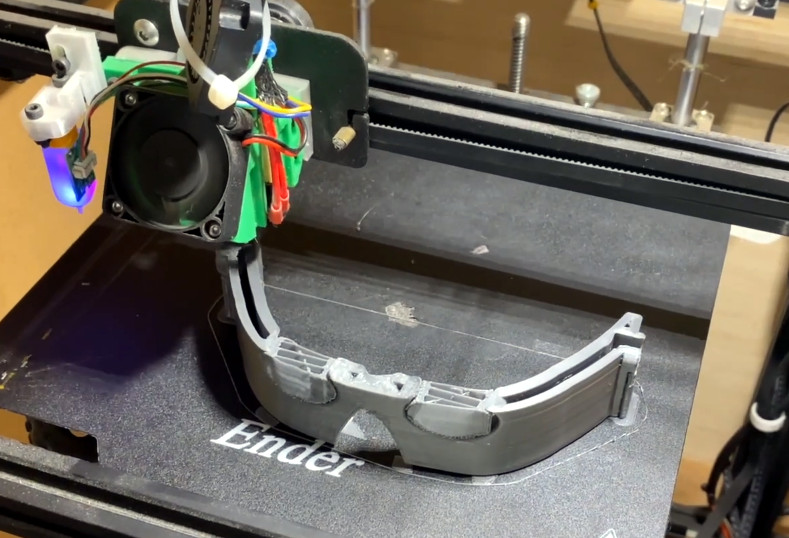
Seeing his wife try to use a cool face mask to get through the pain of a migraine headache, [Sparks and Code] started thinking of ways to improve the situation. The desire to save her from these debilitating bouts of pain drove him to make an actively cooled mask, all the while creating his own headache of an over-engineered mess.

Void spaces inside the printed mask are filled with chilled water.

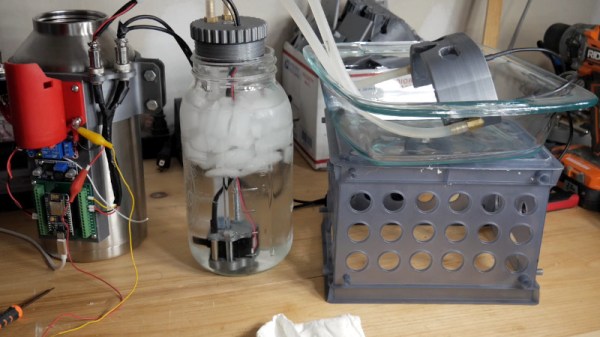
Instead of having to put the face mask into the refrigerator to get it cold, [Sparks and Code] wanted to build a mask that he could circulate chilled water through. With a large enough ice-filled reservoir, he figured the mask should be able to stay at a soothing temperature for hours, reducing the need for trips to the fridge.

[Sparks and Code] started out by using photogrammetry to get a 3D model of his wife’s face. Lack of a compatible computer and CUDA-enabled GPU meant using Google Cloud to do the heavy lifting. When they started making the face mask, things got complicated. And then came the unnecessary electronics. Then the overly complicated  and completely unnecessary instrumentation. The… genetic algorithms? Yes. Those too.

We won’t spoil the ending — but suffice it to say, [Sparks and Code] learned a cold, hard lesson: simpler is better! Then again, sometimes being over-complicated is kind of the point such as in this way-too-complex gumball machine.

Continue reading “Cool Face Mask Turns Into Over-Engineered Headache”

Building A Tube-Based Stereo Amp, In Classic Style

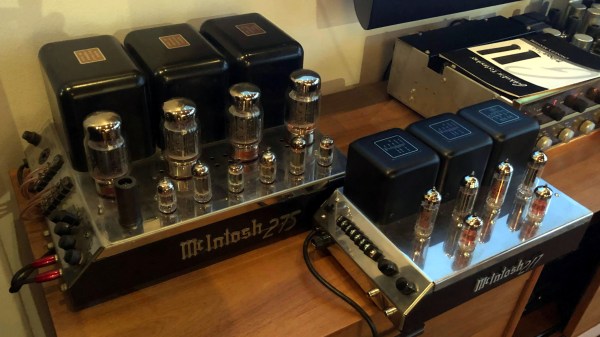
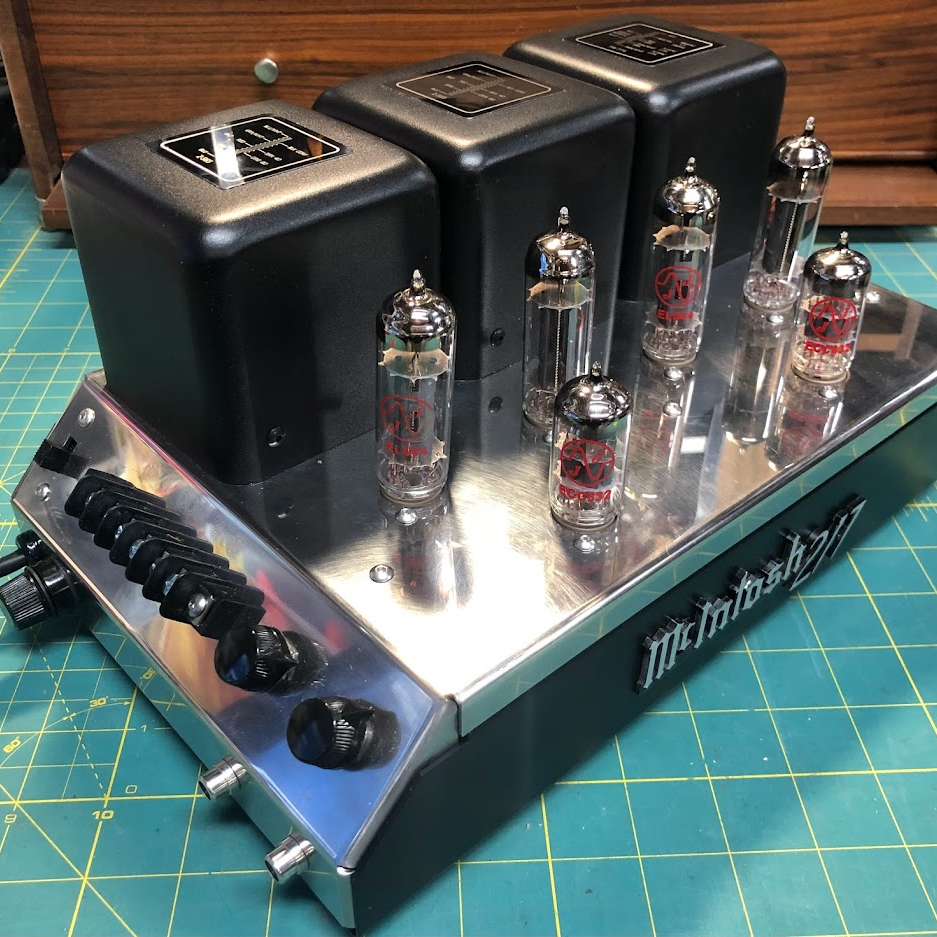
It’s not every day we see the results of someone putting their own spin on a vintage tube amp, but that’s exactly what [lens42] did in creating the McIntosh 217, created as a “mini” version of the McIntosh MC275, a classic piece of audio equipment. Both are pictured next to each other, above.

When it comes to vintage hi-fi stereo amplifiers, two units had particular meaning for [lens42]: the McIntosh MC275 Power Amp, and the Dynaco ST35. The Dynaco was a more budget-friendly amplifier, but looked like a plain box. The McIntosh, however, proudly showed off its tubes and transformers in all their glory. The “McIntosh 217” is design-wise basically a smaller McIntosh MC275, with the innards of a Dynaco ST35.

With so much needing to be designed from the ground up, CAD was invaluable. Component layout, enclosure design, and even wiring and labeling all had to be nailed down as much as possible before so much as heating up the soldering iron. Even so, there were a few hiccups; a vendor had incorrect measurements for a tube socket which meant that the part would not fit. A workaround involved modifying the holes and as luck would have it, the change wasn’t an eyesore. Still, [lens42] reminds us all that whenever you can, have the required parts in-hand for confirmation of dimensions before sending CAD files off for cutting or fabrication.

Many of us can relate to the fact that the whole project was a labor of love and made no real financial sense, but the end result is fantastic, and creating such a thing is something all of us — not just chasers of that elusive “tube sound” — can appreciate.

Turning A Pair Of Syringes Into A Tiny Water Pump

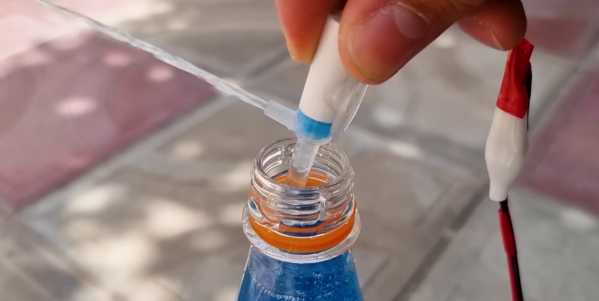
There is something inherently fascinating about tiny mechanical devices, especially when you’re used to seeing much larger versions. This is the case with [Penguin DIY]’s tiny centrifugal water pump built from 5 ml syringes.

The pump is powered by a small 8 mm diameter brushed DC motor, likely the same type that is used for small toy-grade quadcopters. The tiny impeller is a section of the syringe’s original plunger, with its cross-shaped body acting as the impeller blades. [Penguin DIY] first experimented with the original plunger seal to protect the motor from water, but it quickly melted from friction with the spinning shaft. Silicone sealant was used instead, and the motor shaft was covered with a layer of oil to prevent the sealant from sticking to it. Then the blob of sealant was flattened with a translucent plastic disc to allow clearance for the impeller.

A hole was drilled in the side of the syringe where the impeller sits, and a nozzle cut from the tip of another syringe was glued in place as the outlet. It’s notoriously difficult to get anything to stick to polypropylene syringes, but [Penguin DIY] says in the comments he was able to find an “organic superglue” that worked. With the motor and impeller inserted, the remaining space was also sealed with silicone.

This tiny pump packs a surprising amount of power, and was able to empty a 1.5 l bottle in about one minute with enough pressure to send the jet of water flying. There are still some issues that need to be addressed, though. With the motor completely sealed, it could burn itself quite quickly. A commenter also mentioned that it might suck water into the motor past the shaft after a hot run, as the air inside the motor cools and contracts. Even so, this little pump might be practical for applications that only require short runs, like watering potted plants. If you need more power you could always 3D print a larger pump.

Continue reading “Turning A Pair Of Syringes Into A Tiny Water Pump”

Upgraded Film Scanner Handles Bigger Formats At No Cost

Film scanners are a useful tool for digitizing slides and negatives, and the Plustek 8100 that [Christian Chapman] had was capable, but limited to small format film only. Rather than pay for a much more expensive medium format scanner that could handle 120 film, he modified his 8100 to accomplish the same thing with a combination of good old software and hardware tampering.

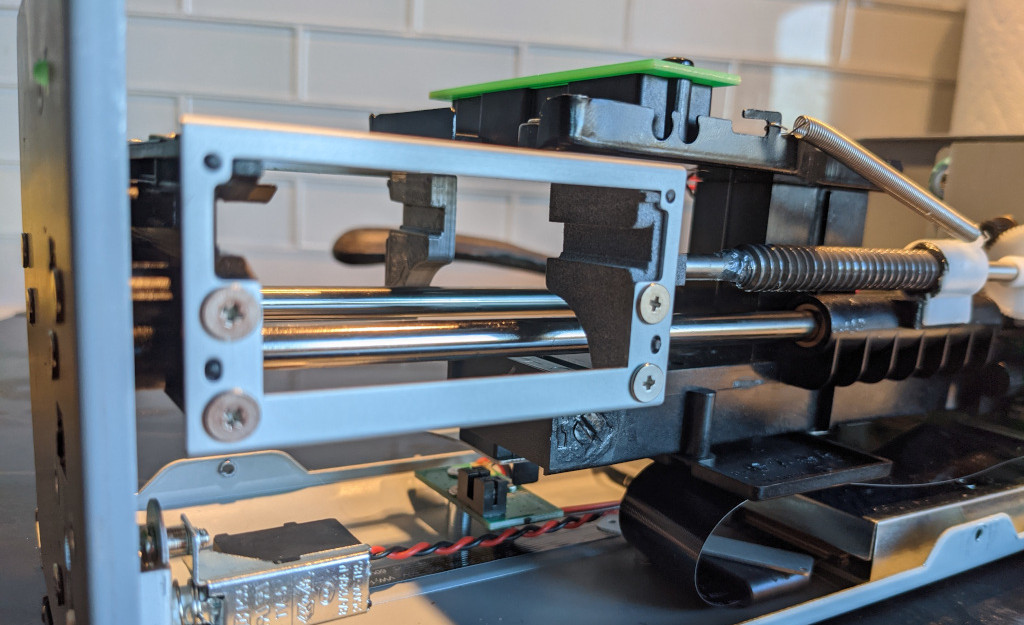
On the software side, [Christian] modified a driver for the Plustek 8100 so that it sweeps the scan head further than usual. At the application level, to scan medium format frames, it does a total of four scans: one for each quadrant. The results get stitched together in software with a thoughtfully-designed shell script that provides previews and handles failures and restarts gracefully.

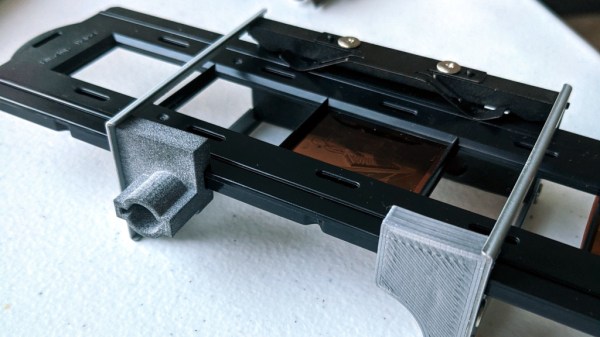
Hardware-wise, the scanning carriage needs modification to ensure nothing interferes with the scan head as it moves further than originally designed. Some CAD and 3D printing made short work of this. Incidentally, this hardware mod is an excellent demonstration of one of the core strengths of 3D printing: the ability to make geometrically-straightforward objects that would nevertheless be troublesome or impractical to construct in any other way.