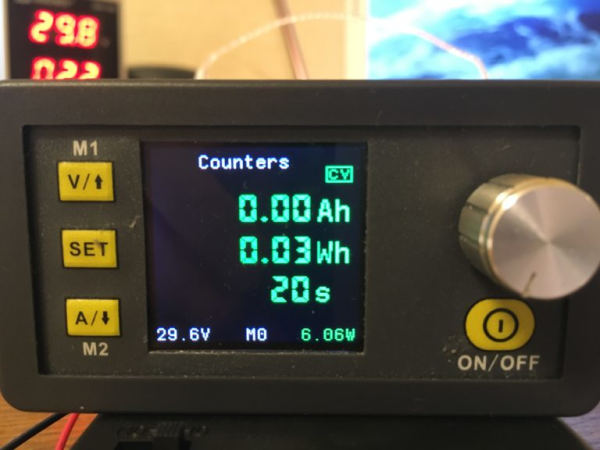
Hacked DSP5005 unit showing amp-hours screen

Another DPS5005 Alternative Firmware

These cheap Chinese-built programmable power supplies are nothing new, we’ve been using them for years. They’re not particularly good power supplies, since current feedback is in software, but for some tasks they’re a great fit and you can’t argue with the price. Alternative firmware projects have also been a thing for a while too, but none we’ve seen have been quite as capable and polished as this latest DPS firmware project by [Profi-max.] We’ve not come across the source code yet, but at least the binary image is freely downloadable.Battery charge screen on hacked DPS5005

The firmware has some interesting features, such as programmable pre-sets intended for battery charging applications. In fact, there is a dedicated battery charge mode screen. We want to warn, however, that charging lithium ion batteries with this might not be at all wise, not in the least because of a lack of protection hardware in place. It would be very easy to destroy the unit or overheat a battery this way! However, if you must do this, there are a few features to help you out, such as a handy ‘counters’ screen showing approximate charge delivered.

Remote programmability is, as usual, via the easily hacked in serial port, with firmware support for Bluetooth serial modules if wired USB serial doesn’t suit. For those who like to mount things differently, the screen can be rotated by holding a key on power-up, or if you hook up a MPU6050 accelerometer/gyro module it will even do it automatically!

To update a stock DPS unit, the only requirements are access to an ST-Link compatible programmer dongle, to target the STM32 SWD programming interface, and the STM32CubeProgrammer utility. Open source alternatives to that are also available, stlink comes to mind as a good option. Once you have the module PCB popped out of its plastic casing, only three wires need tacking onto a handy set of pads to complete the connection to the programmer dongle. Pretty simple stuff.

If you’re looking for a similar project, with source immediately available, then checkout the OpenDPS project we covered a few years ago, and if you’re thinking of going crazy, building a DIY open source electronics lab, we got you covered.

Continue reading “Another DPS5005 Alternative Firmware”

A DIY CAD Mouse You Can Actually Build

When you spend a lot of time on the computer doing certain more specialised tasks (no, we’re not talking about browsing cat memes on twitter) you start to think that your basic trackpad or mouse is, let’s say, lacking a certain something. We think that something may be called ‘usability’ or maybe ease-of-use? Any which way, lots of heavy CAD users gush over their favourite mouse stand-ins, and one particularly interesting class of input devices is the Space Mouse, which is essentially patented up-to-the-hilt and available only from 3DConnexion. But what about open source alternatives you can build yourselves? Enter stage left, the Orbion created by [FaqT0tum.] This simple little build combines an analog joystick with a rotary knob, with a rear button and OLED display on the front completing the user interface.

The idea is pretty straightforward; you setup the firmware with the application you want to use it with, and it emits HID events to the connected PC, replacing the mouse or keyboard input. Since your machine will take input from multiple sources, it doesn’t replace your mouse, it augments it. It may not be very accurate for detailed PCB layout work, but for moving around in a 3D view, or dialling in a video edit, this could be a very useful addition to your workstation, so why not give it a try? The wiring is simple, the parts easily found and cheap, and it’s only a few printed parts! This scribe is already printing the plastics right now, if you listen carefully you might be able to make out the sound of the Lulzbot in background.

There are many other takes on this idea, with varying levels of complexity, like this incredible build from [Ahmsville] that sadly doesn’t make the PCBs available openly, and here’s one we covered earlier mashing the expensive 3DConnexion spacemouse into a keeb.

Continue reading “A DIY CAD Mouse You Can Actually Build”

KiCAD 6.0: What Made It And What Didn’t

I’ve been following the development of KiCAD for a number of years now, and using it as my main electronics CAD package daily for a the last six years or thereabouts, so the release of KiCAD 6.0 is quite exciting to an electronics nerd like me. The release date had been pushed out a bit, as this is such a huge update, and has taken a little longer than anticipated. But, it was finally tagged and pushed out to distribution on Christmas day, with some much deserved fanfare in the usual places.

So now is a good time to look at which features are new in KiCAD 6.0 — actually 6.0.1 is the current release at time of writing due to some bugfixes — and which features originally planned for 6.0 are now being postponed to the 7.0 roadmap and beyond. Continue reading “KiCAD 6.0: What Made It And What Didn’t”

The Eerie Sounds Of Ioalieia: An ESP32/Valve/Analog Hybrid Circuit Sculpture

We’ve not had a circuit sculpture piece for a while, so here’s “ioalieia” a lovely hybrid digital-analog sound sculpture by [Eirik Brandal] to dig into.

Tidy straight lines. Nice job!

The host of the show is the ESP32 module, which generates audio frequency square waves, which are fed into a MCP4251 digital potentiometer. From there, it is fed into a AS3320 Voltage controlled filter (VCF), from Latvia-based ALFA (which is new to us, despite them being manufacturing electronics for sixty years!) This is an interesting device that has a four independently configurable filter elements with voltage controlled inputs for frequency control and resonance. The output from the VCF is then fed into a 6n2p (Soviet equivalent to the 12ax7) twin-triode vacuum tube, which is specifically aimed at audio applications.

The suitably distorted filtered square waves then pass into a Princeton Tech Corp PT2399 echo processor chip, which being digitally constructed, uses the expected ADC/RAM/DAC signal chain to implement an audio echo effect. As with the VCF, the echo depth can be modulated via the digipot, under the ESP32’s command. For a bit of added bling, the vacuum tube output feeds back into the ESP32, to be consumed by the internal ADC and turned into a light show via some PWM controlled LEDs. Lovely.

The final audio output from the echo chip is then fed into a speaker via a pair of LM380 amplifiers giving a power of about 5 W. It sounds pretty good if you ask us, and software configurable via Wi-Fi, giving this sculpture plenty of tweakabilty.

Of course circuit sculpture come in all shapes and sizes, and it wouldn’t do to not mention at least one sculpture clock project, and while we’re on it, here’s last year’s Remoticon circuit sculpture workshop.

Continue reading “The Eerie Sounds Of Ioalieia: An ESP32/Valve/Analog Hybrid Circuit Sculpture”

Rapid-Reload Vacuum Cannon Totally Demolishes Those Veggies

[NightHawkInLight] has been developing his design for a vacuum canon for a while now, so it seems fitting to drop in check out the progress. The idea is pretty straightforward, take a long rigid tube, insert a close fitting piston, magnetically attached to a projectile, and stopper the open end with something easily destroyed. The piston needs to be pulled into the tube with some force, to pull a vacuum against the stopper. The interesting bit happens next, when the piston exits the other end of the tube, with the vacuum at its maximum, there is a sudden inrush of air.  Apparently this inrush of supersonic velocity, and the momentum of the mass of air is sufficient to eject the projectile at considerable velocity, smashing through the plug and demolishing the target. So long as the target is of the soft and squishy variety anyway.

It’s an interesting idea, and certainly gives plenty of bang for not many bucks. That big lump of acrylic tubing (presumably used for ease of explanation in the video) looks fairly expensive to buy off the shelf, but we reckon any old pipe would probably work out fine.

We’ve definitely covered our share of DIY projectile weapons, like this air cannon made from PVC pipe parts, and of course there’s this crazy big one, that you should definitely not try at home.

Continue reading “Rapid-Reload Vacuum Cannon Totally Demolishes Those Veggies”

Soviet-Era Auto Dialler Uses Magnetic Rope Core Memory

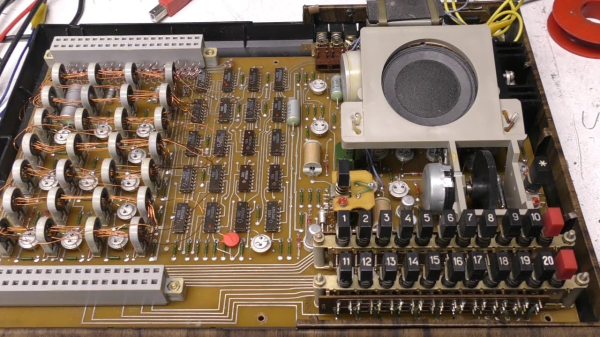
We’ve seen a few interesting magnetic core memories on these fine pages over the years, but we don’t recall seeing too many user programmable magnetic core memory devices. This interesting Russian telephone auto dialer in its day would have been a very useful device, capable of storing and dialing forty user programmable 7-digit numbers. [mikeselectricstuff] tore into one (video, embedded below), and found some very interesting tech. For its era, this is high technology stuff. Older Russian tech has a reputation for incredibly ingenious use of older parts, that can’t be denied. After all, if it works, then there’s no need to change it. But anyway, what’s interesting here is how the designers decided to solve the problem of programming and recalling of numbers, without using a microprocessor, by using discrete logic and core rope memory.

This is the same technology used by the Apollo Guidance Computer, but in a user configurable form, and obviously much smaller storage capacity. The core array consists of seven, four-bit words, one word per telephone digit, which will be read out sequentially bottom to top. The way you program your number is to take your programming wire, insert it into the appropriate hole (one row related to numbers 1-20, the other row is shifted 1-20 for the second bank) and thread it along the cores in a weave type pattern. Along the way, the wire is passed through or bypasses a particular core, depending upon the digit you are coding for. They key for this encoding is written on the device’s lid. At the end, you then need to terminate the wire in the matching top connector, to allow the circuit to be completed.

As far as we can tell, the encoding is a binary sequence, with a special ‘stop’ code to indicate telephone numbers with less than seven digits. We shall leave further analysis to interested parties, and just point you at the Original manufacturer schematics. Enjoy!

Of course we’re not just going to mention rope core memory and the AGC without linking to a fantastic article about the very same, and if that’s wetting your appetite for making a rope core memory, here’s a little thing about that too!

Continue reading “Soviet-Era Auto Dialler Uses Magnetic Rope Core Memory”

A Simple EMF Detector And Electroscope You Can Make From Junk Box Parts

2N2222 devices used, but practically any junkbox NPN will do

Electromagnetic fields are everywhere, all around us. Some are generated naturally, but in vast majority of cases, it’s we humans that are generating them with artificial, electronic means. Everything from your mobile phone to the toaster will emit some sort of signal, be it intentional or not. So we think it only befits the general electronics-orientated hacker to have some way of sniffing around for these signals, so here is [Mirko Pavleski] with his take on a very simple pair of instruments to detect both static and dynamic electromagnetic fields.

CMOS clock input connected directly to the antenna. Warning! ESD damage risk!

The first unit (a simple electroscope) uses a cascade of 2N2222 NPN bipolar transistors configured to give a high current gain, so any charge near the antenna will result in increasing currents in subsequent stages, finally illuminating the LED. Simple stuff.

The second unit relies on the extremely high input impedance of the old-school CMOS 4017 decade counter, which is likely of the order of 100 MΩ or even more. Normally you would not leave such a CMOS input floating, or even connect it with too long a PCB trace — lest it pick up a stray signal —but for detecting alternating EM fields, this appears to work just fine. Configured as a simple divide-by-ten, when presenting 50 Hz AC, the LED can be seen to flash at 5 Hz.

Simple stuff, and this scribe has all those exact parts in the junk box, so will be constructing these shortly!

We’ve covered electroscopes for years, here’s a modern twist on a famous classic experiment, and some hair-raising experiments to get you started.

Continue reading “A Simple EMF Detector And Electroscope You Can Make From Junk Box Parts”