2023 Halloween Hackfest: Meet Creepsy, The Robotic People-Seeking Ghost

The 2023 Halloween Contest might be over, but we saw some great entries and clever modifications bringing projects into the Halloween spirit. One of them is Creepsy by [Hazal Mestci], a Raspberry Pi-based robotic ghost able to autonomously pick people out of a crowd and glide towards them, emitting eerie sounds as it does so.

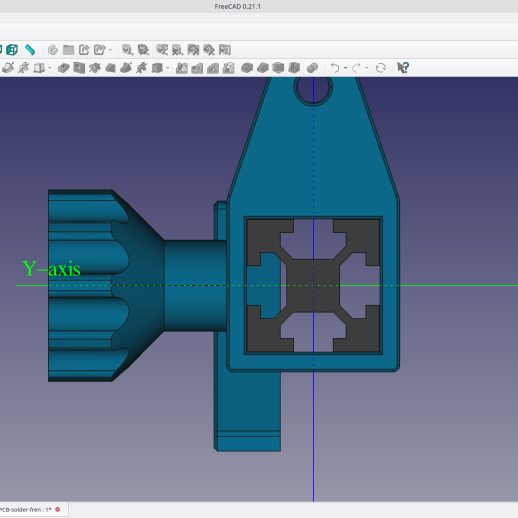
The tech behind Creepsy (GitHub repository) originally led the somewhat less spooky existence of a mobile drink serving platform. But with a little bit of modification and the addition of a bedsheet with cutouts for sensors, the transformation into an obstacle-avoiding people-seeking spooker was complete. Key to this transformation was the Viam Python SDK, a software Swiss army knife used by robot builders everywhere. Creepsy itself was built using handy aluminum extrusion, and 3D printed parts along with the requisite suite of motors, cameras, and ultrasonic sensors.

Thanks to everyone who participated in the 2023 Halloween Contest. Got an idea for next year? It’s never too early to get started because ideas are great, but nothing beats “done on time”!

Most AI Content Is Trash, Just Like Everything Else

[Max Woolf] has been working in the AI space since 2015, and among other work has created numerous useful open-source tools. He also recently wrote a thoughtful blog post that attempts to put into words his feelings on the state of things in the wake of experiencing a bit of an AI backlash-related burnout. Essentially, people effortlessly creating vast amounts of bad AI content has caused a bigger problem than we may realize.

How so? Well, Sturgeon’s law (summarized as “ninety percent of everything is crud”) applies to AI as much as it does to anything else. Theodore Sturgeon was a science fiction author and critic (and writer of multiple Star Trek episodes) who observed in the 1950s that while Science Fiction — the hot new popular thing at the time — was often derided by critics as being little more than low quality pap, so was everything else. It was true that most Science Fiction was garbage. But most work in other fields was of similarly low quality, and thus Science Fiction was really no different. It’s all trash, except for the parts one likes. Just like anything else.

What makes this observation particularly applicable to the current AI landscape is that, according to [Max], the incredible ease of use makes AI’s “ninety percent crud” very large indeed, and the attached backlash is similarly big. The remaining ten percent of AI that is absolutely fantastic and full of possibilities? It’s practically invisible due to how quickly the industry is moving, the speed with which the big players are vying to control it, and how unfashionable it has become to admit one is using AI tools at all.

[Max] knows the scene better than most. One of his projects is simpleaichat, a tool aimed not just at enabling people to integrate AI into projects easier, but piercing the hype around AI to more easily reveal just how these tools actually work. Sadly, a general AI backlash has made developing these tools feel rather less rewarding than it once did.

What The Artisan 3-in-1 CNC Offers (If One Has The Table Space)

I never feel like I have enough space in my workshop. The promise of consolidating tools to make the most of limited space drew me to the Snapmaker Artisan, a plus-sized 3-in-1 tool combining 3D printer, laser engraver, and CNC machine.

Smaller than three separate tools, but still big.

Jacks of all trades may be masters of none, but it is also true that a tool does not need to be a master of its functions to be useful. For many jobs, it enough to simply be serviceable. Does a machine like the Artisan offer something useful to a workshop?

Snapmaker was kind enough to send me an Artisan that I have by now spent a fair bit of time with. While I have come to expect the occasional glitch, having access to multiple functions is great for prototyping and desktop manufacturing.

This is especially true when it allows doing a job in-house where one previously had to outsource, or simply go without. This combo machine does have something to offer, as long as one can give it generous table space in return.

What It Is

The Artisan is a large dual-extrusion 3D printer, CNC router, and diode-based laser engraver. To change functions, one physically swaps toolheads and beds. Very thankfully, there are quick-change fixtures for this.

Driving the Artisan is Snapmaker’s software Luban (GitHub respository). Named for the ancient Chinese master craftsman, it is responsible for job setup and control. For laser and CNC work, there are convenient built-in profiles for a variety of paper, plastic, leather, and wood products.

The unit is enclosed, nicely designed, and — while I have come to expect the occasional glitch — serviceable at all three of its functions. The size and stature of the machine warrants some special mention, however.

Continue reading “What The Artisan 3-in-1 CNC Offers (If One Has The Table Space)”

Chugging Along: A Steam-Powered Sawmill Still Makes Its Mark

[Rural Heritage TV] has video of a private tour of a working, two-story, steam-powered sawmill at Lake Itasca, Minnesota. This is believed to be one of the only working steam-powered band-sawmills in the country with a shotgun (or reciprocating) feed carriage. The carriage moves back and forth with a log while a monstrous 44-foot long bandsaw cuts pieces off on every stroke. There’s even a log turning mechanism, because if there’s one thing that never changes, it’s that time is money.

There is great footage of the whole thing in action, and also a serious tour of just how much work was needed to keep such a tool running. For example, in its heyday a machine like this would be swapping bands out for maintenance and sharpening every few hours.

Viewers unfamiliar with such machinery may notice the lack of rims or guard rails on the bandsaw and other belts and pulleys. How do bands stay centered on spinning wheels without falling off? The crowned pulley was the steam era’s solution, providing a means for belts to self-center without any need for rims or other additions.

This tour of the sawmill is a nifty peek at a technology that, at one point, ruled the roost. Watch it in action in the video, just under the page break. If that leaves you hungry to know more, there’s a second video that goes into added detail about saw sharpening and more.

One last tip: if you’re hungry to know more about the history of the steam engine, The Perfectionists is absolutely a book you should read because it goes into fascinating detail about that, and more.

Continue reading “Chugging Along: A Steam-Powered Sawmill Still Makes Its Mark”

2023 Halloween Hackfest: Organ-playing Skeleton Livens Up Halloween

Every hacker appreciates how off-the-shelf parts can be combined into something greater, and [bryan.lowder] demonstrates this beautifully with his organ-playing skeleton, a wonderful entry to our 2023 Halloween Contest!

Skelly the 3-foot-tall novelty skeleton animatedly plays Bach’s Toccata and Fugue in D Minor while perched at an old (and non-functional) Hammond organ. The small animatronic skeleton has canned motions that work very well for mock organ playing while an embedded MP3 player takes care of playing the music.

That’s not to say the project didn’t have its challenges. Integrating off-the-shelf components into a project always seems to bring its own little inconveniences. In this case, the skeleton the MP3 player both expect to be triggered with button pushes, but taping the button down wasn’t enough to get the skeleton moving when power was applied. [bryan] ended up using relays to simulate button pushes, and a 555 timer circuit to take care of incorporating a suitable delay.

As [bryan] puts it, “a technical tour de force it ain’t, but it is practical and it works and it was done on time” which is well said. Watch Skelly in action in the video, embedded below. There’s also a second video showing the homebrewed controller and MP3 player, both concealed under Skelly’s robe.

Continue reading “2023 Halloween Hackfest: Organ-playing Skeleton Livens Up Halloween”

AI In A Box Envisions AI As A Private, Offline, Hackable Module

[Useful Sensors] aims to embed a variety of complementary AI tools into a small, private, self-contained module with no internet connection with AI in a Box. It can do live voice recognition and captioning, live translation, and natural language conversational interaction with a local large language model (LLM). Intriguingly, it’s specifically designed with features to make it hack-friendly, such as the ability to act as a voice keyboard by sending live transcribed audio as keystrokes over USB.

Based on the RockChip 3588S SoC, the unit aims to have an integrated speaker, display, and microphone.

Right now it’s wrapping up a pre-order phase, and aims to ship units around the end of January 2024. The project is based around the RockChip 3588S SoC and is open source (GitHub repository), but since it’s still in development, there’s not a whole lot visible in the repository yet. However, a key part of getting good performance is [Useful Sensors]’s own transformers library for the RockChip NPU (neural processing unit).

The ability to perform things like high quality local voice recognition and run locally-hosted LLMs like LLaMa have gotten a massive boost thanks to recent advances in machine learning, and it looks like this project aims to tie them together in a self-contained package.

Perhaps private digital assistants can become more useful when users can have the freedom to modify and integrate them as they see fit. Digital assistants hosted by the big tech companies are often frustrating, and others have observed that this is ultimately because they primarily exist to serve their makers more than they help users.

Continue reading AI In A Box Envisions AI As A Private, Offline, Hackable Module”

Behold The Mega-Wheelie, A Huge One-Wheeled Electric Skateboard

DIY electric personal vehicles are a field where even hobbyists can meaningfully innovate, and that’s demonstrated by the Mega-Wheelie, a self-balancing one-wheeled skateboard constructed as an experiment in traversing off-road conditions.

[John Dingley] and [Nick Thatcher] have been building and testing self-balancing electric vehicles since 2008, with a beach being a common testing ground. They suspected that a larger wheel was the key to working better on rough ground and dry sand and tested this idea by creating a skateboard with a single wheel. A very big, very wide wheel, in fact.

The Mega-Wheelie houses a 24V LiFePO4 battery pack, 450 W gearmotor with chain and sprocket drive, SyRen motor controller from Dimension Engineering, Arduino microcontroller, and an inertial measurement unit to enable the self-balancing function. Steering is done by leaning, and the handheld controller is just a dead man’s switch that disables the vehicle if the person piloting it lets go.

Design-wise, a device like this has a few challenging constraints. A big wheel is essential for performance but takes up space that could otherwise be used for things like batteries. Also, the platform upon which the pilot stands needs to be as low to the ground as possible for maximum stability. Otherwise, it’s too easy to fall sideways. On the other hand, one must balance this against the need for sufficient ground clearance.

Beaches are rarely covered in perfectly smooth and firm sand, making them a good test area.

In the end, how well did it work? Well enough to warrant a future version, says [John]. We can’t wait to see what that looks like, considering their past 3000 W unicycle’s only limitation was “personal courage” and featured a slick mechanism that shifted the pilot’s weight subtly to aid steering. A video of the Mega-Wheelie (and a more recent unicycle design) is embedded just below the page break.

Continue reading “Behold The Mega-Wheelie, A Huge One-Wheeled Electric Skateboard”