Relive The Glory Days Of Cable TV With This Retro Weather Feed

This may surprise younger readers, but there was once a time when the reality programming on The Weather Channel was simply, you know, weather. It used to be no more than a ten-minute wait to “Local on the Eights”, with simple text crawls of local conditions and forecasts that looked like they were taken straight from the National Weather Service feed. Those were the days, and sadly they seem to be gone forever.

Or perhaps not, if this retro weather channel feed has anything to say about it. It’s the product of [probnot] and consists of a simple Python program that runs on a Raspberry Pi. Being from Winnipeg, [probnot] is tapping into Environment Canada for local weather data, but it should be easy enough to modify to use your local weather provider’s API. The screen is full of retro goodness, from the simple color scheme to the blocky white text; the digital clock and local news crawl at the bottom complete the old school experience. It doesn’t appear that the code supports the period-correct smooth jazz saxophone, but that too should be a simple modification.

All jibing aside, this would be a welcome addition to the morning routine. And for the full retro ride, why not consider putting it in an old TV case?

Continue reading “Relive The Glory Days Of Cable TV With This Retro Weather Feed”

How Does Starlink Work Anyway?

No matter what you think of Elon Musk, it’s hard to deny that he takes the dictum “There’s no such thing as bad publicity” to heart. From hurling sports cars into orbit to solar-powered roof destroyers, there’s little that Mr. Musk can’t turn into a net positive for at least one of his many ventures, not to mention his image.

Elon may have gotten in over his head, though. His plan to use his SpaceX rockets to fill the sky with thousands of satellites dedicated to providing cheap Internet access ran afoul of the astronomy community, which has decried the impact of the Starlink satellites on observations, both in the optical wavelengths and further down the spectrum in the radio bands. And that’s with only a tiny fraction of the planned constellation deployed; once fully built-out, they fear Starlink will ruin Earth-based observation forever.

What exactly the final Starlink constellation will look like and what impact it would have on observations depend greatly on the degree to which it can withstand regulatory efforts and market forces. Assuming it does survive and gets built out into a system that more or less resembles the current plan, what exactly will Starlink do? And more importantly, how will it accomplish its stated goals?

Continue reading “How Does Starlink Work Anyway?”

Hacked Prosthesis Leads To Mind-Controlled Electronic Music

As amazing as prosthetic limbs have become, and as life-changing as they can be for the wearer, they’re still far from perfect. Prosthetic hands, for instance, often lack the precise control needed for fine tasks. That’s a problem for [Bertolt Meyer], an electronic musician with a passion for synthesizers with tiny knobs, a problem he solved by hacking his prosthetic arm to control synthesizers with his mind. (Video, embedded below.)

If that sounds overwrought, it’s not; [Bertolt]’s lower arm prosthesis is electromyographically (EMG) controlled through electrodes placed on the skin of his residual limb. In normal use, he can control the servos inside the hand simply by thinking about moving muscles. After experimenting a bit with an old hand, he discovered that the amplifiers in the prosthesis could produce a proportional control signal based on his inputs, and with a little help from synthesizer manufacturer KOMA Electronik, he came up with a circuit that can replace his hand and generate multiple control voltage channels. Plugged into any of the CV jacks on his Eurorack modular synths, he now has direct mind control of his music.

We have to say this is a pretty slick hack, and hats off to [Bertolt] for being willing to do the experiments and for enlisting the right expertise to get the job done. Interested in the potential for EMG control? Of course there’s a dev board for that, and [Bil Herd]’s EMG signal processing primer should prove helpful as well.

Continue reading “Hacked Prosthesis Leads To Mind-Controlled Electronic Music”

Open-Source Neuroscience Hardware Hack Chat

Join us on Wednesday, February 19 at noon Pacific for the Open-Source Neuroscience Hardware Hack Chat with Dr. Alexxai Kravitz and Dr. Mark Laubach!

There was a time when our planet still held mysteries, and pith-helmeted or fur-wrapped explorers could sally forth and boldly explore strange places for what they were convinced was the first time. But with every mountain climbed, every depth plunged, and every desert crossed, fewer and fewer places remained to be explored, until today there’s really nothing left to discover.

Unless, of course, you look inward to the most wonderfully complex structure ever found: the brain. In humans, the 86 billion neurons contained within our skulls make trillions of connections with each other, weaving the unfathomably intricate pattern of electrochemical circuits that make you, you. Wonders abound there, and anyone seeing something new in the space between our ears really is laying eyes on it for the first time.

But the brain is a difficult place to explore, and specialized tools are needed to learn its secrets. Lex Kravitz, from Washington University, and Mark Laubach, from American University, are neuroscientists who’ve learned that sometimes you have to invent the tools of the trade on the fly. While exploring topics as wide-ranging as obesity, addiction, executive control, and decision making, they’ve come up with everything from simple jigs for brain sectioning to full feeding systems for rodent cages. They incorporate microcontrollers, IoT, and tons of 3D-printing to build what they need to get the job done, and they share these designs on OpenBehavior, a collaborative space for the open-source neuroscience community.

Join us for the Open-Source Neuroscience Hardware Hack Chat this week where we’ll discuss the exploration of the real final frontier, and find out what it takes to invent the tools before you get to use them.

join-hack-chatOur Hack Chats are live community events in the Hackaday.io Hack Chat group messaging. This week we’ll be sitting down on Wednesday, February 19 at 12:00 PM Pacific time. If time zones have got you down, we have a handy time zone converter.

Click that speech bubble to the right, and you’ll be taken directly to the Hack Chat group on Hackaday.io. You don’t have to wait until Wednesday; join whenever you want and you can see what the community is talking about. Continue reading “Open-Source Neuroscience Hardware Hack Chat”

Wearable Cone Of Silence Protects You From Prying Ears

Careful,  the walls have ears. Or more specifically, the smart speaker on the table has ears, as does the phone in your pocket, the fitness band on your wrist, possibly the TV, the fridge, the toaster, and maybe even the toilet. Oh, and your car is listening to you too. Probably.

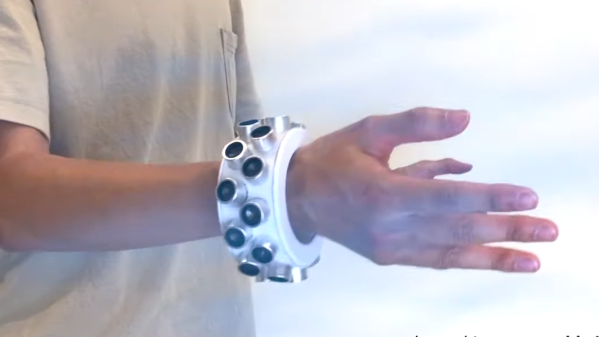
How does one fight this profusion of listening devices? Perhaps this wearable smart device audio jammer will do the trick. The idea is that the MEMS microphones that surround us are all vulnerable to jamming by ultrasonic waves, due to the fact that they have a non-linear response to ultrasonic signals. The upshot of that is when a MEMS hears ultrasound, it creates a broadband signal in the audible part of the spectrum. That creates a staticky noise that effectively drowns out any other sounds the microphone might be picking up.

By why a wearable? Granted, [Yuxin Chin] and colleagues from the University of Chicago have perhaps stretched the definition of that term a tad with their prototype, but it turns out that moving the jammer around does a better job of blocking sounds than a static jammer does. The bracelet jammer is studded with ultrasonic transducers that emit overlapping fields and result in zones of constructive and destructive interference; the wearer’s movements vary the location of the dead spots that result, improving jamming efficacy. Their paper (PDF link) goes into deeper detail, and a GitHub repository has everything you need to roll your own.

We saw something a bit like this before, but that build used white noise for masking, and was affixed to the smart speaker. We’re intrigued by a wearable, especially since they’ve shown it to be effective under clothing. And the effect of ultrasound on MEMS microphones is really interesting.

Continue reading “Wearable Cone Of Silence Protects You From Prying Ears”

Hackaday Links Column Banner

Hackaday Links: February 16, 2020

Have you heard the exciting news about Betelgeuse? It’s been hard to miss these days, with reports of the red supergiant star suddenly dimming, and speculation growing that the star will go supernova sometime in the next 10,000 years. But the exciting part is that astronomers have gotten together and scheduled the Betelgeuse supernova for February 21, 2020. Or at least that’s how at least a half-dozen poorly written articles make it sound. We thought that seemed odd, so we dug a bit and the real story is more complicated and more interesting. Betelgeuse is normally a variable star that goes through complex cycles of brightening and dimming. Its current dimming is unprecedented in magnitude, but the timing coincides with its normal cycle. If this dimming is just a deepening of its normal cycle, the star should start brightening again on February 21. If it doesn’t, it could mean the star is entering the next phase in its evolution. We’d love to see a star so bright it’s visible in daylight and casts shadows at night, but we’ll just have to see what happens on Friday.

One of the last two factories in the world that makes the lacquer master discs needed to make vinyl records burned to the ground last week. Luckily nobody was hurt, but it took 82 firefighters hours to get the blaze under control. It remains to be seen how this loss will impact the vinyl record market, but since the appearance of a new star in the sky has long been seen as a bad omen and a portent of doom, if Betelgeuse does go boom next week, expect to hear the hipsters gnash their teeth and rend their man-buns. In the meantime, enjoy perhaps your last look at the fascinating vinyl manufacturing process.

Rent it once, rent it for life? Apparently, at least if you rent a Ford vehicle from Enterprise and install the FordPass app on your phone. That was the experience of one Masamba Sinclair when he rented a Ford Expedition in October and found that even five months later, the app – which he never unpaired from the rental vehicle – allowed him to start and stop the car’s engine, unlock the doors, and even track its location. The same thing even happened again this month when he rented a Mustang. Ford and Enterprise might both want to rethink the security model here; leaving it up to the customer to unlink the car from the app is a recipe for disaster.

Don’t forget that we have a really interesting contest going on right now: the Train All The Things machine learning contest. With so many different machine learning platforms and frameworks available today, you can surely find a way to build something that really shines. The early entries are interesting, with everything from an intelligent bat detector to sunglasses that give you control of the world. The contest is sponsored by Digi-Key and runs through April 7, so get started on your AI masterpiece and send it in.

Speaking of Digi-Key, they’ve put together a handy list of vendors from their line card who are reporting impacts from the Covid-19 outbreak in China. We wondered about supply chain effects from the outbreak recently, and this is confirmation that we’re starting to see a pinch. As of this writing, there are 62 vendors listed, with the majority reporting impacts from the extension of the Chinese New Year holiday. We’ll stay on top of this story, and of course we continue to wish our friends in China well.

Simplify Your Life With This Pocket Rotary Cellphone

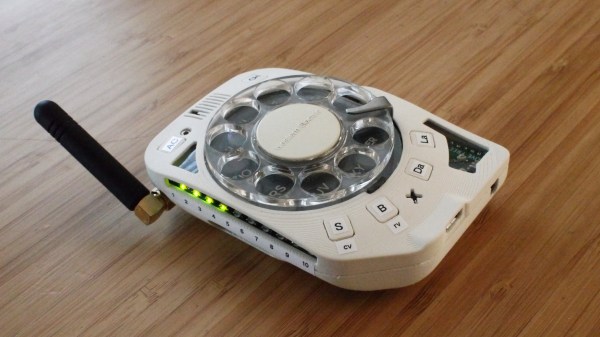
With its constant siren song of distraction and endless opportunity for dopamine hits, a smartphone can cause more problems than it solves. The simple solution would be a no-nonsense flip phone, but that offers zero points for style. So why not build your own rotary dial pocket cellphone?

Of course, what style points accrue to [Justine Haupt] take a hit in terms of practicality, but that was never really the point of this build. And even then, the phone appears to be surprisingly useful. It’s based on the rotary dial from a Trimline phone, which itself was an epic hack back in 1965 when it was introduced. The 3D-printed case contains an ATmega2560V microcontroller and an Adafruit FONA 3G cell module, while a flexible mono eInk display adorns the outside. Some buttons, a folding SMA antenna, and some LEDs for signal strength and battery level complete the build, which easily slips into a pocket. The dial can be used not only to dial the phone but to control the speaker volume; in practice, [Justine] mainly uses the speed dial buttons to make calls, though.

We’ve seen rotary phones converted to cell before, but this one is a next-level integration of the retro and the modern. It’s simple, intuitive, and distraction-free, and best of all, it’s a great excuse not to return a text.

Thanks to [J. Peterson] for the tip.