LEGO And Minecraft Team Up For Custom Gaming PC Case

There are probably few parents who haven’t watched their kids sitting on the floor, afloat on a sea of LEGO pieces and busily creating, and thought, “If only they could make a living at that.” But time goes on and kids grow up, and parents soon sing the same refrain as the kids sit transfixed by the virtual equivalent of LEGO: Minecraft.

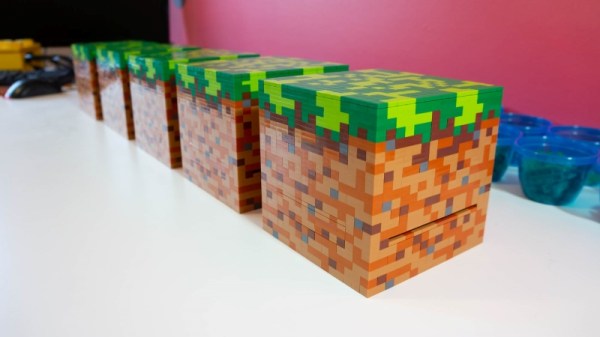
Finding a way to monetize either LEGO or Minecraft is a bit difficult for the young enthusiast; combining both obsessions into a paying proposition would be a dream come true. [Mike Schropp] did it, and this Minecraft-themed LEGO computer case was the result. Intel wanted a LEGO case for their new NUC mini-PC motherboard, and as a sponsor of the Minefaire event, the case needed to be Minecraft themed.

[Mike] chose the block that any Enderman would choose: the basic grass block. Each of the ten cases he made for the show had about 1000 of the smallest LEGO pieces available, to recreate the texture of the grass block in all its faux 8-bit glory. The 4″ x 4″ (10cm x 10cm) 8th Gen NUC board was a great fit for the case, which included slots for ventilation and SD card access, plus pop-out covers to access the board’s ports. It’s not exactly a screamer, but playing Minecraft on a grass block made from LEGO bricks is probably worth the performance hit.

We’ve seen [Mike]’s work a time or two here, most recently with a full-scale LEGO rack-mount server. Our hats off to him for another fun and creative build, and for proving that you’re never too old to LEGO. Or Minecraft.

Retro Hardware Plots Again Thanks To Grbl And ESP32

When it comes to building a new CNC machine, you’ve got a wide world of controller boards to choose from. Whether you’re building a 3D-printer or a CNC plasma cutter, chances are good you’ll find a controller that fits your needs and your budget. Not so much, though, when you want to add CNC to a pen plotter from the early days of the PC revolution.

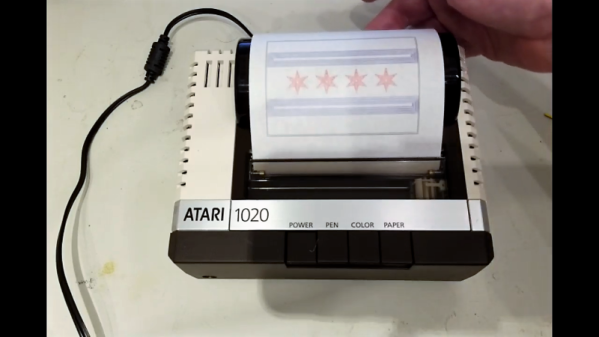
[Barton Dring] just posted the last installment of a five-part series in which he documented putting an Atari 1020 plotter under CNC control. The plotter was a peripheral for the Atari line of 6502 machines from the late 1970s; the guts of the little roll-fed, ballpoint-pen plotter appeared in Commodore, Tandy, and TI versions as well. [Bart]’s goal was to not add or modify anything to the mechanically simple device apart from the controller. That was easier said than done, given the unipolar stepper motors controlling the pen position and paper roll, and the fact that the pen lift mechanism uses a solenoid. Support for those had to be added to his Grbl_ESP32 firmware, as did dealing with the lack of homing switches in the plotter, and adapting the Grbl tool change command to the pen color change mechanism, which rotates the pen holder by bumping it into the right-hand carriage stop. The stock controller was replaced by a custom PCB that fits perfectly within the case, with plenty of room to spare. The video below shows it plotting out a vexillogically relevant sample.

From custom coasters to wooden nickels to complex string art, [Bart] has really put Grbl through the wringer. We really like this retro-redo, though, and fully support his stated desire to convert more old hardware to Grbl_ESP32.

Continue reading “Retro Hardware Plots Again Thanks To Grbl And ESP32”

A Double-Hybrid Mini-Lathe, From Scratch

It’s a treadle lathe! No, it’s a power lathe! It’s a wood lathe! No, it’s a metal lathe! Actually, [Uri Tuchman]’s homebrew lathe is all of the above, and it looks pretty snazzy too.

To say that [Uri]’s creations are quirky is a bit of an understatement – birds, crustaceans, hands, and feet all appear repeatedly as motifs in his work – but there’s no overstating his commitment to craftsmanship. [Uri] turns wood and metal into wonderful tools, nonsense machines, and finely detailed instruments, like this exquisitely engraved astrolabe we featured a while back.

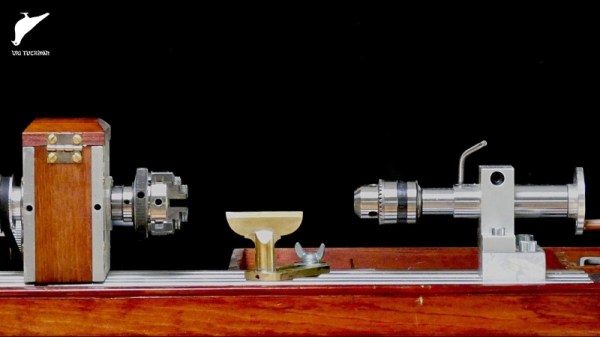
[Uri] mostly works with hand tools, supplemented by an old Singer treadle-powered sewing machine that he turned into a scroll saw. The video below shows how he added a small scratch-built lathe to the treadle base. His first pass at a headstock, using pillow blocks for bearings, didn’t work as well as he wanted, so he built a new headstock around off-the-shelf lathe parts. The aluminum extrusion bed holds the headstock, tailstock, and a custom-built tool rest of heavy brass, all of which look great alongside the rich wood accent pieces and base. And for those times when his feet are tired, he added a surplus electric motor to turn the spindle. We especially like the two settings on the motor speed control: “0” and “>0”. Classic [Uri].

If you haven’t heard of [Uri] before, do yourself a favor and go check out his YouTube channel right now. Or start with our other coverage of his unique projects, from building an intricately detailed hammer to his lobster claw ink-dipping machine and even this unusual take on preserved lemons.

Continue reading “A Double-Hybrid Mini-Lathe, From Scratch”

Open Hardware Month Hack Chat

Join us on Wednesday, October 23 at noon Pacific for the Open Hardware Month Hack Chat with Michael Weinberg!

It seems like everything and everyone has a special day set aside on the calendar. You know the drill – a headline declaring it National Grilled Cheese Day (sorry, you missed it – April 12) or National Bundt Pan Day (not even kidding, November 15). It seems only fair with all these silly recognition days floating around that we in the hacking community should have a day of our own, too, or even a whole month. That’s why the Open Source Hardware Association declared the entire month of October to be Open Hardware Month.

Open hardware is all about accessible, collaborative processes that let everyone see and understand the hardware they’re using. The technological underpinnings of our lives are increasingly hidden from us, locked away as corporate secrets. Open hardware tries to turn that on its head and open up devices to everyone, giving them the freedom to not only use their devices but to truly understand what’s happening in them, and perhaps repair, extend, and even modify them to do something new and useful. Celebrating that and getting the message out to the general public is certainly something worth doing.

Michael Weinberg is a board member at OSHWA, and he’ll be joining the Hack Chat on October 23 (National Boston Cream Pie Day) to discuss Open Hardware Month and open-source hardware in general. We’ll learn about some of the events planned for Open Hardware Month, how open hardware is perceived beyond the hacker community, and what’s on tap for the 10th anniversary Open Hardware Summit in 2020.

join-hack-chatOur Hack Chats are live community events in the Hackaday.io Hack Chat group messaging. This week we’ll be sitting down on Wednesday, October 23 at 12:00 PM Pacific time. If time zones have got you down, we have a handy time zone converter.

Click that speech bubble to the right, and you’ll be taken directly to the Hack Chat group on Hackaday.io. You don’t have to wait until Wednesday; join whenever you want and you can see what the community is talking about.

Hackaday Links Column Banner

Hackaday Links: October 20, 2019

It’s Nobel season again, with announcements of the prizes in literature, economics, medicine, physics, and chemistry going to worthies the world over. The wording of the Nobel citations are usually a vast oversimplification of decades of research and end up being a scientific word salad. But this year’s chemistry Nobel citation couldn’t be simpler: “For the development of lithium-ion batteries”. John Goodenough, Stanley Whittingham, and Akira Yoshino share the prize for separate work stretching back to the oil embargo of the early 1970s, when Goodenough invented the first lithium cathode. Wittingham made the major discovery in 1980 that adding cobalt improved the lithium cathode immensely, and Yoshino turned both discoveries into the world’s first practical lithium-ion battery in 1985. Normally, Nobel-worthy achievements are somewhat esoteric and cover a broad area of discovery that few ordinary people can relate to, but this is one that most of us literally carry around every day.

What’s going on with Lulzbot? Nothing good, if the reports of mass layoffs and employee lawsuits are to be believed. Aleph Objects, the Colorado company that manufactures the Lulzbot 3D printer, announced that they would be closing down the business and selling off the remaining inventory of products by the end of October. There was a reported mass layoff on October 11, with 90 of its 113 employees getting a pink slip. One of the employees filed a class-action suit in federal court, alleging that Aleph failed to give 60 days notice of terminations, which a company with more than 100 employees is required to do under federal law. As for the reason for the closure, nobody in the company’s leadership is commenting aside from the usual “streamlining operations” talk. Could it be that the flood of cheap 3D printers from China has commoditized the market, making it too hard for any manufacturer to stand out on features? If so, we may see other printer makers go under too.

For all the reported hardships of life aboard the International Space Station – the problems with zero-gravity personal hygiene, the lack of privacy, and an aroma that ranges from machine-shop to sweaty gym sock – the reward must be those few moments when an astronaut gets to go into the cupola at night and watch the Earth slide by. They all snap pictures, of course, but surprisingly few of them are cataloged or cross-referenced to the position of the ISS. So there’s a huge backlog of beautiful but unknown cities around the planet that. Lost at Night aims to change that by enlisting the pattern-matching abilities of volunteers to compare problem images with known images of the night lights of cities around the world. If nothing else, it’s a good way to get a glimpse at what the astronauts get to see.

Which Pi is the best Pi when it comes to machine learning? That depends on a lot of things, and Evan at Edje Electronics has done some good work comparing the Pi 3 and Pi 4 in a machine vision application. The SSD-MobileNet model was compiled to run on TensorFlow, TF Lite, or the Coral USB accelerator, using both a Pi 3 and a Pi 4. Evan drove around with each rig as a dashcam, capturing typical street scenes and measuring the frame rate from each setup. It’s perhaps no surprise that the Pi 4 and Coral setup won the day, but the degree to which it won was unexpected. It blew everything else away with 34.4 fps; the other five setups ranged from 1.37 to 12.9 fps. Interesting results, and good to keep in mind for your next machine vision project.

Have you accounted for shrinkage? No, not that shrinkage – shrinkage in your 3D-printed parts. James Clough ran into shrinkage issues with a part that needed to match up to a PCB he made. It didn’t, and he shared a thorough analysis of the problem and its solution. While we haven’t run into this problem yet, we can see how it happened – pretty much everything, including PLA, shrinks as it cools. He simply scaled up the model slightly before printing, which is a good tip to keep in mind.

And finally, if you’ve ever tried to break a bundle of spaghetti in half before dropping it in boiling water, you likely know the heartbreak of multiple breakage – many of the strands will fracture into three or more pieces, with the shorter bits shooting away like so much kitchen shrapnel. Because the world apparently has no big problems left to solve, a group of scientists has now figured out how to break spaghetti into only two pieces. Oh sure, they mask it in paper with the lofty title “Controlling fracture cascades through twisting and quenching”, but what it boils down to is applying an axial twist to the spaghetti before bending. That reduces the amount of bending needed to break the pasta, which reduces the shock that propagates along the strand and causes multiple breaks. They even built a machine to do just that, but since it only breaks a strand at a time, clearly there’s room for improvement. So get hacking!

Coandă Effect Makes A Better Hovercraft Than A Quadcopter

Leaving no stone unturned in his quest for alternative and improbable ways to generate lift, [Tom Stanton] has come up with some interesting aircraft over the years. But this time he isn’t exactly flying, with this unusual Coandă effect hovercraft.

If you’re not familiar with the Coandă effect, neither were we until [Tom] tried to harness it for a quadcopter. The idea is that air moving at high speed across a curved surface will tend to follow it, meaning that lift can be generated. [Tom]’s original Coandă-copter was a bit of a bust – yes, there was lift, but it wasn’t much and wasn’t easy to control. He did notice that there was a strong ground effect, though, and that led him to design the hovercraft. Traditional hovercraft use fans to pressurize a plenum under the craft, lifting it on a low-friction cushion of air. The Coandă hovercraft uses the airflow over the curved hull to generate lift, which it does surprisingly well. The hovercraft proved to be pretty peppy once [Tom] got the hang of controlling it, although it seemed prone to lifting off as it maneuvered over bumps in his backyard. We wonder if a control algorithm could be devised to reduce the throttle if an accelerometer detects lift-off; that might make keeping the craft on the ground a bit easier.

As always, we appreciate [Tom]’s builds as well as his high-quality presentation. But if oddball quadcopters or hovercraft aren’t quite your thing, you can always put the Coandă effect to use levitating screwdrivers and the like.

Continue reading “Coandă Effect Makes A Better Hovercraft Than A Quadcopter”

3D-Printed Transformer Disappoints, But Enlightens

Transformers are deceptively simple devices. Just coils of wire sharing a common core, they tempt you into thinking you can make your own, and in many cases you can. But DIY transformers have their limits, as [Great Scott!] learned when he tried to 3D-print his own power transformer.

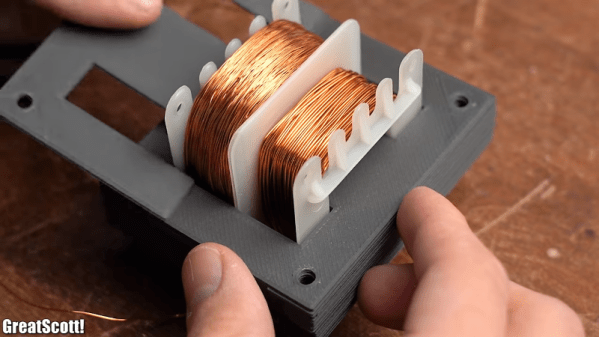
To be fair, the bulk of the video below has nothing to do with 3D-printing of transformer coils. The first part concentrates on building transformer cores up from scratch with commercially available punched steel laminations, in much the same way that manufacturers do it. Going through that exercise and the calculations it requires is a great intro to transformer design, and worth the price of admission alone. With the proper number of turns wound onto a bobbin, the laminated E and I pieces were woven together into a core, and the resulting transformer worked pretty much as expected.

The 3D-printed core was another story, though. [Great Scott!] printed E and I pieces from the same iron-infused PLA filament that he used when he 3D-printed a brushless DC motor. The laminations had nowhere near the magnetic flux density of the commercial stampings, though, completely changing the characteristics of the transformer. His conclusion is that a printed transformer isn’t possible, at least not at 50-Hz mains frequency. Printed cores might have a place at RF frequencies, though.

In the end, it wasn’t too surprising a result, but the video is a great intro to transformer design. And we always appreciate the “DIY or Buy” style videos that [Great Scott!] does, like his home-brew DC inverter or build vs. buy lithium-ion battery packs.

Continue reading “3D-Printed Transformer Disappoints, But Enlightens”