Hackaday Links Column Banner

Hackaday Links: August 11, 2019

By the time this goes to press, DEFCON 27 will pretty much be history. But badgelife continues, and it’d be nice to have a way of keeping track of all the badges offered. Martin Lebel stepped up to the challenge with a DEF CON 27 badgelife tracker. He’s been tracking the scene since March, and there are currently more than 170 badges, tokens, and shitty add-ons listed. Gotta catch ’em all!

Nice tease, Reuters. We spotted this story about the FAA signing off on beyond-visual-line-of-sight, or BVLOS, operation of a UAV. The article was accompanied by the familiar smiling Amazon logo, leading readers to believe that fleets of Amazon Prime Air drones would surely soon darken the skies with cargoes of Huggies and Tide Pods across the US. It turns out that the test reported was conducted by the University of Alaska Fairbanks along an oil pipeline in the Last Frontier state, and was intended to explore medical deliveries and pipeline surveillance for the oil industry. The only mention of Amazon was that the company reported they’d start drone deliveries in the US “in months.” Yep.

Ever wonder what it takes to get your widget into the market? Between all the testing and compliance requirements, it can be a real chore. Nathaniel tipped us off to a handy guide written by his friend Skippy that goes through the alphabet soup of agencies and regulations needed to get a product to market – CE, RoHS, WEEE, LVD, RED, CE for EMC. Take care of all that paperwork and you’ll eventually get a DoC and be A-OK.

A French daredevil inventor made the first crossing of the English Channel on a hoverboard on Sunday. Yes, we know it’s not an “actual” hoverboard, but it’s as close as we’re going to get with the physics we have access to right now, and being a stand-upon jet engine powered by a backpack full of fuel, it qualifies as pretty awesome. The report says it took him a mere 20 minutes to make the 22-mile (35-km) crossing.


We had a grand time last week around the Hackaday writing crew’s secret underground lair with this delightful Hackaday-Dilbert mashup-inator. Scroll down to the second item on the page and you’ll see what appears to be a standard three-panel Dilbert strip; closer inspection reveals that the text has been replaced by random phrases scraped from a single Hackaday article. It looks just like a Dilbert strip, and sometimes the text even makes sense with what’s going on in the art. We’d love to see the code behind this little gem. The strip updates at each page load, so have fun.

And of course, the aforementioned secret headquarters is exactly what you’d picture – a dark room with rows of monitors scrolling green text, each with a black hoodie-wearing writer furiously documenting the black arts of hacking. OpenIDEO, the “open innovation practice” of global design company IDEO, has issued a challenge to “reimagine a more compelling and relatable visual language for cybersecurity.” In other words, no more scrolling random code and no more hoodies. Do you have kinder, gentler visual metaphors for cybersecurity? You might win some pretty decent prizes for your effort to “represent different terms and ideas in the cybersecurity space in an accessible and compelling way.”

Stepper-Controlled Chop Saw Automates A Tedious Job

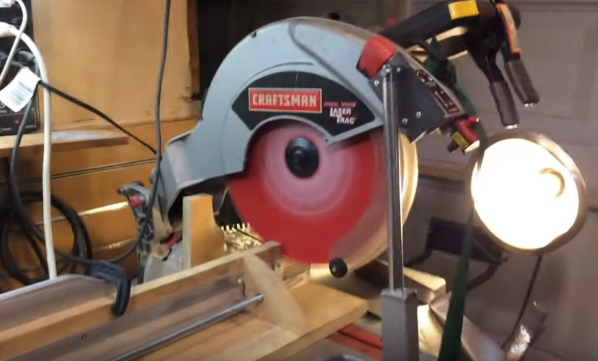
We’re not going to question why [Absorber Of Light] needs to cut a bazillion little fragments of aluminum stock. We assume his reasoning is sound, so all we’re interested in is the automated chop saw he built to make the job less tedious, and potentially less finger-choppy.

There are probably many ways to go about this job, but  [Absorber] leaves few clues as to why he chose this particular setup. Whatever the reason, the build looks like fun, with a long, stepper-driven threaded rod pushing a follower down a track to a standard chop saw. The aluminum stock rides in the track and gets pushed out a set amount before being lopped off cleanly as the running saw is lowered by a linear actuator. The cycle then repeats until the stock is gone.

An Arduino controls the stock-advance stepper in the usual way, but the control method for the linear actuator is somewhat unconventional. A second stepper motor has two cams offset by 180° on the shaft. The cams actuate four microswitches which are set up in an H-bridge configuration. The stepper swivels back and forth to run the linear actuator first in one direction then the other, with a neutral position in between. It’s an interesting approach using mechanical rather than the typical optical isolation. Check it out in action in the video below.

We’ll admit to some curiosity as to the use of the coupons this rig produces, so maybe we’ll get lucky with some details from [Absorber Of Light] in the comment section. After all, we knew exactly what the brass tubes being cut by the similar “Auto Mega Cut-O-Matic”  were being used for.

Continue reading “Stepper-Controlled Chop Saw Automates A Tedious Job”

Pop-Up Outlet Helps Make The Most Of A Tiny Shop

You’ve got to admire the steps some people take to squeeze a shop into a small space. Finding ways to pack in ever more tools and to work on bigger and bigger projects become ends to themselves for some, and the neat little tricks they find to do so can be really instructive.

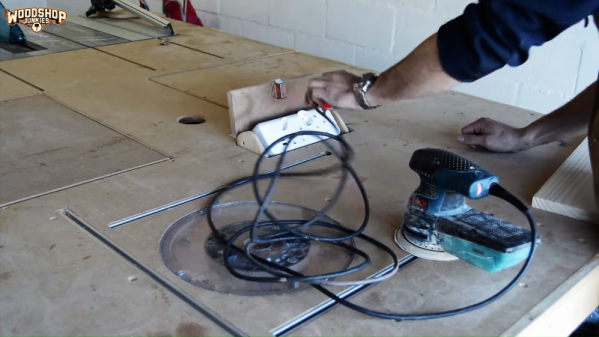
Take this workbench pop-up outlet strip for example. The shop that [Woodshop Junkies] occupies appears to be a single-car garage, on the smallish size in the first place, that is almost entirely filled with a multipurpose workbench. It provides tons of storage underneath and a massive work surface on top, but working with small power tools means stretching extension cords across the already limited floor space and creating a tripping hazard. So he claimed a little space on the benchtop for a clever trap door concealing a small tray holding an outlet strip.

The tray rides on short drawer glides and, thanks to a small pneumatic spring, pops up when the door is unlatched. There was a little trouble with some slop in the glides causing the tray to jam, but that was taken care of with a simple roller bearing. The video below shows its construction and how it stays entirely out of the way until needed.



As cool as this build is, it’s just icing on the small shop cake when compared to the workbench. [Woodshop Junkies] has a complete playlist covering the build which is worth watching. And you might want to refer to our tiny shop roundup for more tips on getting a lot done in a little space.

Continue reading “Pop-Up Outlet Helps Make The Most Of A Tiny Shop”

CNC Machine Rolls Up An Axis To Machine PVC Pipe

Whether it’s wood, metal, plastic, or otherwise, when it comes to obtaining materials for your builds, you have two choices: buy new stock, or scrounge what you can. Fresh virgin materials are often easier to work with, but it’s satisfying to get useful stock from unexpected sources.

This CNC router for PVC pipe is a great example of harvesting materials from an unusual source. [Christophe Machet] undertook his “Pipeline Project” specifically to explore what can be made from large-diameter PVC pipe, of the type commonly used for sewers and other drains. It’s basically a standard – albeit large-format – three-axis CNC router with one axis wrapped into a cylinder. The pipe is slipped around a sacrificial mandrel and loaded into the machine, where it rotates under what looks like a piece of truss from an antenna tower. The spindle seems a bit small, but it obviously gets the job done; luckily the truss has the strength and stiffness to carry a much bigger spindle if that becomes necessary in the future.

The video below shows the machine carving up parts for some lovely chairs. [Christophe] tells us that some manual post-forming with a heat gun is required for features like the arms of the chairs, but we could see automating that step too. We like the look of the pieces that come off this machine, and how [Christophe] saw a way to adapt one axis for cylindrical work. He submitted this project for the 2019 Hackaday Prize; have you submitted your entry yet?

Continue reading “CNC Machine Rolls Up An Axis To Machine PVC Pipe”

Kitty Litter And Broken Light Bulbs Power This Homebrew Gas Chromatograph

We’re always on the lookout for unexpected budget builds here at Hackaday, and stumbling across a low-cost, DIY version of an instrument that sells for tens of thousands of dollars is always a treat. And so when we saw a tip for a homebrew gas chromatograph in the tips line this morning, we jumped on it. (Video embedded below.)

For those who haven’t had the pleasure, gas chromatography is a chemical analytical method that’s capable of breaking a volatile sample up into its component parts. Like all chromatographic methods, it uses an immobile matrix to differentially retard the flow of a mobile phase containing the sample under study, such that measurement of the transit time through the system can be made and information about the physical properties of the sample inferred.

The gas chromatograph that [Chromatogiraffery] built uses a long stainless steel tube filled with finely ground bentonite clay, commonly known as kitty litter, as the immobile phase. A volatile sample is injected along with an inert carrier gas – helium from a party balloon tank, in this case – and transported along the kitty litter column by gas pressure. The sample interacts with the column as it moves along, with larger species held back while smaller ones speed along. Detection is performed with thermal conductivity cells that use old incandescent pilot lamps that have been cracked open to expose their filaments to the stream of gas; using a Wheatstone bridge and a differential amp, thermal differences between the pure carrier gas and the eluate from the column are read and plotted by an Arduino.

The homebrew GC works surprisingly well, and we can’t wait for [Chromatogiraffery] to put out more details of his build.

Continue reading “Kitty Litter And Broken Light Bulbs Power This Homebrew Gas Chromatograph”

Holey Moley: Fixing The Mars InSight Mole

In the early 1990s, NASA experienced a sea change in the way it approached space exploration. Gone were the days when all their programs would be massive projects with audacious goals. The bulk of NASA’s projects would fall under the Discovery Project and hew to the mantra “faster, better, cheaper,” with narrowly focused goals and smaller budgets, with as much reuse of equipment as possible.

The idea for what would become the Mars InSight mission first appeared in 2010 and was designed to explore Mars in ways no prior mission had. Where Viking had scratched the surface in the 1970s looking for chemical signs of life and the rovers of the Explorer program had wandered about exploring surface geology, InSight was tasked with looking much, much deeper into the Red Planet.

Sadly, InSight’s primary means of looking at what lies beneath the regolith of Mars is currently stuck a few centimeters below the surface. NASA and JPL engineers are working on a fix, and while it’s far from certain that that they’ll succeed, things have started to look up for InSight lately. Here’s a quick look at what the problem is, and a potential solution that might get the mission back on track.

Continue reading “Holey Moley: Fixing The Mars InSight Mole”

Punch Those Hole-Drilling Blues Away With A Homebrew Punching Tool

Four times the holes, four times the trouble. With the fate of repetitive motion injury looming due to the need to drill 1,200 holes, [bitluni] took matters into his own hands and built this nifty DIY hole punch for light-gauge sheet metal.

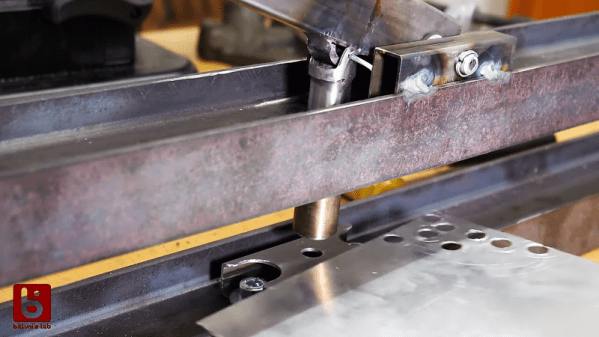
A little backstory will probably help understand why [bitluni] needs so many holes. Back in May, he built a ping pong ball LED video wall for Maker Faire Berlin. That had 300 LEDs and came out great, but at the cost of manually drilling 300 holes in sheet steel with a hand drill. Looking to expand his wall of balls to four times the original size, [bitluni] chose to spend a few days building a punch to make the job more appealing. The business end, with solid bar stock nested inside pieces of tubing, is a great example of how much you can get done without a lathe. The tool is quite complex, with a spring-loaded pilot to help guide the punching operation. When that proved impractical, [bitluni] changed the tool design and added an internal LED to project crosshairs from inside the tool.

The tool itself is mounted into a sturdy welded steel frame that allows him to cover the whole aluminum sheet that will form the panel of his LED wall. It’s pretty impressive metalwork, especially considering this isn’t exactly in his wheelhouse. And best of all, it works – nice, clean holes with no deformation, and it’s fast, too. We’re looking forward to seeing the mega-LED wall when it’s done.

Continue reading “Punch Those Hole-Drilling Blues Away With A Homebrew Punching Tool”