Color Your World With This CNC Painting Robot

Let’s say you’ve watched a few episodes of “The Joy of Painting” and you want your inner [Bob Ross] to break free. You get the requisite supplies for oil painting – don’t forget the alizarin crimson! – and start to apply paint to canvas, only to find your happy little trees are not so happy, and this whole painting thing is harder than it looks.

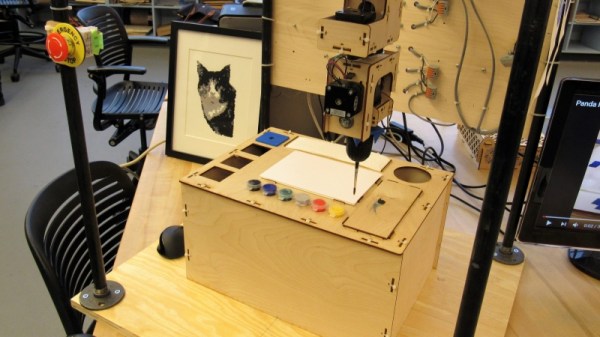
[Saint Bob] would certainly encourage you to stick with it, but if you have not the patience, a CNC painting robot might be a thing to build. The idea behind [John Opsahl]’s “If Then Paint” is not so much to be creative, but to replicate digital images in paint. Currently in the proof-of-concept phase, If Then Paint appears to have two main components: the paint management system, with syringe pumps to squeeze out different paints to achieve just the right color, and the applicator itself, a formidable six-axis device that supports tool changes by using different brushes chucked up into separate hand drill chucks. The extra axes at the head will allow control of how the brush is presented to the canvas, and also allow for cleaning the brush between colors. The videos below show two of the many ways [John] is exploring to clean the brushes, but sadly neither is as exciting as the correct [Bob Ross] method.

It looks like If Then Paint has a ways to go yet, but we’re impressed by some of the painting it has produced already. This is just the kind of project we like to see in the 2019 Hackaday Prize – thought out, great documentation, and a lot of fun.

Continue reading “Color Your World With This CNC Painting Robot”

Kickstarter Hack Chat

Join us on Wednesday, August 7th at noon Pacific for the Kickstarter Hack Chat with Beau Ambur and Clarissa Redwine!

For many of us, magic things happen on our benches. We mix a little of this, one of those, and a couple of the other things, and suddenly the world has the Next Big Thing. Or does it? Will it ever see the light of day? Will you ever build a community around your project so that the magic can escape the shop and survive the harsh light of the marketplace? And perhaps most importantly, will you be able to afford to bring your project to market?

Crowdfunding is often the answer to these questions and more, and Kickstarter is one of the places where hackers can turn their project into a product. Beau and Clarissa, both outreach leads for the crowdfunding company, will stop by the Hack Chat to answer all your questions about getting your project off the bench and into the marketplace. Join us as we discuss everything from building a community that’s passionate enough about your idea to fund it, to the right way to share your design story.

join-hack-chatOur Hack Chats are live community events in the Hackaday.io Hack Chat group messaging. This week we’ll be sitting down on Wednesday, August 7 at 12:00 PM Pacific time. If time zones have got you down, we have a handy time zone converter.

Click that speech bubble to the right, and you’ll be taken directly to the Hack Chat group on Hackaday.io. You don’t have to wait until Wednesday; join whenever you want and you can see what the community is talking about.

Hackaday Links Column Banner

Hackaday Links: August 4, 2019

Is the hacking community facing a HOPEless future? It may well be, if this report from 2600 Magazine is any indication. The biennial “Hackers On Planet Earth” conference is in serious financial jeopardy after the venue that’s hosted it for years, the Hotel Pennsylvania in Manhattan, announced a three-fold increase in price. Organizers are scrambling to save the conference and they’re asking for the community’s help in brainstorming solutions. Hackaday was at HOPE XI in 2016 and HOPE XII in 2018; let’s HOPE we get to see everyone again in 2020.

If you’ve ever been curious about how a 1970s PROM chip worked, Ken Shirriff has you covered. Or uncovered, as he popped the top off a ceramic MMI 5300 DIP to look at the die within. Closeups of the somewhat cockeyed die reveal its secrets – 1,024 tiny fusible links. Programming was a matter of overloading a particular fuse, turning a 1 into a 0 permanently. It’s a fascinating look at how it used to be done, with Ken’s usual attention to detail in the documentation department.

We had a great Hack Chat this week with Mihir Shah from Royal Circuits. Royal is one of the few quick-turn PCB fabs in the USA, and they specialize in lightning-fast turnaround on bare PCBs and assembled boards. He told us all about this fascinating business, and dropped a link to a side project of his. Called DebuggAR, it’s an augmented reality app that runs on a smartphone and overlays component locations, signal traces, pinouts, and more right over a live image of your board. He’s got a beta going now for iPhone users and would love feedback, so check it out.

With all the cool things you can do with LoRa radios, it’s no wonder that wireless hobbyists have taken to pushing the limits on what the technology can do. The world record distance for a LoRa link was an astonishing 702 km (436 miles). That stood for two years until it was topped, twice in the same day. On July 13th, the record was pushed to 741 km, and a mere five hours later to 766 km. All on a scant 25 mW of power.

Linux distro Manjaro made an unconventional choice regarding which office suite to include, and it’s making some users unhappy. It appears that they’ve dumped LibreOffice from the base install, opting instead to include the closed-source FreeOffice. Worse, FreeOffice doesn’t have support for saving .doc and OpenDocument files; potentially leaving LibreOffice users stranded. Paying for an upgrade to SoftMaker’s Office product can fix that, but that’s hardly free-as-in-beer free. It’s kind of like saying the beer is free, but the mug is an upgrade. UPDATE: It looks like the Manjaro team heard all the feedback and are working on a selector so you can install the office suite of your choice.

Tragic news out of New Hampshire, as amateur radio operator Joe Areyzaga (K1JGA) was killed while trying to dismantle an antenna tower. Local news has coverage with no substantial details, however the hams over on r/amateurradio seem to have the inside line on the cause. It appears the legs of the tower had filled with water over the years, rusting them from the inside out. The tower likely appeared solid to Joe and his friend Mike Rancourt (K1EEE) as they started to climb, but the tower buckled at the weak point and collapsed. K1EEE remains in critical condition after the 40′ (12 m) fall, but K1JGA is now a silent key. The tragedy serves as a reminder to everyone who works on towers to take nothing for granted before starting to climb.

And finally, just for fun, feast your eyes on this movie of the ESA’s Rosetta spacecraft as is makes its flyby of comet 67P/Churyumov–Gerasimenko. It’s stitched together from thousands of images and really makes 67P look like a place, not just a streak of light in the night sky.

Fail Of The Week: Toilets And High Voltage Do Not Mix

Imagine if you will that you are enthroned upon the porcelain, minding your own business while doing your business. You’re catching up on Hackaday on your phone – c’mon, admit it – when a whir and a buzz comes from behind you. You sit up in alarm, whereupon your lower back suddenly feels as if someone is scrubbing it with a steel wool pad. Then the real pain sets in as super-hot plasma lances into your skin, the smell of burning flesh fills the bathroom, and you crack your head on the towel bar trying to escape this torture chamber in a panic.

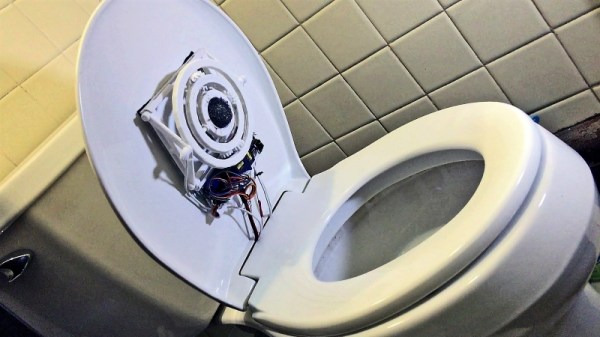
Sound good? Then [Vije Miller]’s plasma-powered toilet air freshener is a must-build for you. We’re not entirely sure where this was going, but the name of the project seems to indicate a desire to, ahem, clear the air near your derrière with the power of ions. While that might work – we’ve recently seen an electrostatic precipitator for 3D-printer fumes – the implementation here is a bit sketchy. The ball of steel wool? It was possibly intended as a way to disperse the ions, but it served as nothing more than fuel when touched by the plasma. The Contact-esque gimballed rings? Not a clue what they’re for, but they look cool. And hats off to [Vije] for the intricate 3D-printed parts, the geartrain and linkages, and the DIY slip rings.

It may be a head-scratcher of a build, but the video below is entertaining. Check out some of [Vije]’s other projects of dubious value, like his licorice launcher or the smartphone back scratcher.

Continue reading “Fail Of The Week: Toilets And High Voltage Do Not Mix”

Ask Hackaday: How Would You Build This Flight Tracker For Kids?

You’ve got to hand it to marketers – they really know how to make you want something. All it takes is a little parental guilt, a bit of technical magic, and bam, you’re locked into a product you never knew you needed.

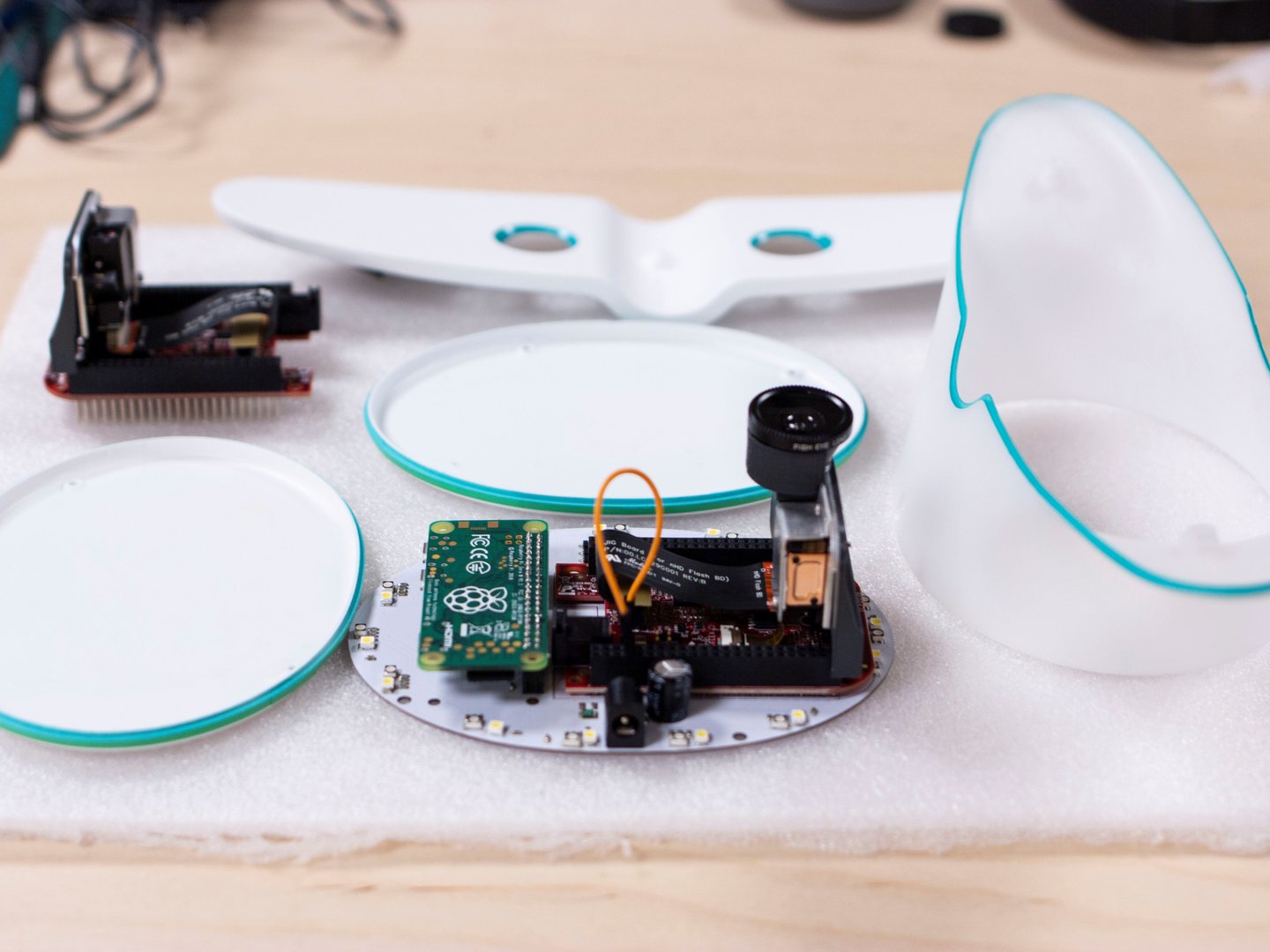
This prototype flight tracking nightlight for kids is a great example. Currently under development by Canadian airline WestJet, the idea is to provide a way for traveling parents to let kids know how long it is until Mommy or Daddy gets home from their trip. The prototype shows a stylized jet airliner with Neopixel lighting in the base. A pair of projectors in the wings shine an animated flight path on the child’s darkened bedroom ceiling, showing them when the wayward parent will return. Get past the schmaltz in the video below, and perhaps get over your jealousy of parents with kids who still eagerly await their return, and it’s actually a pretty good idea.

Now for the ask: how would you go about building something like this? And more importantly, how would you make it work for any plane, train, or automobile trip, and not just a WestJet flight? A look at the “How it will work” section of the page shows several photos of the prototype, which suggests the hardware end is dead easy. A Raspberry Pi Zero W features prominently, and the projectors appear to be TI’s DLP2000EVM, which we’ve featured before, mounted to a riser card. The Neopixels, a 3D-printed case, and the superfluous flashlight fuselage would be pretty easy, too.

On the software side, a generic version that tracks flight from any airline would need an interface for the traveler to define a flight, and something to check an API like FlightAware’s, or similar ones for whatever mode of transportation you’re using.

Seems like a pretty straightforward project. WestJet claims they’ll have their Flight Light ready sometime this summer; think we can beat them to it?

Continue reading “Ask Hackaday: How Would You Build This Flight Tracker For Kids?”

A Farewell To YouTube Sub Counters Set To Break With API Change

Of all the things you never would have guessed you’d need just ten years ago, a YouTube subscriber counter would probably rank highly. You would have guessed that the little hits of dopamine accompanying each tick upward of a number would be so addictive?

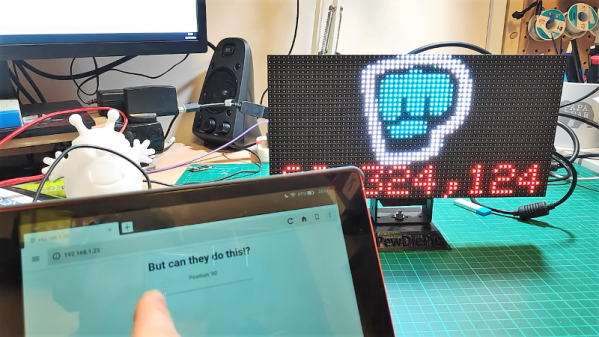
As it turns out, lots of people wanted to keep a running total of their online fans, and a bewilderingly varied ecosystem of subscriber counters has cropped up. All of them rely on the API that YouTube exposes for such purposes, which as [Brian Lough] points out is about to change and break every subscription counter ever made. In the YouTube sub counter space, [Brian] is both an enabler – he built an Arduino wrapper to fetch YT sub counts easily – and a serial builder of displays for other YouTubers. The video below shows a collection of his work, many based on RGB LED matrix display, like the one used in his Tetris-themed sub counter. They’re all well-built, nice to look at, and sadly, destined for obsolescence sometime in August when the API changes.

The details of the API changes were made public in April, and for the subs count it amounts to rounding the count and displaying large counts as, for instance, 510k as opposed to 510,023. We’re confident that [Brian] and other display builders will be able to salvage some of their counters with code changes, but others will probably require hardware changes. Thanks, YouTube.

Continue reading “A Farewell To YouTube Sub Counters Set To Break With API Change”

Automate The Freight: When The Freight Is People

Before I got a license and a car, getting to and from high school was an ordeal. The hour-long bus ride was awful, as one would expect when sixty adolescents are crammed together with minimal supervision. Avoiding the realities going on around me was a constant chore, aided by frequent mental excursions. One such wandering led me to the conclusion that we high schoolers were nothing but cargo on a delivery truck designed for people. That was a cheery fact to face at the beginning of a school day.

What’s true for a bus full of students is equally true for every city bus, trolley, subway, or long-haul motorcoach you see. People can be freight just as much as pallets of groceries in a semi or a bunch of smiling boxes and envelopes in a brown panel truck. And the same economic factors that we’ve been insisting will make it far more likely that autonomous vehicles will penetrate the freight delivery market before we see self-driving passenger vehicles are at work with people moving. This time on Automate the Freight: what happens when the freight is people?

Continue reading “Automate The Freight: When The Freight Is People”