Exploring Basement Humidity With A Raspberry Pi

Sometimes a hack isn’t about building something cool. Sometimes it’s more tactical, where the right stuff is cobbled together to gather the information needed to make decisions, or just to document some interesting phenomenon.

Take this impromptu but thorough exploration of basement humidity undertaken by [Matthias Wandel]. Like most people with finished basements in their homes, [Matthias] finds the humidity objectionable enough to warrant removal. But he’s not one to just throw a dehumidifier down there and forget about it. Seeking data on how well the appliance works, [Matthias] wired a DHT22 temperature/humidity sensor to a spare Raspberry Pi to monitor room conditions, and plugged the dehumidifier into a Kill-A-Watt with a Pi camera trained on the display to capture data on electrical usage.

His results were interesting. The appliance does drop the room’s humidity while raising its temperature, a not unexpected result given the way dehumidifiers work. But there was a curious cyclical spike in humidity, corresponding to the appliance’s regular defrost cycle driving moisture back into the room. And when the dehumidifier was turned off, room humidity gradually increased, suggesting an unknown source of water. The likely culprit: moisture seeping up through the concrete slab, or at least it appeared so after a few more experiments. [Matthias] also compared three different dehumidifiers to find the best one. The video below has all the details.

We always appreciate [Matthias]’ meticulous approach to problems like these, and his field expedient instrumentation. He seems to like his creature comforts, too – remember the target-tracking space heater from a few months back?

Continue reading “Exploring Basement Humidity With A Raspberry Pi”

Automatic Cut-Off Saw Takes The Tedium Out Of A Twenty-Minute Job

For [Turbo Conquering Mega Eagle], the question was simple: Do I spend 20 minutes slaving away in front of a bandsaw to cut a bunch of short brass rods into even shorter pieces of brass rod? Or do I spend days designing and building an automatic cutoff saw to do the same job? The answer is obvious.

It’s only at the end of the video below that [TCME] reveals the need for these brass bits: they’re for riveting together the handles of knives he makes and sells. That makes the effort that went into his “Auto Mega Cut-O-Matic” a little easier to swallow, although we still think he ran afoul of this relevant XKCD. The saw is built out of scraps and odd bits using angle iron as a base and an electric die grinder to spin a cut-off wheel. A small gear motor feeds the brass rod down a guide tube until it hits a microswitch stop, which starts the cut cycle. Another motor swivels the saw to make the cut then moves it out of the way so the stock can advance. The impressive thing is that the only control mechanism is a series of microswitches, cams, levers, and springs  – no Arduino needed. Heck, there’s not even a 555, which we find a refreshing change.

Yes, it’s overkill, but he had fun and made something pretty ingenious. [Turbo Conquering Mega Eagle] always has something interesting going on in the shop, and we couldn’t help but notice him using his aluminum-melting tea kettle to make some parts for this build.

Continue reading “Automatic Cut-Off Saw Takes The Tedium Out Of A Twenty-Minute Job”

Lighting Tech Dives Into The Guts Of Laser Galvanometers

There’s something magical about a laser light show. Watching that intense beam of light flit back and forth to make shapes and patterns, some of them even animated, is pretty neat. It leaves those of us with a technical bent wondering just exactly how the beam is manipulated that fast.

Wonder no more as [Zenodilodon], a working concert laser tech with a deep junk bin, dives into the innards of closed-loop galvanometers, which lie at the heart of laser light shows. Galvos are closely related to moving-coil analog meters, which use the magnetic field of a coil to deflect a needle against spring force to measure current. Laser galvos, on the other hand, are optimized to move a lightweight mirror back and forth, by tiny amounts but very rapidly, to achieve the deflection needed to trace out shapes.

As [Zeno] explains in his teardown of some galvos that have seen better days, this means using a very low-mass permanent magnet armature surrounded by coils. The armature is connected to the mirror on one end, and a sensor on the other to provide positional feedback. We found this part fascinating; it hadn’t occurred to us that laser galvos would benefit from closed-loop control. And the fact that a tiny wiggling vane can modulate light from an IR LED enough to generate a control signal is pretty cool too.

The video below may be a bit long, but it’s an interesting glimpse into the day-to-day life of a lighting tech. It puts a little perspective on some of the laser projection projects we’ve seen, like this giant Asteroids game.

Continue reading “Lighting Tech Dives Into The Guts Of Laser Galvanometers”

Syringe Pump Turns CNC Machine Into A Frosting Bot

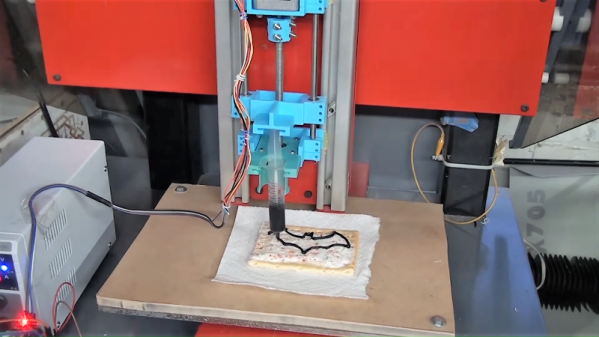
“Amazing how with only the power of 3D-printing, two different computers, hundreds of dollars in CNC machinery, a lathe, and modern microcontroller magic, I can almost decorate a cupcake as well as a hyperactive ten-year-old.”  We can think of no better way to sum up [Justin]’s experiment in CNC frosting application, which turns out to only be a gateway to more interesting use cases down the road.

Granted, it didn’t have to be this hard. [Justin] freely admits that he took the hard road and made parts where off-the-shelf components would have been fine. The design for the syringe pump was downloaded from Thingiverse and does just about what you’d expect – it uses a stepper motor to press down on the plunger of a 20-ml syringe full of frosting. Temporarily attached in place of the spindle on a CNC router, the pump dispenses onto the baked goods of your choice, although with an irregular surface like a muffin top the results are a bit rough. The extruded frosting tends to tear off and drop to the surface of the cake, distorting the design. We’d suggest mapping the Z-height of the cupcake first so the frosting can dispense from a consistent height.

Quality of the results is not really the point, though. As [Justin] teases, this hardware is in support of bioprinting of hydrogels, along with making synthetic opals. We’re looking forward to those projects, but in the meantime, maybe we can all just enjoy a spider silk beer with [Justin].

Continue reading “Syringe Pump Turns CNC Machine Into A Frosting Bot”

Custom Machined Pump Keeps CNC Lubrication Under Control

Rub two pieces of metal against each other hard enough, and it won’t be long before they heat up sufficiently to cause problems. That’s especially true when one is a workpiece and one is a tool edge, and the problems that arise from failing to manage the heat produced by friction can cost you dearly.

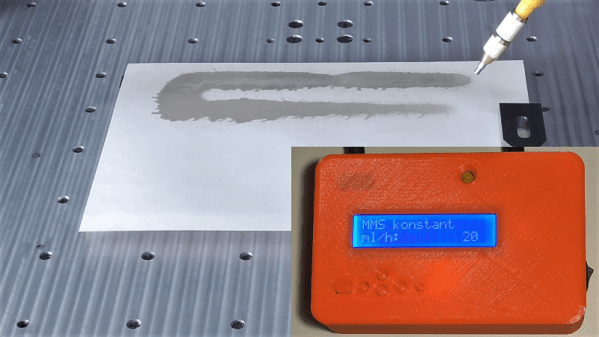
The traditional way of dealing with this is by pumping heavy streams of liquid coolant at the workpiece, but while that works, it creates problems of its own. That’s where minimum quantity lubrication comes in. MQL uses a fine mist of lubricant atomized in a stream of compressed air, which saves on lube and keeps swarf cleaner for easier recycling. The gear needed for MQL can be pricey though, so [brockard] decided to add homebrew MQL to his CNC router, with great results.

The video below shows the whole process, from raw metal to finished system – skip ahead to about 12 minutes if you just want to see final testing, but be warned that you’ll be missing some high-quality machining. The finished pump is a double-piston design, with each side driven by a cam rotated by a servo. An Arduino controls the speed of the motor based on the current settings; the pump is turned on and off through G-code control of a relay.

The lubricant stream is barely visible in the video, as opposed to the sloshing mess of traditional flood coolants, and seems much more suitable for a hobbyist-grade CNC setup. Need to build a CNC router before you build this? You can do much worse than this one.

Continue reading “Custom Machined Pump Keeps CNC Lubrication Under Control”

Trick Shot Bot Flings Balls Into Wine Glass Every Time

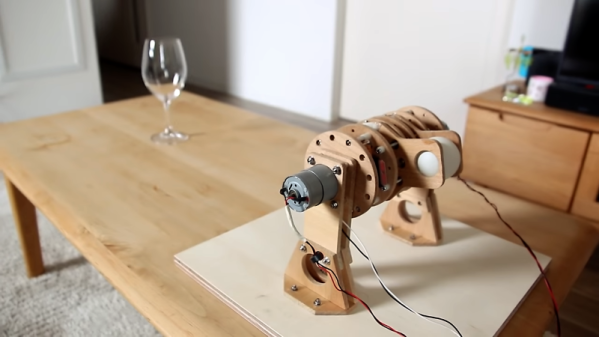
We’ve heard of beer pong, but we’re not sure we’ve heard of wine pong. And certainly never wine pong automated with a ping pong ball throwing robot like this one.

There’s not a huge amount of detail available in the video below, and no build log per se. But [Electron Dust] has a few shots in the video that explain what’s going on, as well as a brief description in a reddit thread about the device. The idea is to spin a ball up to a steady speed and release it the same way every time. The rig itself is made of wood and spun by plain brushed DC motors – [Electron Dust] explains that he chose them over PWM servos to simplify things and eliminate uncertainty in the release point. The ball is retained by a pair of arms, each controlled by a pair of hobby servos. An Arduino spins along with everything else and counts 50 revolutions before triggering the servos to retract and release the ball. A glass positioned at the landing spot captures the ball perfectly once everything is dialed in.

Here’s hoping that build details end up on his blog soon, as they did for this audio-feedback juggling machine. And while we certainly like this project, it might be cool if it could aim the ball into the glass. Or it could always reposition the target on the fly.

Continue reading “Trick Shot Bot Flings Balls Into Wine Glass Every Time”

Preserving Computer History Hack Chat

Join us on Wednesday 26 June 2019 at noon Pacific for the Preserving Computer History Hack Chat with Dag Spicer!

In our age of instant access to the seeming total of human knowledge at the swipe of a finger, museums may seem a little anachronistic. But the information available at our fingertips is often only the tip of the iceberg, and institutions like the Computer History Museum in Mountain View, California are dedicated to collecting and preserving the artifacts of the information age, capturing the intellectual capital that went into making them, and perhaps more importantly, providing context and making everything accessible.

The CHM is an incredible resource for anyone doing research involving the early days of computing. Dag Spicer is the Senior Curator at CHM, or “Chief Content Officer” as he likes to put it. Dag has been collecting, cataloging, and overseeing the largest collection of computer artifacts in the world for almost 25 years, and he has some stories to tell. He’ll stop by the Hack Chat this week to share them, and to answer your questions about the history of computers and how studying the past shapes the future of computing.

join-hack-chatOur Hack Chats are live community events in the Hackaday.io Hack Chat group messaging. This week we’ll be sitting down on Wednesday June 26 at 12:00 PM Pacific time. If time zones have got you down, we have a handy time zone converter.

Click that speech bubble to the right, and you’ll be taken directly to the Hack Chat group on Hackaday.io. You don’t have to wait until Wednesday; join whenever you want and you can see what the community is talking about.