Sensor-Laden Pigeons Gather Data For Urban Weather Modeling

When it comes to gathering environmental data in real-world settings, urban environments have to be the most challenging. Every city has nooks and crannies that create their own microenvironments, and placing enough sensors to get a decent picture of what’s going on in all of them is a tough job. But if these sensor-laden pigeons have anything to say about it, the job might get a bit easier.

The idea for using pigeons as biotelemetry platforms comes to us from the School of Geography, Earth, and Environmental Sciences at the University of Birmingham in the UK. [Rick Thomas], lead investigator on the “CityFlocks” project, explains that meteorological models are hampered by a lack of data about the air in the urban canyons formed by tall buildings. Placing a lot of fixed sensors has a prohibitive cost, and using drones to do the job would probably cause regulatory problems, especially given recent events. But pigeons are perfect for the job once they’re outfitted with an “Avian-Meteorology Instrumentation Package (AvMIP)”. From the photographs we’re guessing the AvMIP is a pretty simple data logger with GPS and inputs for the usual sensors, all powered by a small LiPo pack. Luckily, the pigeons used are all domesticated racing birds that return to the nest, so no radio transmitter is needed, but if other urban avians such as peregrine falcons and seagulls are used then a future AvMIPS might leverage pervasive WiFi networks to upload data.

It’s not the first time we’ve seen mobile platforms used to fill in gaps in weather data, of course. And if this at all puts you in mind of that time pigeons were used to guide bombs, relax – no pigeons were harmed in the making of this research project.

Thanks to [Itay Ramot] for the tip [via Gizmodo].

Ask Hackaday: Get The Lead Out Or Not?

For most of the history of industrial electronics, solder has been pretty boring. Mix some lead with a little tin, figure out how to wrap it around a thread of rosin, and that’s pretty much it. Sure, flux formulations changed a bit, the ratio of lead to tin was tweaked for certain applications, and sometimes manufacturers would add something exotic like a little silver. But solder was pretty mundane stuff.

Source: RoHS Guide

Then in 2003, the dull gray world of solder got turned on its head when the European Union adopted a directive called Restriction of Hazardous Substances, or RoHS. We’ve all seen the little RoHS logos on electronics gear, and while the directive covers ten substances including mercury, cadmium, and hexavalent chromium, it has been most commonly associated with lead solder. RoHS, intended in part to reduce the toxicity of an electronic waste stream that amounts to something like 50 million tons a year worldwide, marked the end of the 60:40 alloy’s reign as the king of electrical connections, at least for any products intended for the European market, when it went into effect in 2006.

Continue reading “Ask Hackaday: Get The Lead Out Or Not?”

ESP32 Video Tricks Hack Chat With Bitluni

Join us Wednesday at noon Pacific time for the ESP32 Video Tricks Hack Chat!

The projects that bitluni works on have made quite a few appearances on these pages over the last couple of years. Aside from what may or may not have been a street legal electric scooter, most of them have centered around making ESP32s do interesting tricks in the analog world. He’s leveraged the DACs on the chip to create an AM radio transmitter, turned an oscilloscope into a video monitor, and output composite video. That last one was handy for turning a Sony Watchman into a retro game console. He’s also found ways for the ESP32 to output VGA signals. Looks like there’s no end to what he can make the versatile microcontroller do.

Although the conversation could (and probably will) go anywhere, we’ll start with video tricks for the ESP32 and see where it goes from there. Possible topics include:

  • Tricks for pushing the ESP32 DACs to their limits;
  • When to use an external DAC;
  • Optimizing ESP32 code by running on separate cores; and
  • What about HDMI on the ESP32?

You are, of course, encouraged to add your own questions to the discussion. You can do that by leaving a comment on the ESP32 Video Tricks Hack Chat and we’ll put that in the queue for the Hack Chat discussion.

join-hack-chatOur Hack Chats are live community events on the Hackaday.io Hack Chat group messaging. This week we’ll be sitting down on Wednesday, March 27, at noon, Pacific time. If time zones have got you down, we have a handy time zone converter.

Click that speech bubble to the right, and you’ll be taken directly to the Hack Chat group on Hackaday.io. You don’t have to wait until Wednesday; join whenever you want and you can see what the community is talking about.

Magnetic Bearings Might Keep This Motor Spinning For Millennia

We see our share of pitches for perpetual motion machines in the Hackaday tips line, and we generally ignore them and move along. And while this magnetic levitation motor does not break the laws of thermodynamics, it can be considered a perpetual motion machine, at least for certain values of perpetuity.

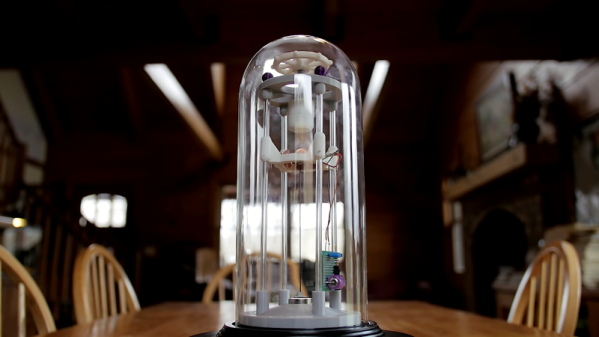
The motor that [lasersaber] presents in the video below is unconventional, to say the least. It’s not a motor that can do any useful work, spinning at a stately pace beneath its bell-jar enclosure as it does. The design is an extension of [lasersaber]’s “EZ-Spin” motor, which we’ve featured before, and has the same basic layout – a ring of coils wired in series forms the stator, while a disc bearing permanent magnets forms the rotor. The coils, scavenged from those dancing flowerpot solar ornaments, are briefly energized by the rotor passing over a reed switch, giving the rotor a little boost.

The difference here is that rather than low-friction sapphire bearings, this motor uses zero-friction magnetic levitation using pyrolyzed graphite discs. The diamagnetic material hovers above a rare-earth ring magnet, supporting a slender vertical shaft that holds the rotor and another magnetic bearing at the top. It’s fussy to adjust, but once it’s stable, the only friction in the system should be the drag caused by air in the bell jar. [lasersaber]’s current measurements of the motor running at slow speed are hard to believe – 150 nanoamps – leading to an equally jaw-dropping calculated run-time on a single AA battery of 89 millennia.

[lasersaber] is the first to admit that he’s not confident with his measurements, but it seems clear that his motor will likely outlive any chemical battery used to power it. Whatever the numbers are, we like the styling of the thing, and the magnetic bearings are cool too.

Continue reading “Magnetic Bearings Might Keep This Motor Spinning For Millennia”

Imitating Art In Life With A Reverse-Engineered Tattoo

In general, tattoo artists are not electrical engineers. That’s fine; the world needs both professions. But when you need a circuit designed, you’re better off turning to an EE rather than a tattoo artist. And you certainly don’t want an EE doing your new ink. Disaster lies that way.

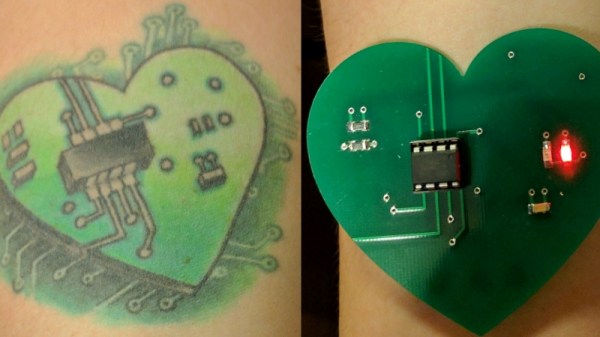
Surprisingly, [Missa]’s tattoo of a heart-shaped circuit turned out at least to be plausible design, even if it’s not clear what it’s supposed to do. So her friend [Jeremy Elson] took up the challenge to create a circuit that looked like the tattoo while actually doing something useful. He had to work around the results of tattoo artistic license, like sending traces off to the board’s edge and stranding surface-mount components without any traces. The artist had rendered an 8-pin DIP device, albeit somewhat proportionally challenged, so [Jeremy] went with an ATtiny85, threw on a couple of SMD resistors and a cap, and placed two LEDs for the necessary blinkenlights. Most of the SMDs are fed from traces on the back of the board that resurface through vias, and a small coin cell hidden on the back powers it. One LED blinks “Happy Birthday [Missa]” in Morse, while the other blinks prime numbers from 2 to 23 – we’ll assume this means it was [Missa]’s 23rd birthday.

There’s a surprising amount of crossover between the worlds of electronics and tattooing. We’ve featured functional temporary tattoo circuits, prison-expedient tattoo guns, and even a CNC tattoo machine.

Continue reading “Imitating Art In Life With A Reverse-Engineered Tattoo”

Raspberry Pi Tracks Humans, Blasts Them With Heat Rays

Given how long humans have been warming themselves up, you’d think we would have worked out all the kinks by now. But even with central heating, and indeed sometimes because of it, some places we frequent just aren’t that cozy. In such cases, it often pays to heat the person, not the room, but that can be awkward, to say the least.

Hacking polymath [Matthias Wandel] worked out a solution to his cold shop with this target-tracking infrared heater. The heater is one of those radiant deals with the parabolic dish, and as anyone who’s walked past one on demo in Costco knows, they throw a lot of heat in a very narrow beam. [Matthias] leveraged a previous project that he whipped up for offline surveillance as the core of the project. Running on a Raspberry Pi with a camera, the custom software analyzes images and locates motion across the width of a frame. That drives a stepper that swivels a platform for the heater. The video below shows the build and the successful tests; however, fans of [Matthias] should prepare themselves for a shock as he very nearly purchases a lazy susan to serve as the base for the heater rather than building one.

We’re never disappointed by [Matthias]’ videos, and we’re always impressed by his range as a hacker. From DIY power tools to wooden logic circuits to his recent Lego chocolate engraver, he always finds ways to make things interesting.

Continue reading “Raspberry Pi Tracks Humans, Blasts Them With Heat Rays”

Whirling Sawblades Turn Foam Packaging Into Wall Insulation

If you’re like us, the expanded polystyrene (EPS) foam inserts that protect many packages these days are a source of mixed feeling. On the one hand, we’re glad that stuff arrives intact thanks to the molded foam inserts. But it seems so wasteful, especially when chucking it in the garbage can. If only it could be effectively recycled.

It turns out that it can be, if you equip yourself with this spinning “sawblades of doom” EPS recycler. It comes by way of [HowToLou], who was looking for a way to insulate a wall on the cheap. Almost all commercially available insulating materials – fiberglass batts, blown-in cellulose, expanding polyisocyanurate – are pretty pricey. Foam packing pieces are pretty easy to come by, though, and usually free for the taking. [Lou]’s method of turning them into insulation is a box containing four circular saw blades mounted to a piece of threaded rod and spun by a cordless drill. The blades are mounted askew on the rod for better reduction of the foam; [Lou] chose to use wire to hold the blades down, while we’d have printed up some slanted arbors and bolted the blades down more firmly. A chicken wire prefilter keeps the big chunks from clogging a blower made from an old bathroom exhaust fan, which does a great job of filling the wall cavities with pulverized EPS nuggets. The video below has all the details.

Honestly, the box is a little scary, and we have doubts that [Lou] will be able to get enough foam to finish the job, but it’s still a clever little hack. Grinding things up seems to be a theme for him; check out his leaf collector or his apple cider press.

Continue reading “Whirling Sawblades Turn Foam Packaging Into Wall Insulation”