Flash A Light Bulb, Win A Prize

How many geeks does it take to flash a lightbulb? Judging from the list of entries in the 2017 Flashing Light Prize, so far only seven. But we suspect Hackaday readers can add to that total.

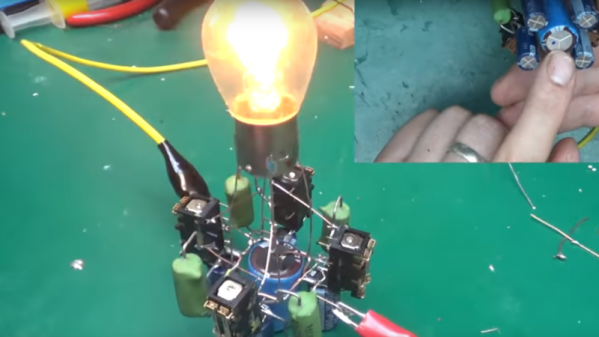
The goal is almost as simple as possible: build something that can flash an incandescent light bulb for at least five minutes. The system actually has to power the bulb’s filament, so no mechanical shutters are allowed. Other than that, the sky is the limit — any voltage, any wattage, any frequency and duty cycle, and any circuit. Some of the obvious circuits, like an RC network on a relay, have been tried. But we assume there will be points for style, in which case this sculptural cascading relay flasher might have a chance. Rube Goldberg mechanical approaches are encouraged, as in this motor, thread, stick and switch contraption. But our fave thus far is the 1000-watt bulb with solar cell feedback by Hackaday regular [mikeselectricstuff].

Get your entry in before August 1st and you’ll be on your way to glory and riches — if your definition of rich is the £200 prize. What the heck, your chances are great right now, and it’s enough for a few pints with your mates. Just don’t let it distract you from working on your 2017 Hackaday Prize entry — we’re currently in the “Wheels, Wings, and Walkers” phase, so maybe there’ll be a little crossover that you can leverage for your flasher.


Continue reading “Flash A Light Bulb, Win A Prize”

IPad, Not Flux Capacitor, Brings DeLorean Back To The Future

Add a flux capacitor and a Mr. Fusion to a DeLorean and it becomes a time machine. But without those, a DeLorean is just a car. A 35-year old car at that, and thus lacking even the most basic modern amenities. No GPS, no Bluetooth — not even remote locks for the gullwing doors!

To fix that, [TheKingofDub] decided to deck his DeLorean out with an iPad dash computer that upgrades the cockpit experience, and we have to say we’re impressed by the results. Luckily, the space occupied by the original stereo and dash vents in the center console is the perfect size for an iPad mini, even with the Lightning cable and audio extension cable attached. A Bluetooth relay module is used to interface to the doors, windows, trunk, garage door remote, and outdoor temperature sensor. A WiFi backup camera frames the rear license plate. Custom software ties everything together with OEM-looking icons and a big GPS speedometer. The build looks great, adds functionality, and should make road trips a little easier.

When [TheKingofDub] finally gets sick of people complaining about where the BTTF guts are, maybe he can add a flux capacitor and time circuits.

[via r/electronics]

Fail Of The Week: Tracking Meteors With Weather Radio

It’s not hard to detect meteors: go outside on a clear night in a dark place and you’re bound to see one eventually. But visible light detection is limiting, and knowing that meteors leave a trail of ions means radio detection is possible. That’s what’s behind this attempt to map meteor trails using broadcast signals, which so far hasn’t yielded great results.

Passing jet’s Doppler signature

The fact that meteor trails reflect radio signals is well-known; hams use “meteor bounce” to make long-distance contacts all the time. And using commercial FM broadcast signals to map meteor activity isn’t new, either — we’ve covered the “forward scattering” technique before. The technique requires tuning into a frequency used by a distant station but not a local one and waiting for a passing meteor to bounce the distant signal back to your SDR dongle. Capturing the waterfall display for later analysis should show characteristic patterns and give you an idea of where and when the meteor passed.

[Dave Venne] is an amateur astronomer who turns his eyes and ears to the heavens just to see what he can find. [Dave]’s problem is that the commercial FM band in the Minneapolis area that he calls home is crowded, to say the least. He hit upon the idea of using the National Weather Service weather radio broadcasts at around 160 MHz as a substitute. Sadly, all he managed to capture were passing airplanes with their characteristic Doppler shift; pretty cool in its own right, but not the desired result.

The comments in the RTL-SDR.com post on [Dave]’s attempt had a few ideas on where this went wrong and how to improve it, including the intriguing idea of using 60-meter ham band propagation beacons. Now it’s Hackaday’s turn: any ideas on how to fix [Dave]’s problem? Sound off in the comments below.

Simple Electric Bike Conversion From 3D-Printed Parts

Challenge: Perform an electric conversion on a bicycle. Problem: No significant metal working skills or equipment. Solution: 3D print everything needed to electrify the bike.

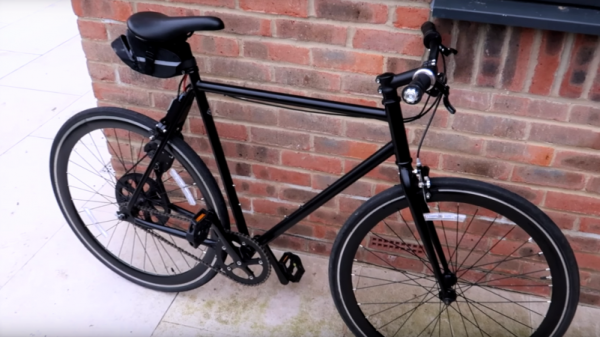
At least that’s the approach that [Tom Stanton] took to his electric bike build. Having caught the electric locomotion bug on a recent longboard build, [Tom] undertook the upgrade of a cheap “fixie,” or fixed-gear bike. His delta printer was big enough for the motor mount and weather-resistant ESC enclosure, but he needed to print the drive pulley in four quadrants that were later glued together. We can’t say we hold much faith in the zip ties that transmit all the torque through the rear wheel’s spokes, but as a proof of concept it seems sturdy enough. With a throttle from an electric scooter and a battery in a saddle bag, the bike turns in pretty decent performance — at least after a minor gearing change. And everything blends in or accents the black frame of the bike, so it’s a good-looking build to boot.

Want to catch the cheap electric personal transportation bug too? Check out this electric longboard, or this all-terrain hoverboard.

Continue reading “Simple Electric Bike Conversion From 3D-Printed Parts”

Go Small, Get Big: The Hack That Revolutionized Bioscience

Few people outside the field know just how big bioscience can get. The public tends to think of fields like physics and astronomy, with their huge particle accelerators and massive telescopes, as the natural expressions of big science. But for decades, biology has been getting bigger, especially in the pharmaceutical industry. Specialized labs built around the automation equipment that enables modern pharmaceutical research would dazzle even the most jaded CERN physicist, with fleets of robot arms moving labware around in an attempt to find the Next Big Drug.

I’ve written before on big biology and how to get more visibility for the field into STEM programs. But how exactly did biology get big? What enabled biology to grow beyond a rack of test tubes to the point where experiments with millions of test occasions are not only possible but practically required? Was it advances in robots, or better detection methodologies? Perhaps it was a breakthrough in genetic engineering?

Nope. Believe it or not, it was a small block of plastic with some holes drilled in it. This is the story of how the microtiter plate allowed bioscience experiments to be miniaturized to the point where hundreds or thousands of tests can be done at a time.

Continue reading “Go Small, Get Big: The Hack That Revolutionized Bioscience”

Adding A Riving Knife For Table Saw Safety

What in the world is a riving knife? Just the one thing that might save you from a very bad day in the shop. But if your table saw doesn’t come with one, fret not — with a little wherewithal you can add a riving knife to almost any table saw.

For those who have never experienced kickback on a table saw, we can assure you that at a minimum it will set your heart pounding. At the worst, it will suck your hand into the spinning blade and send your fingers flying, or perhaps embed a piece of wood in your chest or forehead. Riving knives mitigate such catastrophes by preventing the stock from touching the blade as it rotates up out of the table. Contractor table saws like [Craft Andu]’s little Makita are often stripped of such niceties, so he set about adding one. The essential features of a proper riving knife are being the same width as the blade, wrapping closely around it, raising and lowering with the blade, and not extending past the top of the blade. [Craft Andu] hit all those points with his DIY knife, and the result is extra safety with no inconvenience.

It only takes a few milliseconds to suffer a life-altering injury, so be safe out there. Even if you’re building your own table saw, you owe it to yourself.

Continue reading “Adding A Riving Knife For Table Saw Safety”

The Silence Of The Fans

The good thing about using a server-grade machine as your desktop is having raw computing power at your fingertips. The downside is living next to a machine that sounds like a fleet of quadcopters taking off. Luckily, loud server fans can be replaced with quieter units if you know what you’re doing.

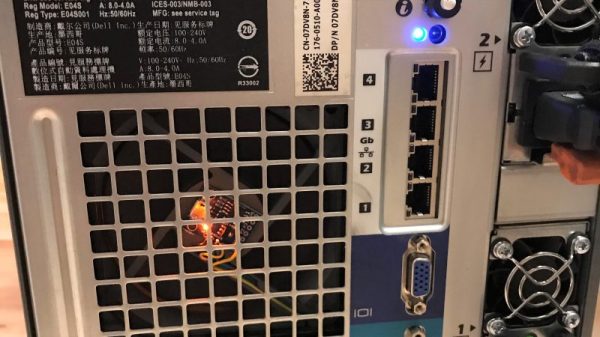
Servers are a breed apart from desktop-grade machines, and are designed around the fact that they’ll be installed in some kind of controlled environment. [Juan] made his Dell PowerEdge T710 tower server a better neighbor by probing the PWM signals to and from the stock Dell fans; he found that the motherboard is happy to just receive a fixed PWM signal that indicates the fans are running at top speed. Knowing this, [Juan] was able to spoof the feedback signal with an ATtiny85 and a single line of code. The noisy fans could then be swapped for desktop-grade fans; even running full-tilt, the new fans are quieter by far and still keep things cool inside.

But what to do with all those extra fans? Why not team them up with some lasers for a musical light show?