Kill The Exhaust, Not Your Lungs With The Fume Coffin

As if slinging around 40 watts of potentially tattoo-removing or retina-singeing laser beams wasn’t anxiety-inducing enough, now comes a new, scary acronym – LCAGs, or “laser-generated airborne contaminants.” With something that scary floating around your shop, it might be a good idea to build a souped-up laser cutter exhaust fan to save your lungs.

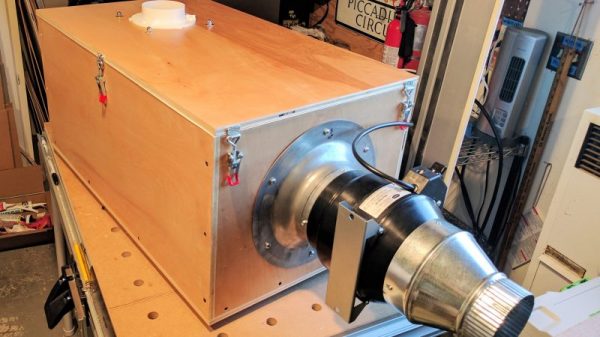
We jest, but taking care of yourself is the responsible way to have a long and fruitful hacking career, and while [patternmusic]’s “Fume Coffin” might seem like overkill, can you go too far to protect your lungs? Plywood and acrylic, the most common materials that come across a laser cutter’s bed, both release quite a witch’s brew of toxins when vaporized by a laser beam. The Fume Coffin clears the air in your shop by venting it to the outdoors after giving it a good scrubbing through an activated charcoal pre-filter and a HEPA polishing element. Both filters are commercially available so replacements won’t be an issue, and the entire thing is housed in a wooden box that gives the device its name.

Since it’s ejecting 200 cubic feet per minute, you’ll have to provide at least that much make-up air, but other than that the Fume Coffin should be a welcome addition to the shop. We’ve seen a few other attempts to handle LCAGs effectively before, including a DIY charcoal and automotive air filter design.

MRIs: Why Are They So Loud?

My dad was scheduled for his first MRI scan the other day, and as the designated family technical expert, Pop had plenty of questions for me about what to expect. I told him everything I knew about the process, having had a few myself, but after the exam he asked the first question that everyone seems to ask: “Why is that thing so damn loud?”

Sadly, I didn’t have an answer for him. I’ve asked the same question myself after my MRIs, hoping for a tech with a little more time and lot more interest in the technology he or she uses to answer me with more than the “it’s the machine that makes the noise” brush-off. Well, duh.

MRI is one of those technologies that I don’t feel I have a firm enough grasp on, and it seems like something I should really be better versed in. So I decided to delve into the innards of these modern medical marvels to see if I can answer this basic question, plus see if I can address a few more complicated questions.

Continue reading “MRIs: Why Are They So Loud?”

Graphene From Graphite By Electrochemical Exfoliation

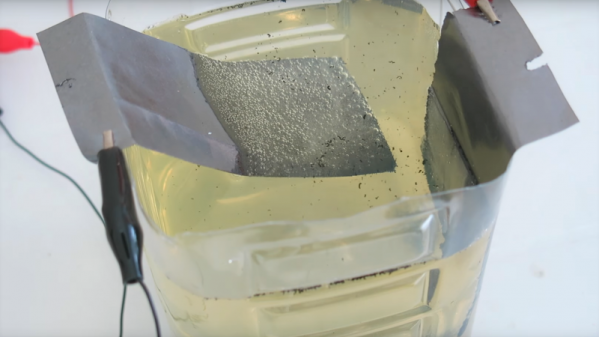
Graphene is an interesting material, but making enough of the stuff to do something useful can be a little tough. That’s why we’re always on the lookout for new methods, like this electrochemical process for producing graphene in bulk.

You probably know that graphene is a molecular monolayer of carbon atoms linked in hexagonal arrays. Getting to that monolayer is a difficult proposition, but useful bits of graphene can be created by various mechanical and chemical treatments of common graphite. [The Thought Emporium]’s approach to harvesting graphene from graphite is a two-step process starting with electrochemical exfoliation. Strips of thin graphite foil are electrolyzed in a bath of ferrous sulfate, resulting in the graphite delaminating and flaking off into the electrolyte. After filtering and cleaning, the almost graphene is further exfoliated in an ultrasonic cleaner. The result is gram quantity yields with very little work and at low cost.

There’s plenty of effort going into new methods of creating graphene these days, whether by barely controlled explosions or superheating soybean oil. But will graphene be the Next Big Thing? The jury is still out on that.

Continue reading “Graphene From Graphite By Electrochemical Exfoliation”

Sharpening Drills Bits The Hard Way

Drill bits are so cheap that when one is too chowdered up to keep working, we generally just toss it out. So you might expect a video on sharpening drill bits to be somewhat irrelevant, but [This Old Tony] makes it work.

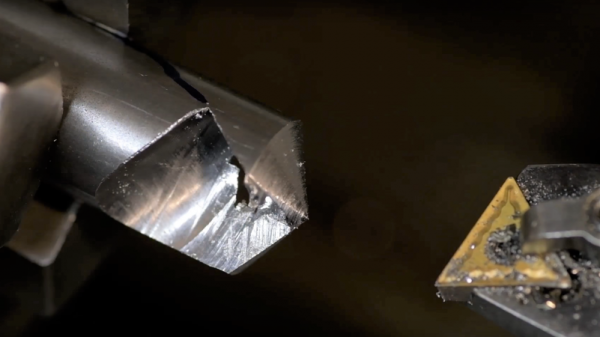
The reason this video is worth watching is not just that you get to learn how to sharpen your bits, although that’s an essential metalworker’s skill. Where [This Old Tony]’s video shines is by explaining why a drill bit is shaped the way it is, which he does by fabricating a rudimentary twist drill bit from scratch. Seeing how the flutes and the web are formed and how all the different angles interact to cut material and transport the swarf away is fascinating. And as a bonus, knowing what the angles do allows you to customize a grind for a special job.

[This Old Tony] may be just a guy messing around in his shop, but he’s got a wealth of machine shop knowledge and we always look forward to seeing what he’s working on, whether it’s a homemade fly cutter or a full-blown CNC machine.

Continue reading “Sharpening Drills Bits The Hard Way”

Unlikely Cascade Of Failures Leads To Microwave’s Demise

Surely a blown light bulb can’t kill a microwave oven, right? You might not expect it to, but that was indeed the root cause of a problem that [mikeselecticstuff] recently investigated; the cascade of failures is instructive to say the least.

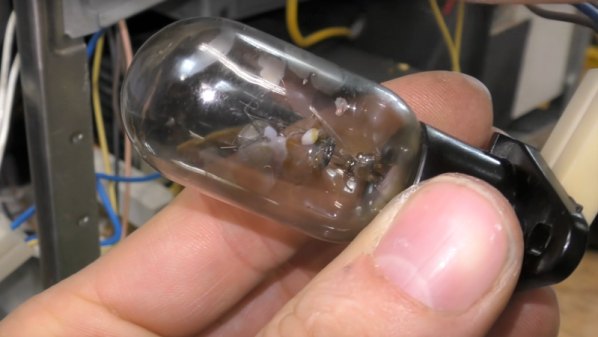
While the microwave that made its way to [mike]’s bench wasn’t exactly engineered to fail, it surely was not designed to succeed. We won’t spoil the surprise, but suffice it to say that his hopes for a quick repair after the owner reported a bang before it died were dashed by an arc across the interior light bulb that put a pulse of mains voltage in places it didn’t belong. That the cascade of failures killed the appliance is a testament to how designing to a price point limits how thoroughly devices can be tested before production runs in the millions are stuffed into containers for trips to overseas markets.

Even though [mike] made his best effort to adhere to the Repair Manifesto, the end result was a scrapped microwave. It wasn’t a total loss given the interesting parts inside, but a disappointment nonetheless unless it forces us to keep in mind edge-case failure modes in our designs.

Continue reading “Unlikely Cascade Of Failures Leads To Microwave’s Demise”

A Mechanical Laser Show With 3D-Printed Cams And Gears

Everyone knows how to make a POV laser display — low-mass, first-surface mirrors for the X- and Y-axes mounted on galvanometers driven rapidly to trace out the pattern. [Evan Stanford] found a simpler way, though: a completely mechanical laser show from 3D-printed parts.

The first 10 seconds of the video below completely explains how [Evan] accomplished this build. A pair of custom cams wiggles the laser pointer through the correct sequences of coordinates to trace the desired pattern out when cranked by hand through a 1:5 ratio gear train. But what’s simple in concept is a bit more complicated to reduce to practice, as [Evan] amply demonstrates by walking us through the math he used to transfer display shapes to cam profiles. If you can’t follow the math, no worries — [Evan] has included all the profiles in his Thingiverse collection, and being a hand model software guy by nature, he’s thoughtfully developed a program to automate the creation of cam profiles for new shapes. It’s all pretty slick.

Looking for more laser POV goodness? Perhaps a nice game of laser Asteroids would suit you.

Continue reading “A Mechanical Laser Show With 3D-Printed Cams And Gears”

Hacked Car Axle Yields Custom 90° Gearbox

Need a sturdy angle gearbox to handle power transmission for your next big project? Why not harvest a rear axle from a car and make one yourself?

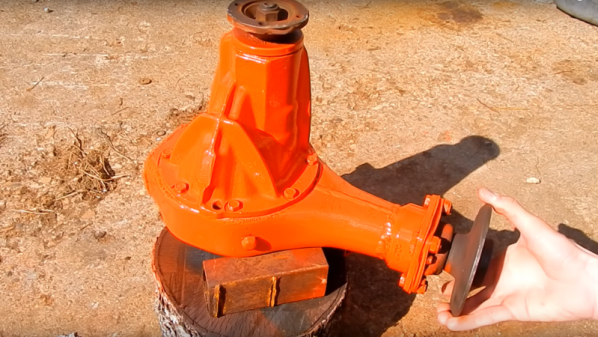
When you think about it, the axle of a rear-wheel drive vehicle is really just a couple of 90° gearboxes linked together internally, and a pretty sturdy assembly that’s readily available for free or on the cheap. [Donn DIY]’s need for a gearbox to run a mower lead him to a boneyard for the raw material. The video below shows some truly impressive work with that indispensable tool of hardware hackers, the angle grinder. Not only does he amputate one of the half axles with it, he actually creates almost perfect splines on the remaining shortened shaft. Such work is usually done on a milling machine with a dividing head and an end mill, but [DonnDIY]’s junkyard approach worked great. Just goes to show how much you can accomplish with what you’ve got when you have no choice.

We’re surprised to not see any of [DonnDIY]’s projects featured here before, as he seems to have quite a body of hacks built up. We hope to feature some more of his stuff soon, but in the meantime, you can always check out some of the perils and pitfalls of automotive differentials.

Continue reading “Hacked Car Axle Yields Custom 90° Gearbox”