A 489 Megapixel Camera For Not A Lot

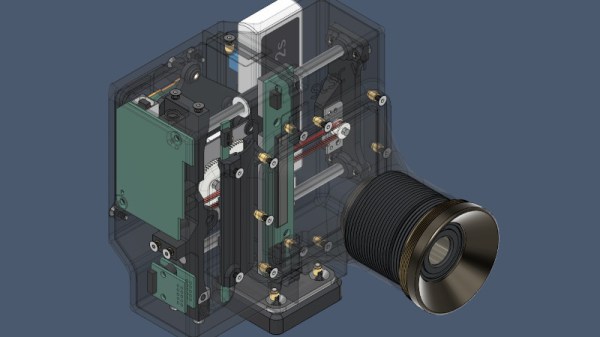
The megapixel wars of a decade ago saw cameras aggressively marketed on the resolution of their sensors, but as we progressed into the tens of megapixels it became obvious even to consumers that perhaps there might be a little more to the quality of a digital camera than just its resolution. Still, it’s a frontier that still has a way to go, even if [Yunus Zenichowski]’s 489 megapixel prototype is a bit of an outlier. As some of you may have guessed it’s a scanner camera, in which the sensor is a linear CCD that is mechanically traversed over the focal plane to capture the image line by line.

In the 3D printed shell are the guts of a cheap second-hand Canon scanner, and the lens comes from a projector. Both these components make it not only one of the highest resolution cameras we’ve ever brought you, but also by no means the most expensive. It’s definitely a work in progress and the results of a sensor designed for the controlled environment of a document scanner being used with real-world light leave something to be desired, but even with the slight imperfections of the projector lens it’s still a camera capable of some fascinating high-resolution photography. The files are all available, should you be interested, and you can see it in action in the video below the break.

It’s by no means the first scanner camera we’ve brought you, though some of the earlier projects now have dead links. It is however easily the one with the highest resolution.
Continue reading “A 489 Megapixel Camera For Not A Lot”

A Modular Analogue Computer

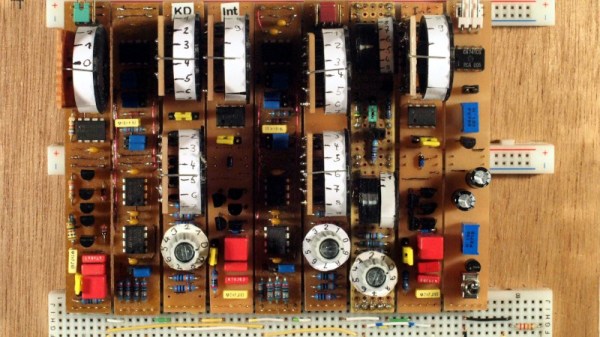
We are all used to modular construction in the analogue synth world, to the extent that there’s an accepted standard for it in EuroRack. But the same techniques are just as useful wherever else analogue circuits need to be configured on the fly, such as in an analogue computer. It’s something [Rainer Glaschick] has pursued, with his Flexible Analog Computer, an analogue computer made from a set of modules mounted on breadboard strips.

Standard modules are an adder and an integrator, with the adder also having inverter, comparator, and precision rectifier functions. The various functions can be easily configured by means of jumpers, and there are digital switches on board to enable or disable outputs and inputs. he’s set up a moon landing example to demonstrate the machine in practice.

We’re not going to pretend to be analogue computer experts here at Hackaday,but we naturally welcome any foray into analogue circuitry lest it become a lost art. If you’d like to experiment with analogue computing there are other projects out there to whet your appetite, and of course they don’t even need to be electronic.

They Used To Be A Big Shot, Now Eagle Is No More

There once was a time when to make a PCB in our community was to use CadSoft EAGLE, a PCB design package which neatly filled the entry level of that category with a free version for non-commercial designs. Upgrading it to the commercial version was fairly inexpensive, and indeed that was a path which quite a few designers making the step from hobby project to small production would take.

Then back in 2017, CadSoft were bought by Autodesk, and their new version 8 of the software changed its licensing model from purchase to rental. It became a product with a monthly subscription and an online side, and there began an exodus of users for whom pay-to-play meant too much risk of losing access to their designs. Now six years later the end has come, as the software behemoth has announced EAGLE’s final demise after a long and slow decline. Continue reading “They Used To Be A Big Shot, Now Eagle Is No More”

Bye Bye Ubuntu, Hello Manjaro. How Did We Get Here?

Last week I penned a cheesy fake relationship breakup letter to Ubuntu, my Linux distribution of choice for the last 15 years or so. It had well and truly delivered on its promise of a painless Linux desktop for most of that time, but the most recent upgrades had rendered it slow and bloated, with applications taking minutes to load and USB peripherals such as my film scanner mysteriously stopping working. I don’t have to look far to identify the point at which they adopted Snap packages as the moment when it all went wrong. I’d reached the point at which I knew our ways must part, and it was time to look for another distro.

Continue reading “Bye Bye Ubuntu, Hello Manjaro. How Did We Get Here?”

Apple Invent The Mechanical Watch

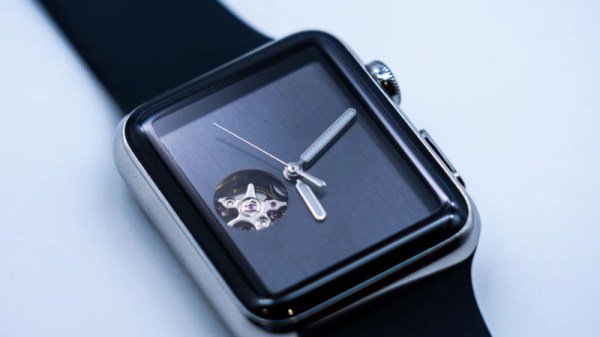
The Apple Watch has been on the market for long enough that its earlier iterations are now unsupported. Where some see little more than e-waste others see an opportunity, as has [NanoRobotGeek] with this mechanical watch conversion on a first-generation model.

What makes this build so special is its attention to detail. Into the Apple Watchcase has gone a Seiko movement, but it hasn’t merely been dropped into place. It uses the original Apple watch stem which is offset, so he’s had to create a linkage and a tiny pulley system to transfer the forces from one to the other. The rotor is custom-machined with am Apple logo, and the new watch face is a piece of laser-cut and heat treated zirconium. Even the watch movement itself needed a small modification to weaken the stem spring and allow the linkage to operate it.

The build is a long one with many steps, and we’re being honest when we say it would put our meager tiny machining skills to an extreme test. Sit down and take your time reading it, it really is a treat. Apple Watches may head to the tip after five years, but not this one!

See more in the video below the break, and of course long-time readers may remember we’ve considered the Apple Watch versus mechanical watches before.

Continue reading “Apple Invent The Mechanical Watch”

Know Audio: Distortion Part One

If you follow audiophile reviewers, you’ll know that their stock-in trade is a very fancy way of saying absolutely nothing of quantifiable substance about the subject while sounding knowledgeable about imagined differences between devices that are all of superlative quality anyway. If you follow us, we’ll tell you that the only reviews that matter are real-world measurements of audio performance, and blind listening tests. We don’t have to tell you how to listen to music, but perhaps it’s time in our Know Audio series to look at how audio performance is measured.

Before reaching for the bench, it’s first necessary to ask just what we are measuring. What are the properties which matter in an audio chain, or in other words, just what is it that makes an audio device good?

Continue reading “Know Audio: Distortion Part One”

That Handheld 386SX Gets A Teardown

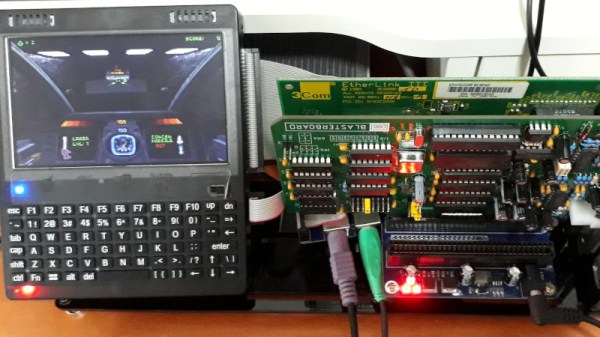
A few weeks ago our community was abuzz with the news of a couple of new portable computers available through AliExpress. Their special feature was that they are brand new 2023-produced retrocomputers, one with an 8088, and the other with a 386SX. Curious to know more? [Yeo Kheng Meng] has one of the 386 machines, and he’s taken it apart for our viewing pleasure.

What he found is a well-designed machine that does exactly what it claims, and which runs Windows 95 from a CF card. It’s slow because it’s an embedded version of the 386 variant with a 16-bit bus originally brought to market as a chip that could work with 16-bit 286-era chipsets. But the designer has done a good job of melding old and new parts to extract the most from this vintage chip, and has included some decidedly modern features unheard of in the 386 era such as a CH375B USB mass storage interface.

If we had this device we’d ditch ’95 and run DOS for speed with Windows 3.1 where needed. Back in the day with eight megabytes of RAM it would have been considered a powerhouse before users had even considered its form factor, so there’s an interesting exercise for someone to get a vintage Linux build running on it.

One way to look at it is as a novelty machine with a rather high price tag, but he makes the point that considering the hardware design work that’s gone into it, the 200+ dollar price isn’t so bad. With luck we’ll get to experience one hands-on in due course, and can make up our own minds. Our original coverage is here.