Finalists Announced For The 2020 Hackaday Prize

In light of everything going on in 2020, the 7th annual Hackaday Prize is devoted to nurturing ideas that could literally help change the world. In a first, we partnered with several nonprofits to help identify some of today’s most difficult problems, ranging from conservation and disaster relief to the need for advanced assistive technology. With over $200,000 up for grabs, including microgrants to help teams work full-time on their projects, this year’s competition was designed to help bring critical solutions to fruition which otherwise might never see the light of day.

But it hasn’t been easy. The global pandemic has made it far more difficult to collaborate on projects in the way we’re all used to, parts have become harder to source, and many makers found themselves so engaged with grassroots efforts to combat COVID-19 that they found little time for anything else. But despite all of this uncertainty, we received hundreds of incredible entries from all over the globe.

It’s never easy to select who will move on to the next round of the competition. But with the help of our nonprofit partners, the panel of expert judges was able to whittle the list of entries down to the 34 finalists that produced some of the most impressive and impactful ideas the Hackaday Prize has ever seen. Let’s take a look at just a few of the projects that will be vying for the top prizes in November.

Continue reading “Finalists Announced For The 2020 Hackaday Prize”

Floating Spaceports For Future Rockets

While early prototypes for SpaceX’s Starship have been exploding fairly regularly at the company’s Texas test facility, the overall program has been moving forward at a terrific pace. The towering spacecraft, which CEO Elon Musk believes will be the key to building a sustainable human colony on Mars, has gone from CGI rendering to flight hardware in just a few short years. That’s fast even by conventional rocket terms, but then, there’s little about Starship that anyone would dare call conventional.

An early Starship prototype being assembled.

Nearly every component of the deep space vehicle is either a technological leap forward or a deviation from the norm. Its revolutionary full-flow staged combustion engines, the first of their kind to ever fly, are so complex that the rest of the aerospace industry gave up trying to build them decades ago. To support rapid reusability, Starship’s sleek fuselage abandons finicky carbon fiber for much hardier (and heavier) stainless steel; a material that hasn’t been used to build a rocket since the dawn of the Space Age.

Then there’s the sheer size of it: when Starship is mounted atop its matching Super Heavy booster, it will be taller and heavier than both the iconic Saturn V and NASA’s upcoming Space Launch System. At liftoff the booster’s 31 Raptor engines will produce an incredible 16,000,000 pounds of thrust, unleashing a fearsome pressure wave on the ground that would literally be fatal for anyone who got too close.

Which leads to an interesting question: where could you safely launch (and land) such a massive rocket? Even under ideal circumstances you would need to keep people several kilometers away from the pad, but what if the worst should happen? It’s one thing if a single-engine prototype goes up in flames, but should a fully fueled Starship stack explode on the pad, the resulting fireball would have the equivalent energy of several kilotons of TNT.

Thanks to the stream of consciousness that Elon often unloads on Twitter, we might have our answer. While responding to a comment about past efforts to launch orbital rockets from the ocean, he casually mentioned that Starship would likely operate from floating spaceports once it started flying regularly:

While history cautions us against looking too deeply into Elon’s social media comments, the potential advantages to launching Starship from the ocean are a bit too much to dismiss out of hand. Especially since it’s a proven technology: the Zenit rocket he references made more than 30 successful orbital launches from its unique floating pad.

Continue reading “Floating Spaceports For Future Rockets”

World Radio Lets Your Fingers Do The Walking

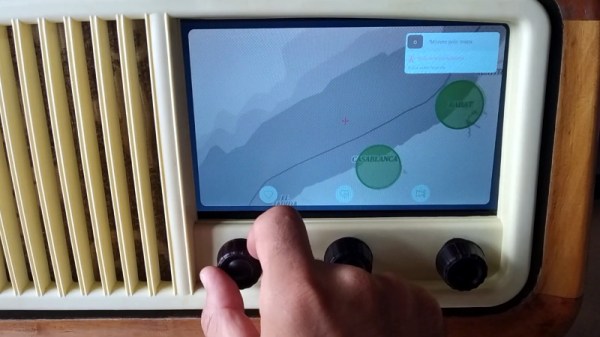
Listening to radio from distant countries used to take a shortwave rig, but thanks to the Internet we can now pull in streams from all over the globe from the comfort of our own desktop. With a few clicks you can switch between your local news station and the latest in pop trends from Casablanca. But as convenient as online streaming might be, some folks still yearn for the traditional radio experience.

For those people, the Raspberry Pi World Radio by [Abraham Martinez Gracia] might be the solution. Built into the body of a 1960s Invicta radio, this Internet radio uses a very unique interface. Rather than just picking from a list of channels, you use the knobs on the front to pan and zoom around a map of the world. Streaming channels are represented by bubbles located within their country of origin, so you’ll actually have to “travel” there to listen in. The video after the break gives a brief demonstration of how it works in practice.

We’ll admit it might become a bit tedious eventually, but from a visual standpoint, it’s absolutely fantastic. [Abraham] even gave the map an appropriately vintage look to better match the overall aesthetic. Normally we’d say using a Raspberry Pi 4 to drive a streaming radio player would be a bit overkill, but considering the GUI component used here, it’s probably the right choice.

Of course we’ve seen Internet radios built into vintage enclosures before, and we’ve even seen one that used a globe to select the station, but combining both of those concepts into one cohesive project is really quite an accomplishment.

Continue reading “World Radio Lets Your Fingers Do The Walking”

A Deep Dive Into The Sterzo Steering Plate

Pedaling in place isn’t the most exciting pastime, so it’s no surprise that modern technology is being used to make the in-home biking experience a bit more interactive. With a stand on the rear wheel providing resistance, and a movable steering plate under the front to read the handlebar angle, you can now use your standard bike as the “controller” in a virtual environment provided by software such as Zwift.

Paving the way towards a DIY Sterzo clone

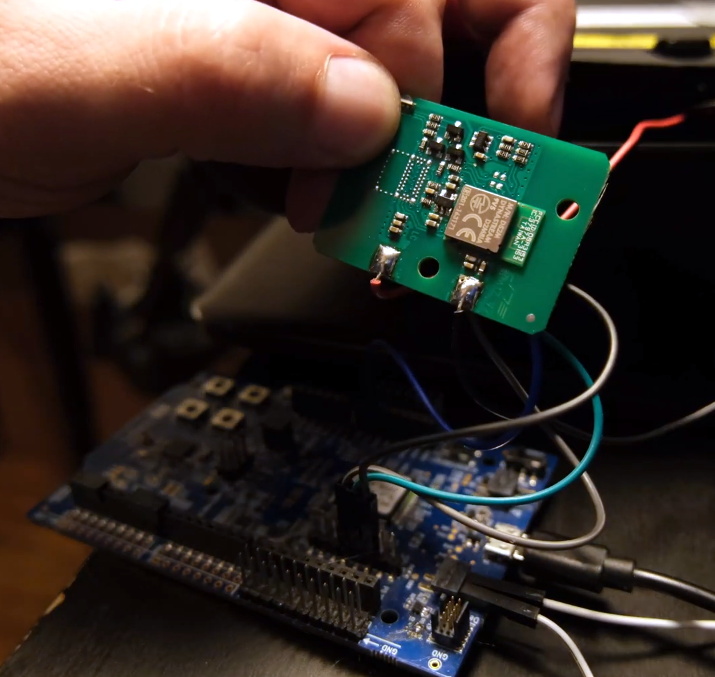
[Keith Wakeham] wanted to take a closer look at how Zwift communicated with his Sterzo steering device, and it turned into a pretty epic bout of exploration and reverse engineering. As the video after the break shows, he didn’t just go from sniffing the device’s proprietary Bluetooth Low Energy (BLE) communications protocol to figuring out how to emulate it in software so you could roll your own Zwift peripheral. He also tore the device apart, pulled the firmware from its microcontroller, and postulated how you could build your own low-cost clone device that would work with the existing software.

Even if you have absolutely zero interest in virtual biking, the video [Keith] has put together for this project is really a must watch. Have you ever wanted to sniff and reverse engineer BLE communications? Looking for a real-world example of pulling the firmware off of a consumer device? Maybe in the market for some tips on how to identify unknown ICs on a board? All of that, and quite a bit more, is covered in this nearly hour long hacking tour de force.

On the other hand, if you are interested in adding your own hardware to Zwift, then this look at getting an unsupported stationary bike working with it should be useful.

Continue reading “A Deep Dive Into The Sterzo Steering Plate”

Arduino Takes Control Of Dead Business Card Cutter

It’s a common enough situation, that when an older piece of equipment dies, and nobody wants to spend the money to repair it. Why fix the old one, when the newer version with all the latest bells and whistles isn’t much more expensive? We all understand the decision from a business standpoint, but as hackers, it always feels a bit wrong.

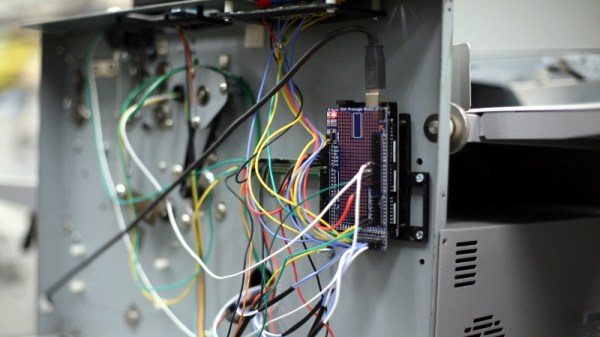
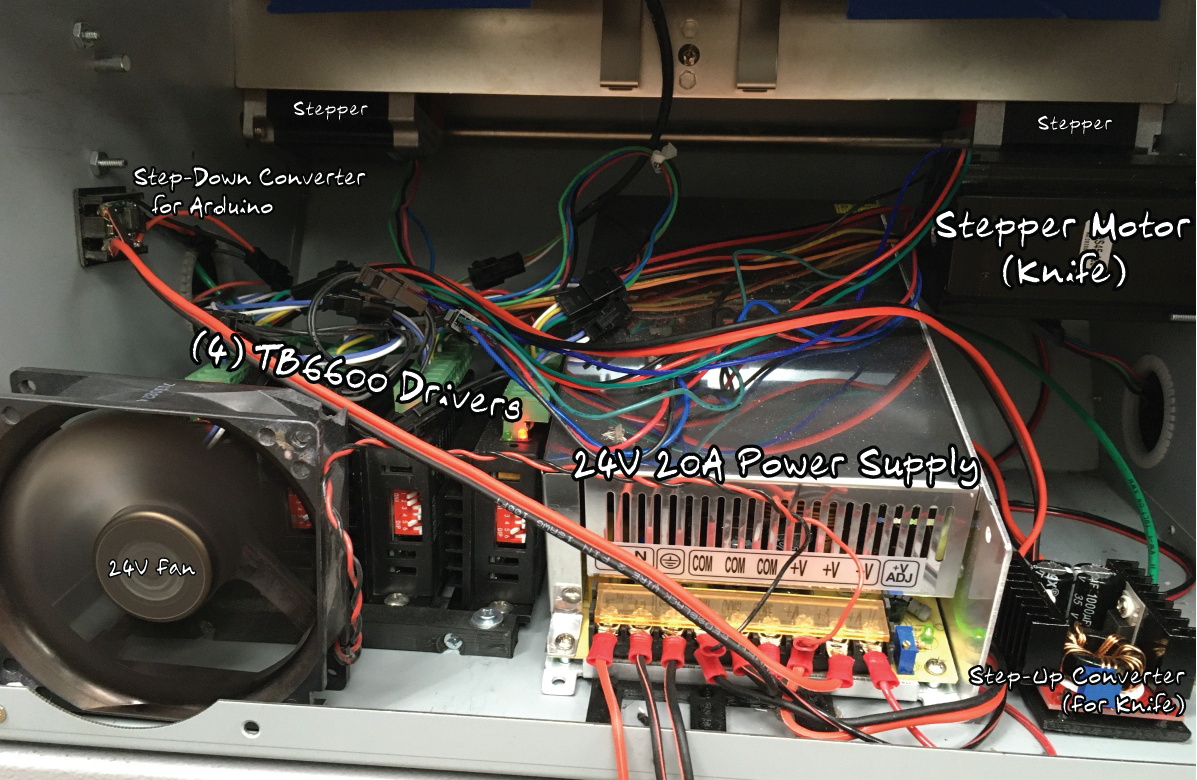
Which is exactly why [tommycoolman] decided to rebuild the office’s recently deceased Duplo CC-330 heavy duty business card cutter. It sounds like nobody really knows what happened to the machine in the first place, but since the majority of the internals were cooked, some kind of power surge seems likely. Whatever the reason, almost none of the original electronics were reused. From the buttons on the front panel to the motor drivers, everything has been implemented from scratch.

An Arduino Mega 2560 clone is used to control four TB6600 stepper motor drivers, with a common OLED display module installed where the original display went. The keypad next to the screen has been replaced with 10 arcade-style buttons soldered to a scrap of perfboard, though in the end [tommycoolman] covers them with a very professional looking printed vinyl sheet. There’s also a 24 V power supply onboard, with the expected assortment of step up and step down converters necessary to feed the various electronics their intended voltages.

In the end, [tommycoolman] estimates it took about $200 and 30 hours of work to get the card cutter up and running again. The argument could be made that the value of his time needs to be factored into the repair bill as well, but even still, it sounds like a bargain to us; these machines have a four-figure price tag on them when new.

Stories like this one are important reminders of the all wondrous things you can find hiding in the trash. Any time a machine like this can be rescued from the junkyard, it’s an accomplishment worthy of praise in our book.

Building An Affordable Press For Heat Set Inserts

If you’re building mechanical assemblies with 3D printed parts, you’ll quickly realize that driving machine screws into thermoplastic isn’t exactly an ideal solution. It can work in a pinch, but you can easily strip the threads if you crank down too hard. The plastic holes can also get worn down from repeated use, which is a problem if you’re working on something that needs to be taken apart and reassembled frequently. In those situations, using brass heat set inserts gives the fasteners something stronger to bite into.

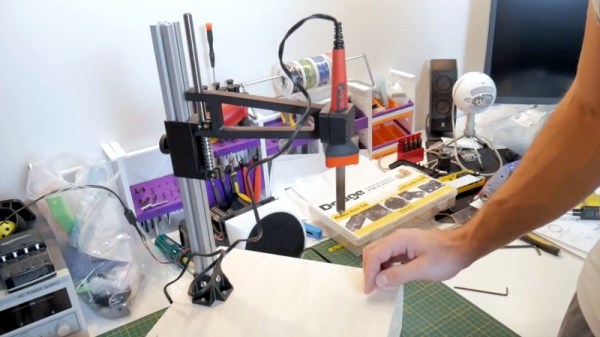
You can install these inserts by hand, but if you plan on doing a lot of them, a dedicated press station like the one [Chris Chimienti] recently put together will save you a lot of aggravation in the long run. In the video after the break he walks viewers through the design and use of the device, which itself relies on a number of 3D printed parts using the very same inserts it’s designed to install.

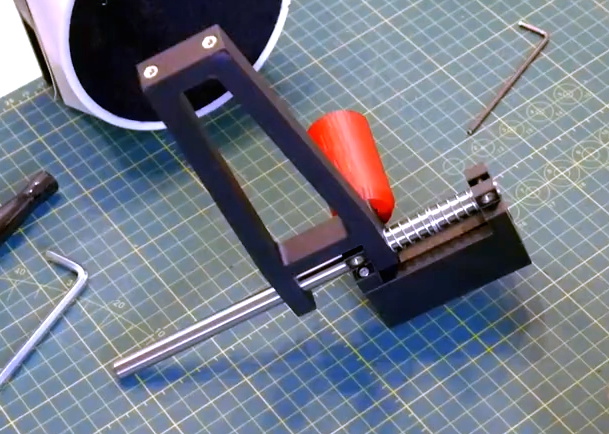
The spring-loaded arm can slide up and down the extrusion to adjust for height.

To build this tool you’ll need a piece of aluminum extrusion, some smooth rod, a couple springs, and an assortment of fasteners. Nothing that wouldn’t likely be in the parts bin of anyone who’s been tinkering with 3D printers for awhile, though even if you had to buy everything, the Bill of Materials will hardly break the bank. For the base you can use a piece of scrap wood, though [Chris] has opted to make it a storage compartment where he can store the inserts themselves. We really like this approach, but obviously you’ll need to have access to woodworking tools in that case.

Clearly shopping on the top shelf, [Chris] purchased a kit that actually came with a Weller soldering iron and the appropriate tips for the various sized inserts. If you’re like us and just buy the inserts that come in a plastic baggie, you may need to adapt the arm to fit your iron of choice. That said, the idea of having a dedicated iron that you can leave mounted in the press makes a lot of sense to us if you can swing it.

[Joshua Vasquez] wrote up a phenomenal guide to getting started with heat set inserts last year that’s an absolute must-read for anyone interested in the concept. Whether you build a dedicated press or just push them in freehand, his tips and tricks will help insure you get the best result possible.

Continue reading “Building An Affordable Press For Heat Set Inserts”

Google Turns Android Up To 11 With Latest Update

Just going by the numbers, it’s a pretty safe bet that most Hackaday readers own an Android device. Even if Google’s mobile operating system isn’t running on your primary smartphone, there’s a good chance it’s on your tablet, e-reader, smart TV, car radio, or maybe even your fridge. Android is everywhere, and while the development of this Linux-based OS has been rocky at times, the general consensus is that it seems to have been moving in the right direction over the last few years. Assuming your devices actually get the latest and greatest update, anyway.

So it’s not much of a surprise that Android 11, which was officially released yesterday, isn’t a huge update. There’s no fundamental changes in the core OS, because frankly, there’s really not a whole lot that really needs changing. Android has become mature enough that from here on out we’re likely to just see bug fixes and little quality of life improvements. Eventually Google will upset the apple cart (no pun intended) with a completely new mobile OS, but we’re not there yet.

Of course, that’s not to say there aren’t some interesting changes in Android 11. Or more specifically, changes that may actually be of interest to the average Hackaday reader. Let’s take a look at a handful of changes and tweaks worth noting for the more technical crowd.

Continue reading “Google Turns Android Up To 11 With Latest Update”