Put An Open Source Demon In Your Pocket

Back in 1996, the Tamagotchi was a triumph of hardware miniaturization. Nearly 25 years later, our expectations for commercially designed and manufactured gadgets are naturally quite a bit higher. But that doesn’t mean we can’t be impressed when somebody pulls off a similar feat in the DIY space.

The Xling by [dsl] follows the classic Tamagotchi concept. A little creature, apparently inspired by the demon from Netflix’s Disenchantment, lives in your pocket and needs occasional attention to remain healthy. The user pushes a few buttons to interact with the creature displayed on the display to do…whatever it is you do with a pet demon. Feed it souls and what have you.
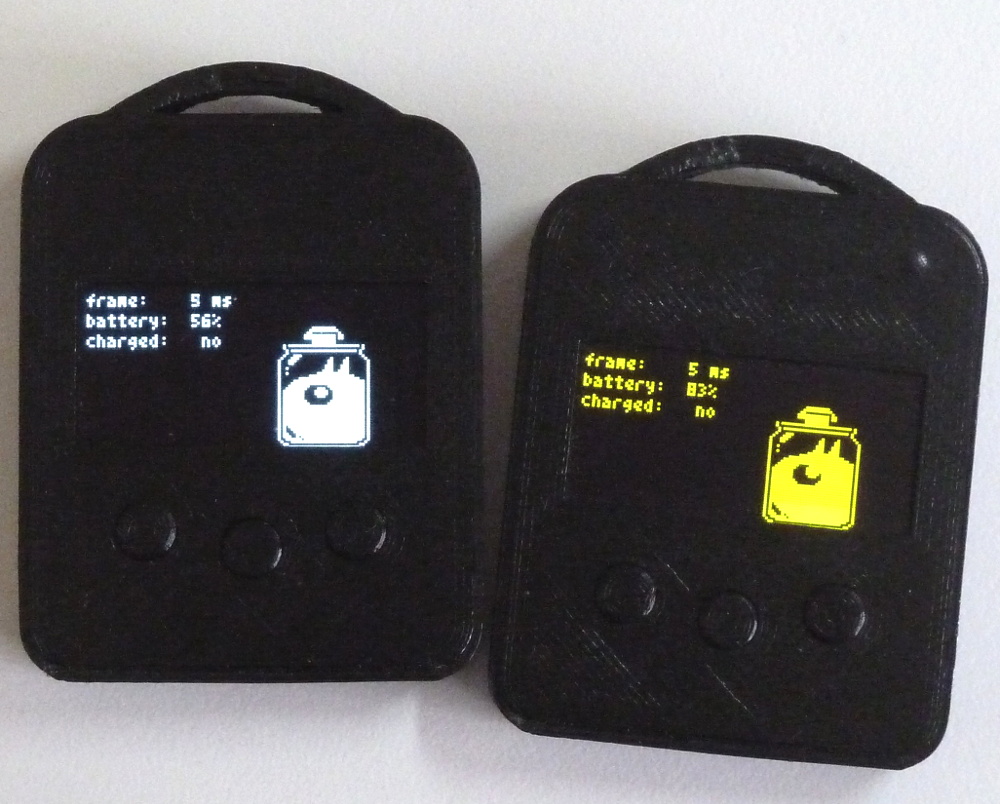
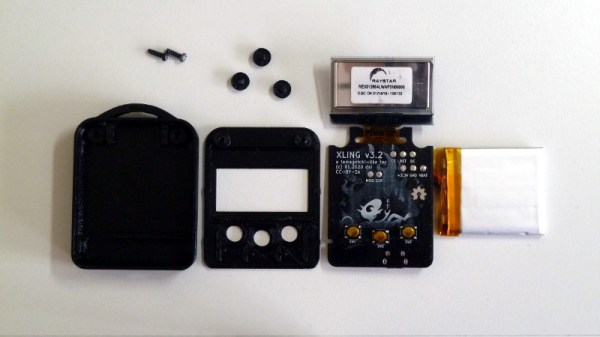
But unlike the iconic 90s toy, both the hardware and software for the Xling are open source. The CERN-OHL-W licensed PCB was designed in KiCad and features an ATmega1284P microcontroller and SH1106G controller for the 128 x 64 OLED display.

Power is provided by an AP3401 DC-DC converter, MCP73831 charge controller, and a 400 mAh 3.7 V battery. Everything fits inside of a 3D printed case that looks like it could easily hang off of a keyring.

While the hardware is admirable enough, the software side of things is quite interesting as well. The Xling is running on a FreeRTOS kernel ported to the ATmega, but the GPLv3 licensed firmware sill needs some work. Right now only a few core functions are implemented, and [dsl] is hoping to get some ideas and feedback from the community so his dream of a fully open source demonic Tamagotchi can finally be realized.

Build enough of them, and you might even be able to implement another virtual pet Singularity. But to be safe, maybe you shouldn’t.
Continue reading “Put An Open Source Demon In Your Pocket”

Global Status Board Keeps Eye On COVID-19 Situation

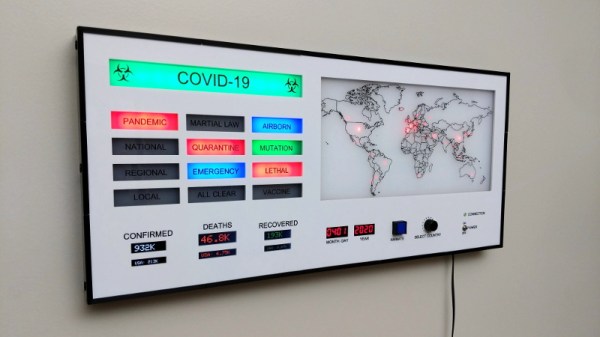
When it comes to keeping abreast of the COVID-19 pandemic, there are basically two schools of thought. Some people would rather not hear the number of confirmed cases or deaths, and just want to focus on those who recovered. That’s fair enough. But others want to have all of the available data at their disposal so they can form their own conclusions about what’s happening with this virus on a global scale. Looking at this incredible COVID-19 status board, we’ll give you one guess which category [Reuben] falls into.

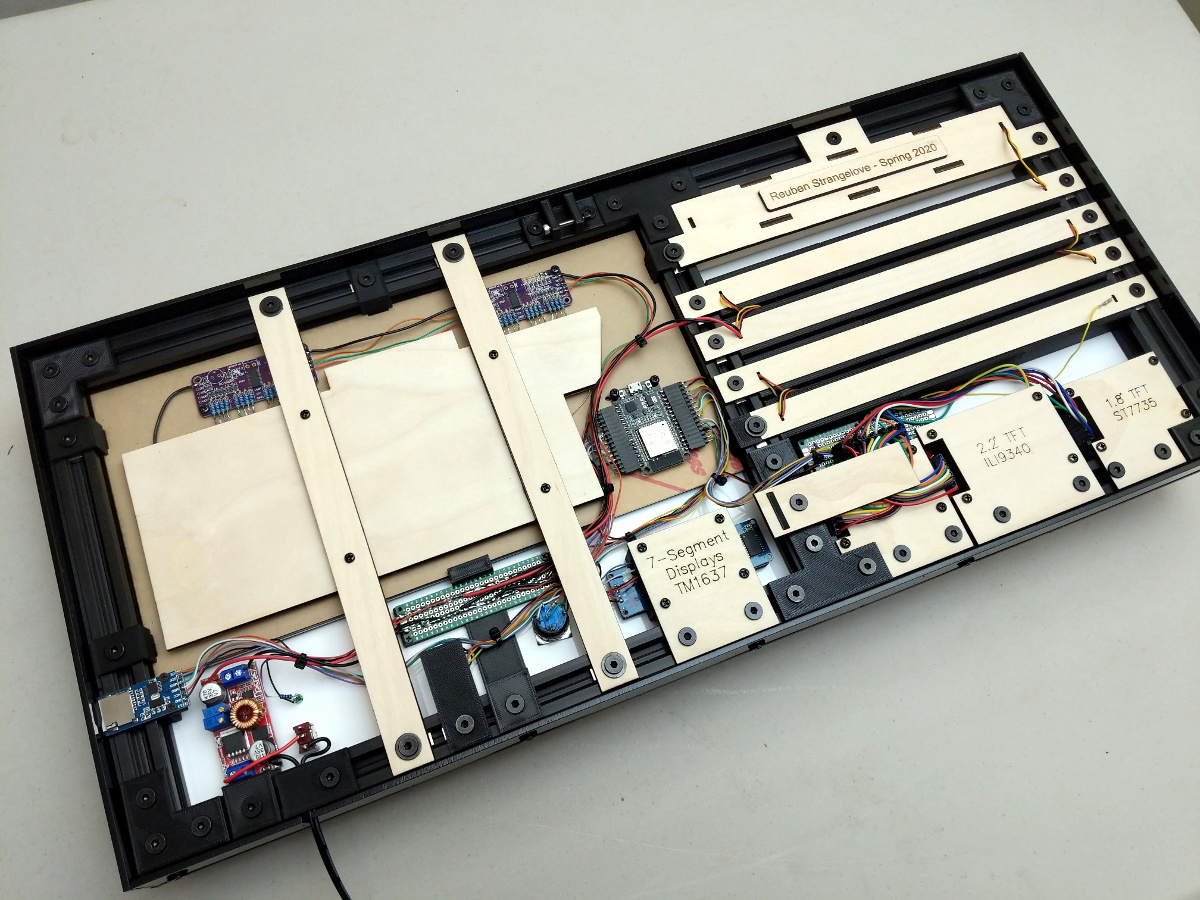
Note the laser engraved component labels

Constructed out of 2020 extrusion with both 3D printed and laser cut parts, this wall-mounted display is built to last. Clearly [Reuben] believes we’re in this one for the long haul, and taking a peek at the plethora of data points this device can show at once, it’s not hard to see why.

Stats are pulled down every hour from a JSON API by an ESP32 and stored on an SD card. A running total of confirmed cases, deaths, and recoveries are shown on several TFT displays located behind the face of the display. On the right, the relative severity of the infection in 32 different countries is visualized with LEDs of varying brightness.

Perhaps the most visually striking element of the display is the large annunciator panel on the left side, which lights up to show various conditions all over the world. We appreciate that [Reuben] has thought ahead and added a light that can be used once a vaccine is deployed for COVID-19, but the inclusion of a “MARTIAL LAW” indicator certainly doesn’t help us shake the feeling we’ve all found ourselves in a proper dystopia.

For those who’d would rather get their information from the source rather than have it filtered through the media, we’ve recently covered a few APIs that will allow you to pull your own up-to-date COVID-19 stats. Whether you’re looking to build something as elaborate as this display, or just want to echo it out to the terminal, making sure you’re seeing accurate data is key to identifying the turning point.

Continue reading “Global Status Board Keeps Eye On COVID-19 Situation”

R/C Toilet Paper Roll Is The Hero We Deserve

For reasons that most rational consumers can’t fathom, a not inconsiderable segment of the population believes the key to their continued survival during a pandemic unprecedented in modern times is to stockpile toilet paper. This leaves those of us not compelled to act based on the whims of our bowels looking at bare racks in the paper product aisle more often than not.

Which makes it the perfect time for [Ariel Yahni] to develop his remote controlled toilet paper roll. With this gadget deployed, you just might have a chance at drawing the Karens away from all the rolled gold long enough to grab yourself a pack. Even if it doesn’t distract the other competitors shoppers, you can at least enjoy the looks on their faces as it scurries by.

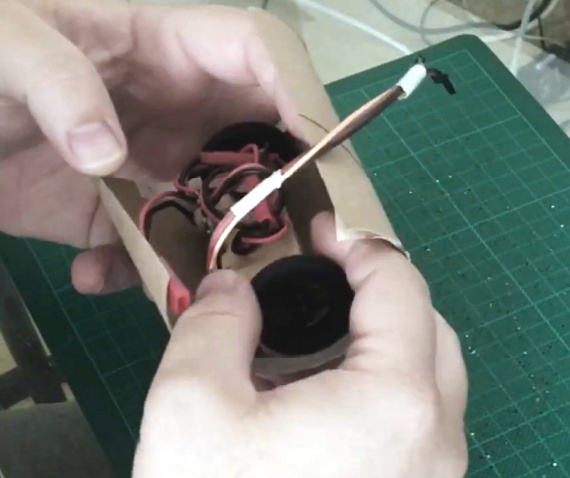
The project starts with, of all things, popsicle sticks. These are used to make a reinforced platform to which the two motors, radio receiver, speed controller, and battery are mounted. With some clever packing, [Ariel] is able to (tightly) fit it inside of a cardboard tube with just the bottoms of the two wheels protruding through cutouts. A careful wrapping with toilet paper is then used to give it the look of a partially used roll, including a trailing “tail” that flutters in its wake.

In the video after the break, you can see [Ariel] take his roll of motorized TP through a local mall for a test drive. We’re sorry to say that nobody appears to make a wild dive for it during the test. But that could be because the video was recorded back in December before people had resorted to fighting over toiletries. It also explains why he was able to get into a mall in the first place.

Just think, if we had embraced the high-tech toilets of the future back when we had a chance, we could have avoided this whole thing. As far as dystopias go, this one is shaping up to be pretty weird.

Continue reading “R/C Toilet Paper Roll Is The Hero We Deserve”

An Adapter To Solve Your ESP-01 Breadboard Woes

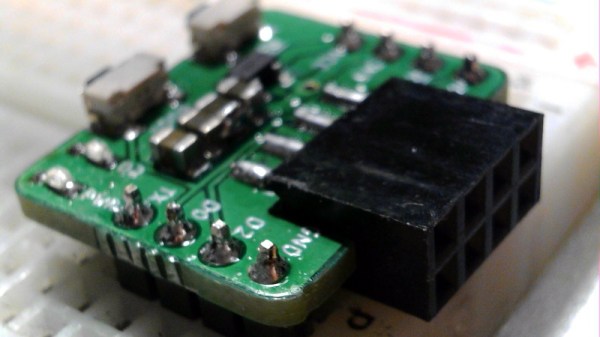
The ESP-01 launched the ESP8266 revolution back in 2014, and while today you’re far more likely to see somebody use a later version of the chip in a Wemos or NodeMCU development board, there are still tasks the original chip is well suited for. Unfortunately, they can be tricky to use while prototyping because they aren’t very breadboard friendly, but this adapter developed by [Miguel Reis] can help.

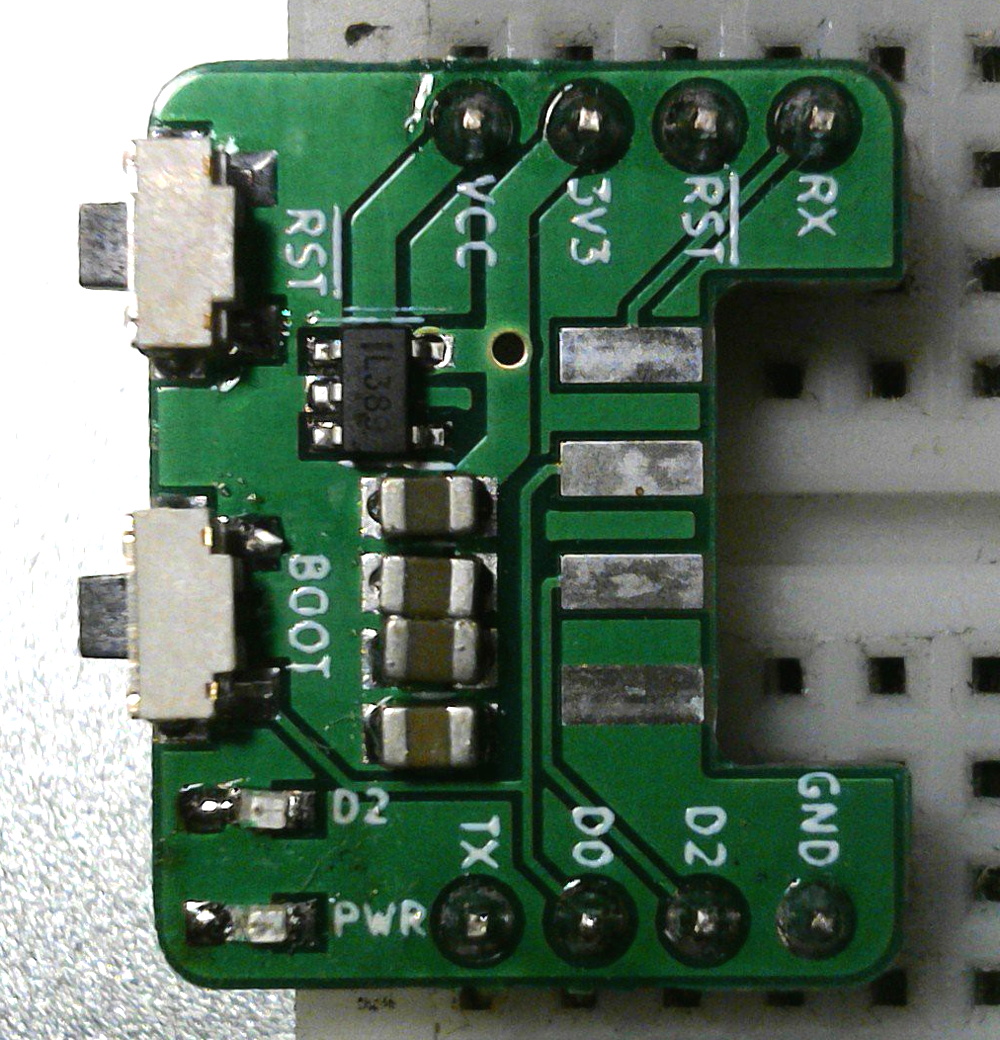
Of course, the main issue is the somewhat unusual pinout of the ESP-01. Since it was designed as a daughter board to plug into another device, the header is too tight to fit into a breadboard. The adapter that [Miguel] has come up with widens that up to the point you can put it down the centerline of your breadboard and have plenty of real estate around it.

The second issue is that the ESP-01 is a 3.3 V device, which can be annoying if everything else in the circuit is running on 5 V. To get around this, the adapter includes an SPX3819 regulator and enough capacitors that the somewhat temperamental chip gets the steady low-voltage supply it needs to be happy.

[Miguel] has released the schematics and board files so you can spin up your own copy of the adapter, but they’re also available for around $3 USD from his Tindie store.

ESP8266 And Sensors Make For A Brainy NERF Ball

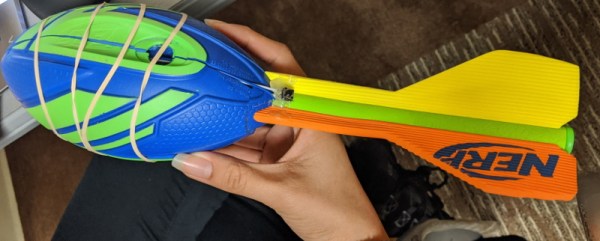
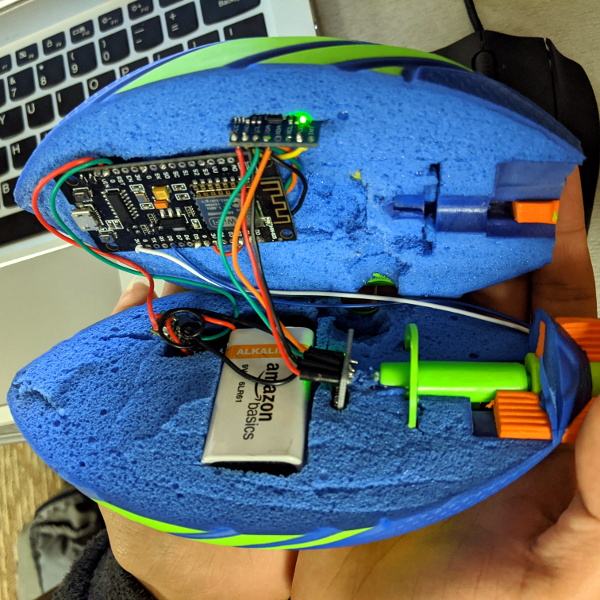
For his final project in UCLA’s Physics 4AL program, [Timothy Kanarsky] used a NodeMCU to smarten up a carefully dissected NERF football. With the addition to dual MPU6050 digital accelerometers and some math, the ball can calculate things like the distance traveled and angular velocity. With a 9 V alkaline battery and a voltage regulator board along for the ride it seems like a lot of weight to toss around; but of course nobody on the Hackaday payroll has thrown a ball in quite some time, so we’re probably not the best judge of such things.

Even if you’re not particularly interested in refining your throw, there’s a lot of fascinating science going on in this project; complete with fancy-looking equations to make you remember just how poorly you did back in math class.

As [Timothy] explains in the write-up, the math used to find velocity and distance traveled with just two accelerometers is not unlike the sort of dead-reckoning used in intercontinental ballistic missiles (ICBMs). Since we’ve already seen model rockets with their own silos, seems all the pieces are falling into place.

The NodeMCU polls the accelerometers every 5 milliseconds, and displays the data on web page complete with scrolling graphs of acceleration and angular velocity. When the button on the rear of the ball is pressed, the data is instead saved to basic Comma Separated Values (CSV) file that’s served up to clients with a minimal FTP server. We might not know much about sportsball, but we definitely like the idea of a file server we can throw at people.

Interestingly, this isn’t the first time we’ve seen an instrumented football. Back in 2011 it took some pretty elaborate hardware to pull this sort of thing off, and it’s fascinating to see how far the state-of-the-art has progressed.

Teaching Science With An Empty Soda Bottle

Creating the next generation of scientists and engineers starts by getting kids interested in STEM at an early age, but that’s not always so easy to do. There’s no shortage of games and movies out there to entertain today’s youth, and just throwing a text book at them simply isn’t going to cut it anymore. Modern education needs to be engrossing and hands-on if it’s going to make an impact.

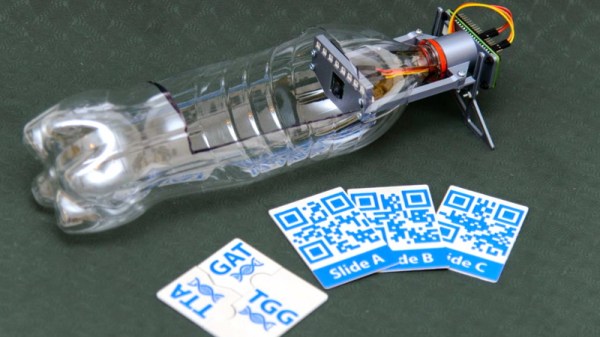
Which is exactly what the Institute of Science and Technology Austria hopes to accomplish with the popSCOPE program. Co-founded by [Dr. Florian Pauler] and [Dr. Robert Beattie], the project uses off-the-shelf hardware, 3D printed parts, and open source software to create an engaging scientific instrument that students can build and use themselves. The idea is to make the experience more personal for the students so they’re not just idle participants sitting in a classroom.

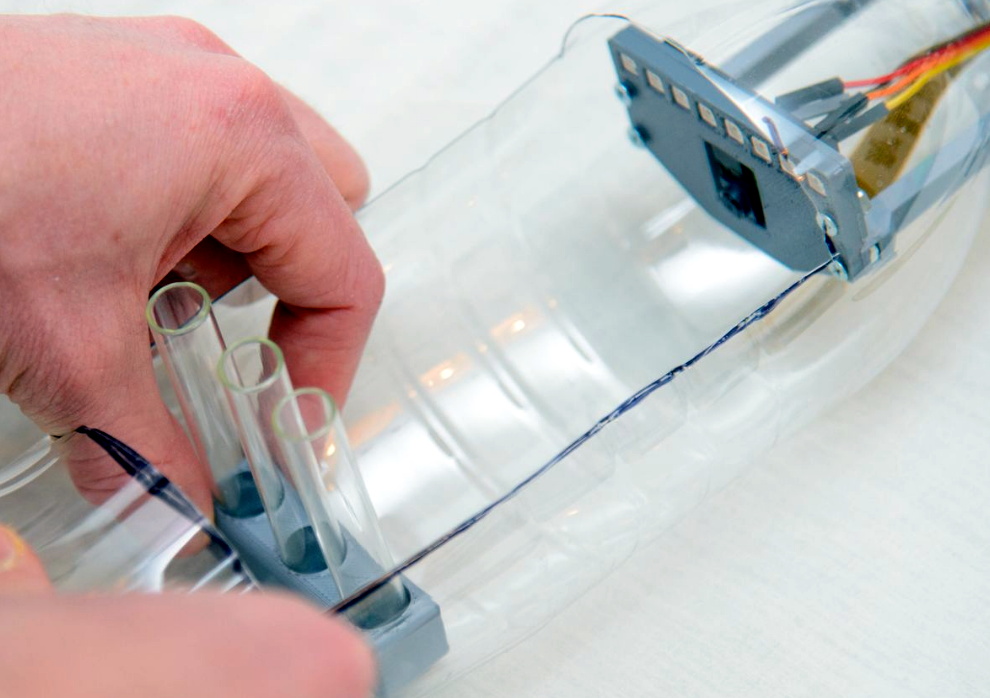
The hardware in use here is quite simple, essentially just a Raspberry Pi Zero W, a camera module, a Pimoroni Blinkt LED module, and a few jumper wires. It all gets bolted to a 3D printed frame, which features a female threaded opening that accepts a standard plastic soda (or pop, depending on your corner of the globe) bottle. You just cut a big opening in the side of the bottle, screw it in, and you’ve saved yourself a whole lot of time by not printing an enclosure.

So what does the gadget do? That obviously comes down to the software it’s running, but out of the box it’s able to do time-lapse photography which can be interesting for biological experiments such as watching seeds sprout. There’s also a set of 3D printable “slides” featuring QR codes, which the popSCOPE software can read to show images and video of real microscope slides. This might seem like cheating, but for younger players it’s a safe and easy way to get them involved.

For older students, or anyone interested in homebrew scientific equipment, the Poseidon project offers a considerably more capable (and complex) digital microscope made with 3D printed parts and the Raspberry Pi.

DIY ESP32 Alarm System Leverages 433 MHz Sensors

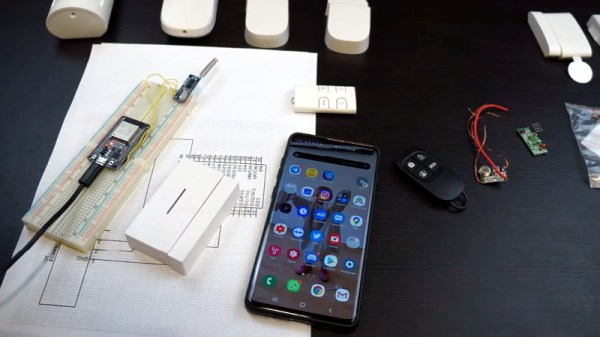
There’s a huge market for 433 MHz alarm system hardware out there, from PIR motion detectors to door and window sensors. If you want to put them to work, all you need is a receiver, a network-enabled microcontroller, and some code. In his latest video, [Aaron Christophel] shows how easy it can be.

In essence, you connect a common 433 MHz receiver module to an ESP32 or ESP8266 microcontroller, and have it wait until a specific device squawks out. From there, the code on the ESP can fire off using whatever API works for your purposes. In this case [Aaron] is using the Telegram API to send out messages that will pop up with a notification on his phone when a door or window is opened. But you could just as easily use something like MQTT, or if you want to go old-school, have it toggle a relay hooked up to a loud siren.

Even if you aren’t looking to make your own makeshift alarm system, the code and video after the break are a great example to follow if you want to get started with 433 MHz hardware. Specifically, [Aaron] walks the viewer through the process of scanning for new 433 MHz devices and adding their unique IDs to the list the code will listen out for. If you ever wondered how quickly you could get up and running with this stuff, now you’ve got your answer.

In the past we’ve seen the Raspberry Pi fill in as an RF to WiFi gateway for these type of sensors, as well as projects that pulled them all together into a complete home automation system on the cheap.

Continue reading “DIY ESP32 Alarm System Leverages 433 MHz Sensors”