The Thermochromic Display You Didn’t Know You Needed

We love unique ways of displaying data here at Hackaday, and this ingenious thermochromic display created by [Moritz v. Sivers] more than fits the bill. Using sheets of color changing liquid crystals and careful temperature control of the plates they’re mounted on, he’s built a giant seven-segment display that can colorfully (albeit somewhat slowly) show the current temperature and humidity.

The sheets of temperature sensitive liquid crystals are a bit like flattened out Mood Rings; they starts out black, but as heat is applied, their color cycles through vibrant reds, greens, and blues. The sheets are perhaps best known as the sort of vaguely scientific toys you might see in a museum gift shop, but here [Moritz] has put their unique properties to practical use.

To achieve the effect, he first cut each segment out of copper. The crystal sheets were applied to the segments, thanks to their handy self-stick backing, and the excess was carefully trimmed away. Each segment was then mounted to a TES1-12704 Peltier module by way of thermally conductive epoxy. TB6612FNG motor controllers and a bevy of Arduino Nano’s are used to control the Peltier modules, raising and lowering their temperature as necessary to get the desired effect.

You can see the final result in the video after the break. It’s easily one of the most attractive variations on the classic seven-segment display we’ve ever seen. In fact, we’d go as far as to say it could pass for an art installation. The idea of a device that shows the current temperature by heating itself up certainly has a thoughtful aspect to it.

This actually isn’t the first display we’ve seen that utilized this concept, though it’s by far the largest. Back in 2014 we featured a small flexible display that used nichrome wires to “print” digits on a sheet of liquid crystals.

Continue reading “The Thermochromic Display You Didn’t Know You Needed”
Exploring The Science Behind Dirty Air Filters

Obviously, if the air filters in your home HVAC system are dirty, you should change them. But exactly how dirty is dirty? [Tim Rightnour] had heard it said that if you didn’t change your filter every month or so, it could have a detrimental effect on the system’s energy consumption. Thinking that sounded suspiciously like a rumor Big Filter™ would spread to bump up their sales, he decided to collect his own data and see if there was any truth to it.

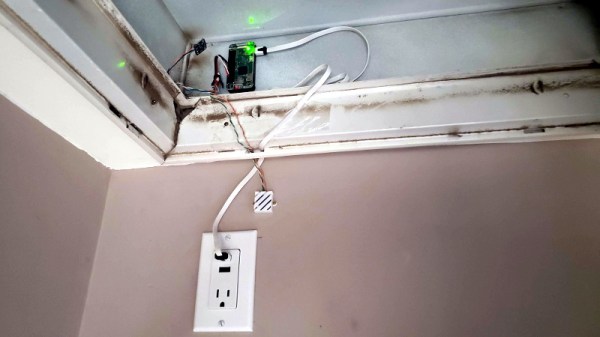
There’s a number of ways you could tackle a project like this, but [Tim] wanted to keep it relatively simple. A pressure sensor on either side of the filter should tell him how much it’s restricting the airflow, and recording the wattage of the ventilation fan would give him an idea on roughly how hard the system was working.

Now [Tim] could have got this all set up and ran it for a couple months to see the values gradually change…but who’s got time for all that? Instead, he recorded data while he switched between a clean filter, a mildly dirty one, and one that should have been taken out back and shot. Each one got 10 minutes in the system to make its impression on the sensors, including a run with no filter at all to serve as a baseline.

The findings were somewhat surprising. While there was a sizable drop in airflow when the dirty filter was installed, [Tim] found the difference between the clean filter and mildly soiled filter was almost negligible. This would seem to indicate that there’s little value in preemptively changing your filter. Counter-intuitively, he also found that the energy consumption of the ventilation fan actually dropped by nearly 50 watts when the dirty filter was installed. So much for a clean filter keeping your energy bill lower.

With today’s cheap sensors and virtually infinite storage space to hold the data from them, we’re seeing hackers find all kinds of interesting trends in everyday life. While we don’t think your air filters are spying on you, we can’t say the same for those fancy new water meters.

A Custom Milled Jig For Smart Bulb Programming

Who would have thought that some day we’d need programming jigs for our light bulbs? But progress marches on, and as there’s currently a number of affordable Internet-controlled bulbs powered by the ESP8266 on the market, we’re at the point where a tool to help update the firmware on the light over your kitchen sink might be something nice to have. Which is why [cperiod] created this programming jig for AiLight smart bulbs.

Flashing the AiLight bulbs is easy enough, there’s a series of test points right on the face of the PCB that you can hook up to. But if you’re updating more than one of them, you don’t want to have to solder your programmer up to each bulb individually. That’s where the jig comes in. [cperiod] says there are already some 3D printed designs out there, but they proved to be a bit finicky.

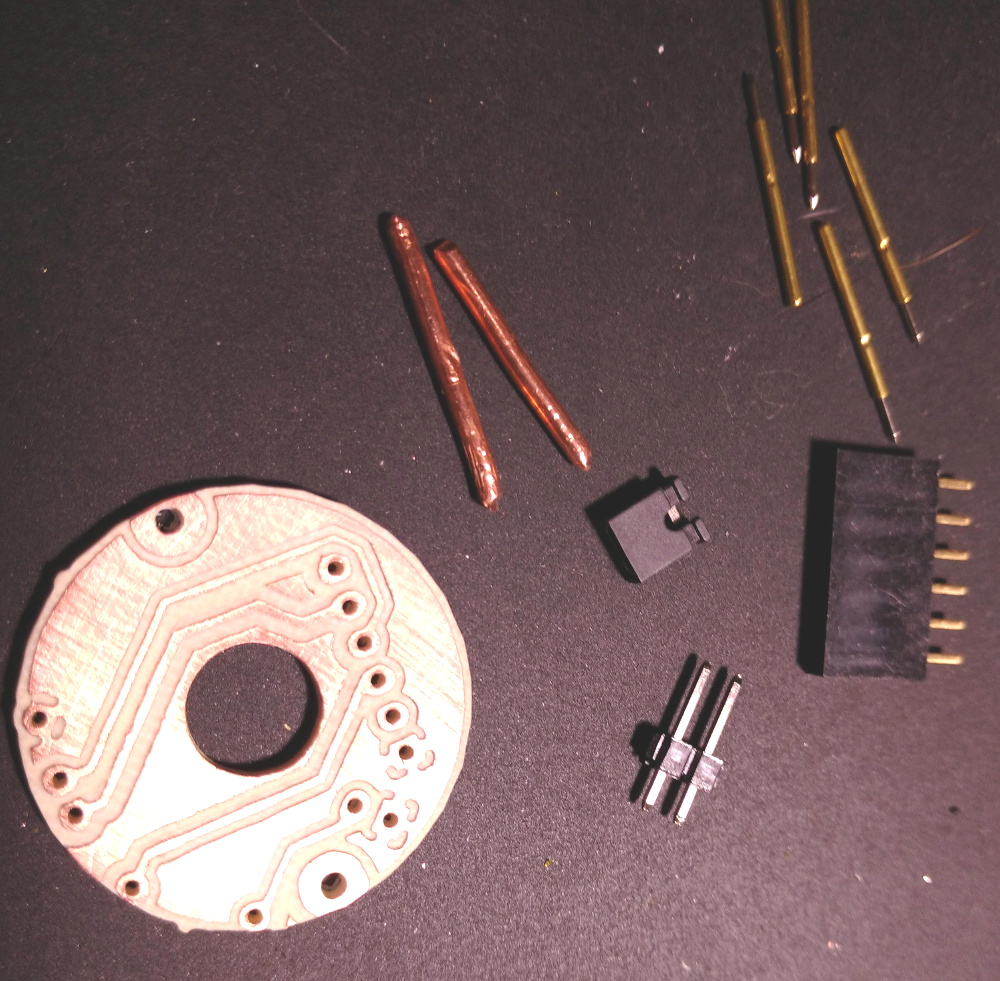
The design that [cperiod] came up with and eventually milled out on a 1610 CNC router is quite simple. It’s effectively just a holder to keep the five pogo pins where they need to be, and a jumper that lets you toggle the chip’s programming mode (useful for debugging).

The neat trick here are the “alignment pins”, which are actually two pieces of 14 gauge copper wire that have had their ends rounded off. It turns out these will slip perfectly into holes on the AliLight PCB, ensuring that the pogo pins end up on target. It works well enough that you can hold the bulb and jig in one hand while programming, it just needs a little downwards pressure to make good contact.

We’ve previously seen how easily you can replace the firmware on some of these ESP8266 bulbs. While there’s certainly a downside to these bulbs being so simple to modify, it’s hard to deny their hackability makes them very appealing for anyone looking to roll their own network-controlled lighting system.

Perfecting A Bluetooth N64 Controller

Love it or hate it, the Nintendo 64 controller doesn’t seem to be going anywhere. Dedicated fans are still looking for ways to use the unique trilobed controller with modern systems, and they won’t be satisfied until they perfectly replicate the original experience. [Shyri Villar] has been working on perfecting a blend of original and modern hardware that looks very promising.

The project started when [Shyri] found that you could take the internals from a modern third party Bluetooth N64 controller made by 8BitDo and put them into the original controller’s case. This would give you the original buttons back, and overall a more authentic weight and feel. Unfortunately, this usually means dumping the original N64 joystick for the 8BitDo’s.

What [Shyri] wanted to do was install the 8BitDo PCB into an original N64 controller, but adapt Nintendo’s joystick to communicate with it. Unfortunately, since the original joystick used optical encoders and the 8BitDo version uses potentiometers, there’s something of a language gap.

To bridge the divide, both the X and Y dimensions of the joystick get their own PIC12F675 microcontroller and X9C103S digital potentiometer. The microcontrollers read the X and Y values from the original joystick’s encoders, and use the digital potentiometers to provide the 8BitDo with the expected analog input. Right now the electronics are held on two scraps of perfboard tucked into the side “wings” of the controller, but hopefully we’ll see a custom PCB in the future.

If you’re more interested in going back in time with your trusty N64 controller, then you might be interested in learning more about how one hacker managed to hook it up to the MSX.

Cruising GitHub For Slack Webhook Tokens

GitHub is an incredibly powerful tool for sharing source code, and its value to the modern hacker can’t be overstated. But there’s at least one downside to effortlessly sharing your source: it’s now much easier for the whole world to find out when you screw up. Back in the day, if you accidentally left a username or password in a tarball hosted on your site, you could pull it down before anyone noticed. But push something like that up to GitHub, and you’ve got a problem on your hands.

For an example, look no farther than this tool that crawls GitHub for Slack webhooks written by [Michele Gruppioni]. Exploiting the fact that Slack webhook links have a predictable format, the tool searches repositories to find code that erroneously includes the authentication token. With the token in hand, an attacker now has the ability to send unsolicited messages into that channel.

But [Michele] restrained himself and didn’t Rickroll the over 6,500 Slack channels he had access to after searching GitHub with his tool. Instead, he sent them all a friendly message explaining their webhook tokens were available on GitHub, and gave them a link to where they could get more information about his project.

Most of the people who contacted him after the fact appreciated that he sent a gentle warning and not something unsavory. Still, we’d recommend caution to anyone looking to expose a vulnerability in this manner. While [Michele] had honorable intentions, it’s certainly not unheard of for an embarrassed administrator to blame the messenger.

When used properly, webhooks can be a very handy way of pushing data into your chat platform of choice. We’ve previously looked at a practical example of a weather station that pushes current conditions into a Discord channel. Just try not to accidentally commit your authentication token to the world’s largest database of open source projects, or you might receive more than you bargained for.

You Need A Cyberdeck, This Board Will Help

In 1984, William Gibson’s novel Neuromancer helped kick off the cyberpunk genre that many hackers have been delighting in ever since. Years before Tim Berners-Lee created the World Wide Web, Gibson was imagining worldwide computer networks and omnipresent artificial intelligence. One of his most famous fictional creations is the cyberdeck, a powerful mobile computer that allowed its users to navigate the global net; though today we might just call them smartphones.

While we might have the functional equivalent in our pockets, hackers like [Tillo] have been working on building cyberdecks that look a bit more in line with what fans of Neuromancer imagined the hardware would be like. His project is hardly the first, but what’s particularly notable here is that he’s trying to make it easier for others to follow in his footsteps.

There’s a trend to base DIY cyberdecks on 1980s vintage computer hardware, with the logic being that it would be closer to what Gibson had in mind at the time. Equally important, the brutalist angular designs of some of those early computers not only look a lot cooler than anything we’ve got today, but offer cavernous internal volume ripe for a modern hardware transfusion. Often powered by the Raspberry Pi, featuring a relatively small LCD, and packed full of rechargeable batteries, these cyberdecks make mobile what was once anchored to a desk and television.

[Tillo] based his cyberdeck on what’s left of a Commodore C64c, reusing the original keyboard for that vintage feel. That meant he needed to adapt the keyboard to something the Raspberry Pi could understand, for which some commercially available options existed already. But why not take the idea farther for those looking to create their own C64c cyberdecks?

He’s currently working on a new PCB specifically designed for retrofitting one of these classic machines with a Raspberry Pi. The board includes niceties like a USB hub, and should fill out some of those gaping holes left in the case once you remove the original electronics. [Tillo] has already sent the first version of his open source board out for fabrication, so hopefully we’ll get an update soon.

In the meantime, you might want to check out some of the other fantastic cyberdeck builds we’ve covered over the last couple of years.

Home Automation At A Glance Using AI Glasses

There was a time when you had to get up from the couch to change the channel on your TV. But then came the remote control, which saved us from having to move our legs. Later still we got electronic assistants from the likes of Amazon and Google which allowed us to command our home electronics with nothing more than our voice, so now we don’t even have to pick up the remote. Ushering in the next era of consumer gelification, [Nick Bild] has created ShAIdes: a pair of AI-enabled glasses that allow you to control devices by looking at them.

Of course on a more serious note, vision-based home automation could be a hugely beneficial assistive technology for those with limited mobility. By simply looking at the device you want to control and waving in its direction, the system knows which appliance to activate. In the video after the break, you can see [Nick] control lamps and his speakers with such ease that it almost looks like magic; a defining trait of any sufficiently advanced technology.

So how does it work? A Raspberry Pi camera module mounted to a pair of sunglasses captures video which is sent down to a NVIDIA Jetson Nano. Here, two separate image classification Convolutional Neural Network (CNN) models are being used to identify objects which can be controlled in the background, and hand gestures in the foreground. When there’s a match for both, the system can fire off the appropriate signal to turn the device on or off. Between the Nano, the camera, and the battery pack to make it all mobile, [Nick] says the hardware cost about $150 to put together.

But really, the hardware is only one small piece of the puzzle in a project like this. Which is why we’re happy to see [Nick] go into such detail about how the software functions, and crucially, how he trained the system. Just the gesture recognition subroutine alone went through nearly 20K images so it could reliably detect an arm extended into the frame.

If controlling your home with a glance and wave isn’t quite mystical enough, you could always add an infrared wand to the mix for that authentic Harry Potter experience.

Continue reading “Home Automation At A Glance Using AI Glasses”