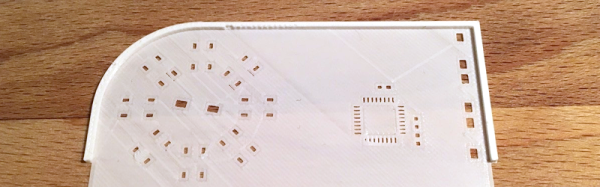
If you are soldering with paste, a stencil makes life a lot easier. Sure, you can apply paste by hand with a syringe, but a modern PCB might have hundreds or even thousands of pads. Like a lot of us, [Robert Kirberich] doesn’t like paying to have stencils made and he wondered if he could use his 3D printer to make stencils. He found the answer was yes.
Although the Internet of Things (IoT) is a reasonably new term, the idea isn’t really all that new. Many engineers and hackers have created networked embedded systems for many years. So what’s different? Two things: the Internet is everywhere and the use of connected embedded systems in a consumer setting.
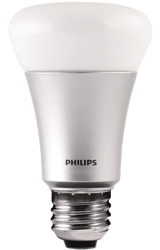
The Philips Hue light bulb
Like anything else, there’s a spectrum of usefulness to IoT. Watching The Expanse, the other day (which is not a bad show, by the way), I noticed that if you had the right IoT lights, you could run an app that would change your lighting to suit the show in real-time. I don’t have those lights, but I suppose when the action moves to a dark sub-basement, your lights dim and when you are in a space ship’s reactor room, they turn red, and so on. Fun, but hardly useful or life-changing.
On the other hand, there are some very practical IoT items like the Nest thermostat. It might seem lazy to want to monitor and control your thermostat from your tablet, but if you are frequently away from home, or you have multiple houses, it can be a real positive to be able to control things remotely. With the recent blizzard on the U.S. east coast, for example, it would be great to turn on the heat in your weekend cottage 150 miles away while you were still at work or home. However, the Nest recently had a hiccup during an upgrade and it has made many of their customers mad (and cold). I’ll get back to that, in a minute. First, I want to talk about the problems with deploying something that will be in many varied environments (like people’s homes) that controls something real.
A lot of people got drones for Christmas this year (and many Hackaday readers already had one, anyway). A lot of these drones have cameras on them. The expensive ones beam back live video via RF. The cheaper ones just record to an SD card that you can download later.
If you are NASA, of course, this just isn’t good enough. At the Langley Research Center in Virginia, they’ve been building the Greased Lightning (also known as the GL-10) which is a 10-engine tilt-prop unmanned aerial vehicle. The carbon fiber drone is impressive, sure, but what wows is the recent video NASA released (see below).
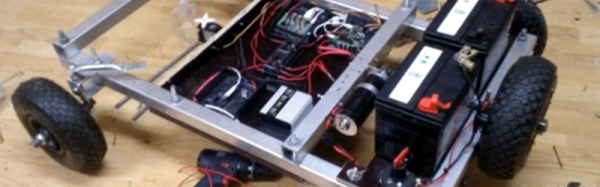
[Emil Kalstø] has a pretty solid remote control car. We don’t mean a little car with a handheld remote you can drive around the neighborhood. [Emil’s] car has a camera and a cell phone so that it can go anywhere there’s 3G or 4G networking available.
The video (see below) shows the results (along with [Emil’s] little brother acting as a safety officer). The video offers tantalizing detail you might find useful if you want to reproduce a similar vehicle. However, it stops short of providing complete details.
The two batteries onboard will power the vehicle for over 20 hours of continuous use. The 30W motor is reduced with a chain drive to go about “walking speed.” There’s a Raspberry Pi with a Huawei 3G USB dongle onboard and [Emil] uses an XBox controller to do the steering from the warmth of his living room. Of course, a Pi can’t handle a big motor like that directly, so a Phidgets USB motor controller does the hard work. The software is written using Node.js.
The camera mount can swivel 230 degrees on a servo so that the operator can scan the road ahead. The video mentions that steering the car required a heavy-duty servo with metal gears (an earlier attempt with nylon gears didn’t work out).
Overall, it looks like a solid build. We hope [Emil] will share code and more details soon. If you can’t wait (and your insurance is paid up), you might have a go at an even bigger car. Surprisingly, there’s more than one example of that.
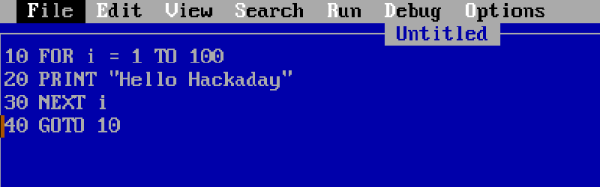
In the 1970s and 1980s, a lot of us learned to program using good old-fashioned BASIC on machines ranging from Altairs, Commodores, Apple IIs, and the like. Sometime in the 80’s the IBM PC running MSDOS because the de facto standard, but it was still easy enough to launch BASIC and write a simple little program. Of course, there were other programs, some serious like C compilers, some semi-serious like flight simulators, and some pure fun like Wolfenstein 3D.
If you read Hackaday, you’ve probably noticed that a lot of people emulate old computers–including old MSDOS PCs–using a variety of techniques, including Raspberry PI boards running DOSBox or another emulator. Honestly, though, that’s a lot of effort just to run some old software, right? You can load up DOS emulators on your desktop too. That’s a little easier, but you still have to find software. But if you are as lazy as we are, you might want to check out the MSDOS collection at archive.org.
Comedian Steven Wright used to say (in his monotone way):
“We lived in a house that ran on static electricity. If we wanted to cook something, we had to take a sweater off real quick. If we wanted to run a blender, we had to rub balloons on our head.”
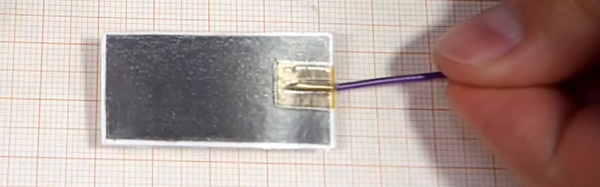
Turns out, all you need to generate a little electricity is some paper, Teflon tape and a pencil. A team from EPFL, working with researchers at the University of Tokyo, presented just such a device at a MEMS conference. (And check out their video, below the break.)
An ordinary integrated circuit is made of layers of material. Typically a layer is made from some material (like silicon dioxide, polysilicon, copper, or aluminum). Sometimes a process will modify parts of a layer (for example, using ion implantation to dope regions of silicon). Other times, some part of the layer will be cut away using a photolithography process.
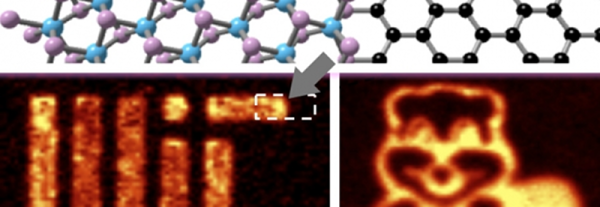
Researchers at MIT have a new technique that allows super thin layers (1-3 atoms thick) and–even more importantly–enables you to use two materials in the same layer. They report that they have built all the basic components required to create a computer using the technique.