Experimenting With 3D Printed Rocket Nozzles

Rocketry is an exacting science, involving a wide variety of disciplines, encompassing everything from fluid mechanics to thermodynamics and materials engineering. As complex as it sounds, that doesn’t mean it’s beyond the purview of the average maker. [Sciencish] demonstrates this with a series of experiments on rocket nozzles in the home lab. (Video, embedded below.)

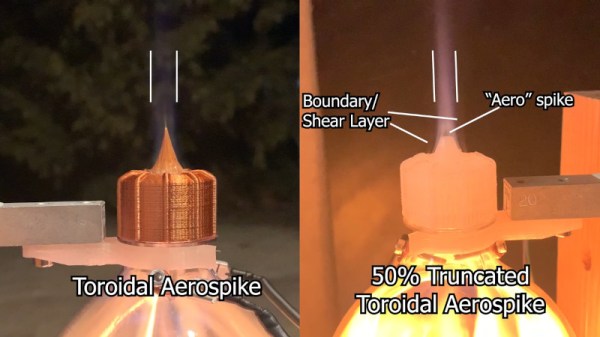
The video starts with an amusing analogy about nozzle design based on people fleeing a bad pizza. From there, [Sciencish] 3D prints a wide variety of nozzle designs for testing. The traditional bell nozzle is there, of course, along with the familiar toroidal and linear aerospikes and an expansion deflection design. Of course, 3D printing makes it easy to try out fun, oddball geometries, so there’s also a cowbell nozzle , along with the fancy looking square and triangular aerospikes too. Testing involves running the nozzles on a test stand instrumented with a load cell. A soda bottle is filled with rubbing alcohol vapour, and the mixture is ignited, with each nozzle graded on its thrust output. The rockets are later flown outside, reaching heights over 40 feet.

[Sciencish] notes that the results are a rough guide only, as the fuel/air mixture was poorly controlled. Despite this, it’s a great look at nozzle design and all the science involved. It also wouldn’t be too hard to introduce a little more rigour and get more accurate data, either. However, if solid fuels are more your jam, consider brewing up some rocket candy instead.

Continue reading “Experimenting With 3D Printed Rocket Nozzles” →
Dreamcast Controller Adapter Even Works With Mice

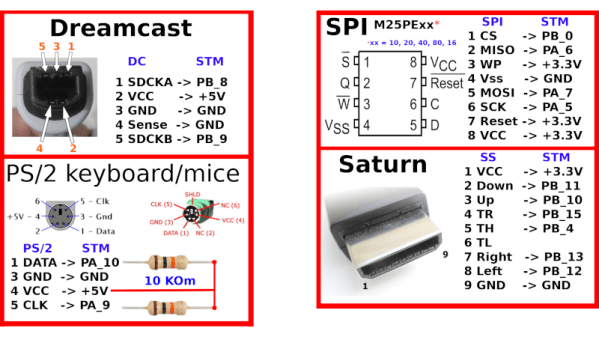
PC gamers have the benefit of a broad ecosystem of peripherals built to serve their gaming pleasure. As a bonus, if there’s something out there that doesn’t work with the platform, someone is likely already selling an adapter for it. Console gamers aren’t so lucky, and the vast majority stick with the factory standard controller. [megavolt85] isn’t one of them however, and spun up a multi-adapter for the Sega Dreamcast.

The adapter lets the player use a huge variety of controllers with the Dreamcast. There’s support for both PS1 & PS2 controllers, including vibration support, as well as MegaDrive & Saturn pads, too. PS/2 mice and keyboards can be used as well, and up to 16 VMUs can be hooked up as well. The adapter uses the STM32F103C8T6 microcontroller, which runs at up to 72MHz, giving it plenty of grunt to emulate the Dreamcast’s Maple controller interface.

We’ve seen other hacks of the Dreamcast’s controller bus, too; this custom controller implements the interface on a Raspberry Pi Pico. If you’ve been cooking up your own glorious Dreamcast mods, be sure to drop us a line!

Prototyping A Turbojet Engine In The Home Shop

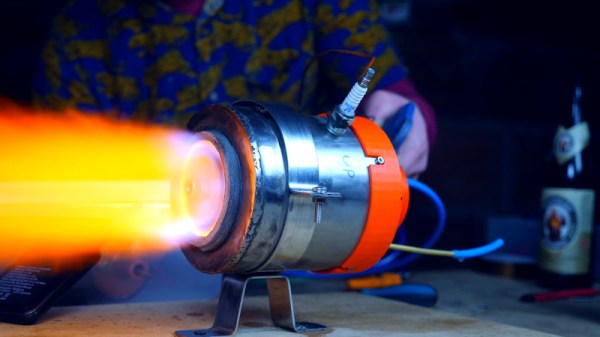
The development of the turbojet engine was a gamechanger in aviation, as no longer would aircraft designers have to struggle with ever larger and more complex piston engines, nor would propellers keep planes stuck below the speed of sound. However, the turbojet is an exacting device, demanding the utmost of materials in order to work successfully. [Integza] discovered just this in his quest to build one at home.

Unlike most home jet engine builds, this one doesn’t use a turbocharger or go with a simpler pulse jet design – though [Integza] has built those, too. This is a proper radial-flow turbojet design. The build uses a 3D-printed compressor, which is possible as it doesn’t have to deal with much heat. However, for the turbine, [Integza] realised that plastic wouldn’t cut it. After experiments with ceramic resins failed too, a 3D printed jig was instead built to allow sheet metal to easily be crafted into a workable turbine. Other internal components were made out of concrete for heat resistance, and a combustion chamber welded up out of steel.

The engine did run after several attempts, albeit for just ten seconds before components started to melt. While the engine is a long way off being flight ready, it goes to show just how hard it is to build even a bench-running turbojet. Even major world powers have struggled with this problem over the years. Video after the break.

Continue reading “Prototyping A Turbojet Engine In The Home Shop” →

Bone Vibration Brings Typing Into VR

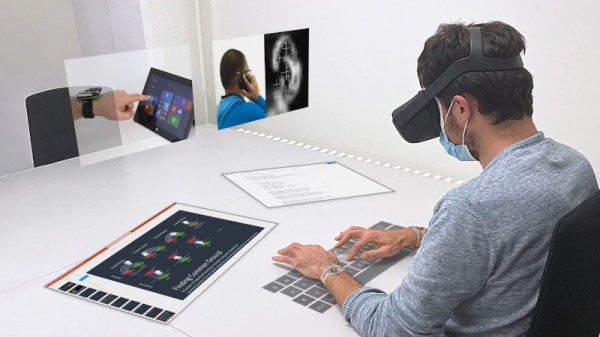
Virtual reality is becoming more of a thing, now that we have high quality headsets and the computing power to generate attractive environments. Many VR systems use controllers held in mid air, or camera-based systems that track limbs and hands for interaction. However, productivity scenarios often require prolonged interactions over a long period of time, which typically necessitates working at surfaces that allow the body to rest intermittently. To help facilitate this, a group of researchers at ETH Zurich developed TapID, including a preprint paper (PDF) that will be presented at IEEE VR 2021 later this month.

TapID consists of a wristband that carries two motion sensors, with one worn on each wrist. This allows TapID to detect taps from each of the user’s fingers individually, thanks to a machine learning algorithm that analyses the unique vibrations through your skeletal system. This is demonstrated as being useful for VR environments, where the user can type into a virtual keyboard, or interact with virtual objects on a surface, using their fingers as they would in the real world. This is a sensor fusion with the features of modern VR headsets that include hand tracking. The TapID wristbands deliver granularity and detection of small motions that is not nearly as accurate through headset-mounted senors and camera-based detection.

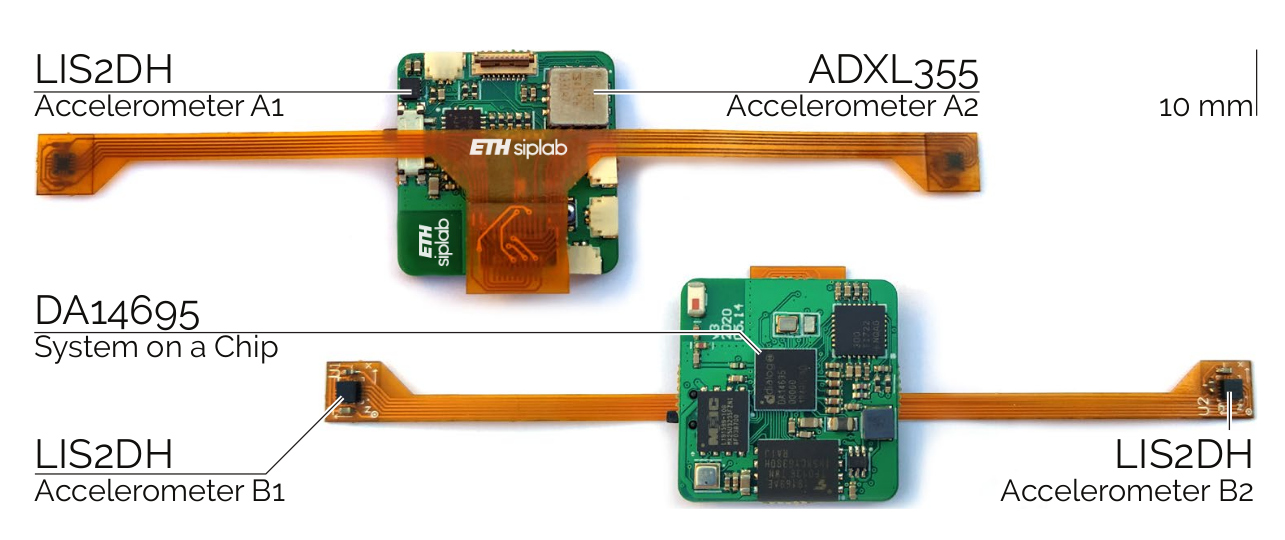
Test hardware includes 4 accelerometers. Two on flexible PCBs are the sensing hardware used by the system, the other two on the rigid PCB are used as a baseline during testing but do not contribute to the tap detection.

We’re not entirely convinced of the utility of sitting down in a virtual environment to type at a fake keyboard when monitors and real keyboards are more tactile and cheaper. However, having a device that can accurately determine individual finger interactions is sure to have applications in VR. And whether or not the demonstrated use cases are viable, the technology does indeed work.

It’s exciting to see the wrist-band form factor. It brings to mind the possibility of improving tap interactions in smart watches for non-VR uses. We envision chorded keyboard type gestures that detect which fingers are tapping but don’t need positional accuracy.

Those experimenting in VR interfaces may find it useful to reverse engineer what’s already out on the market, as we’ve featured before. Or, you can simply build your own! Video after the break.

Continue reading “Bone Vibration Brings Typing Into VR” →

Mini Hygrometer Packs E-Paper Display

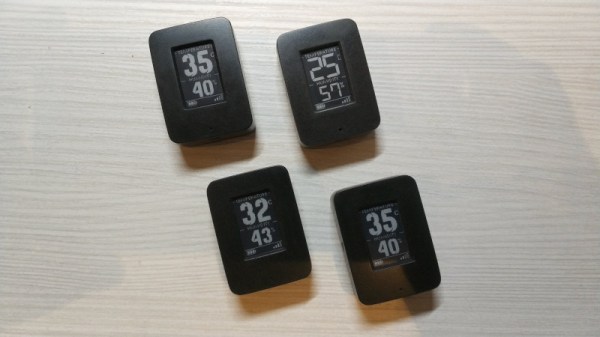
Historically, display technologies have always been power thirsty things. In the past, CRTs and incandescent bulbs sucked down electrons like they were free beer. Eventually, LEDs and LCDs came along and lowered this significantly, but the king of low power display technologies remains ePaper and eInk displays. Only requiring power when refreshing the display, they can be left off indefinitely, drawing little to no current. This is great for low-power builds such as [Andrew Lamchenko’s] miniature hygrometer. (Video, embedded below.)

The build runs on an nRF52811 microcontroller, hooked up to a 1.02″ ePaper display sourced for just $7. A SHT20 temperature and humidity sensor is then queried to sample the ambient conditions, and the results displayed on the screen. The benefit of this is that the device can be powered from a coin cell, and set to update at infrequent intervals – say, once per hour. It can then be checked by the user without having to turn on.

The low-power design means it would be the perfect device for leaving in a guitar case or humidor for months at a time. As a bonus, it’s also capable of Smart Home integration thanks to the Bluetooth capabilities onboard. It would likely be trivial to upgrade this into a tweeting humidor, the likes of which we haven’t seen since 2009!

Continue reading “Mini Hygrometer Packs E-Paper Display” →

Design Solutions For The Heat Crisis In Cities Around The World

It was 1999 when Smash Mouth dropped the smash hit All Star, stating “The ice we skate is getting pretty thin, the water’s getting warm so you might as well swim.” Since then, global temperatures have continued to rise, with no end in sight. Political will has been unable to make any grand changes, and the world remains on track to blow through the suggested hard limits set by scientists.

As a result, heatwaves have become more frequent, and of greater intensity, putting many vulnerable people at risk and causing thousands of deaths each year. This problem is worse in cities, where buildings and roads absorb more heat from the sun than natural landscapes do. This is referred to as the heat island effect, with cities often being several degrees warmer than surrounding natural areas. It’s significant enough that experts are worried some cities could become uninhabitable within decades. Obviously, that’s highly inconvenient for those currently living in said cities. How bad is the problem, and what can be done?

Continue reading “Design Solutions For The Heat Crisis In Cities Around The World” →

Jet Powered Go Kart Built With RC Gear

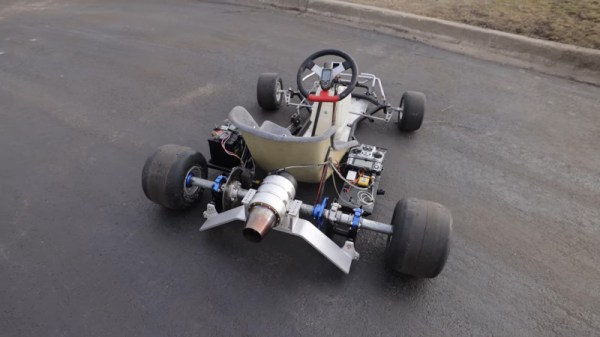
Turbine cars never quite came to be, despite many experiments in the 20th century. Despite their high power output for their size, they’re just not well suited to land transport applications; even the M1A1 tank has been much maligned for its turbine power plant. That didn’t stop [Warped Perception] for throwing a jet on the back of a kart though, and it looks like a whole lot of fun. (Video, embedded below.)

The build starts with a garden variety gokart, with the piston engine and all associated running gear stripped off in haste. The RC-sized turbo jet is then mounted on an elegant aluminium bracket, neatly welded on to the back of the car. It’s hooked up with its electronic controller, with throttle controlled by an RC transmitter. It’s not ideal trying to steer one-handed with another on the stick, but these are the sacrifices made when parts don’t arrive in time.

Early testing revealed issues with air ingestion into the fuel line over bumps, but overall performance was impressive. Future plans involve a top speed run which we can’t wait to see. Of course, if it’s not outrageous enough for your taste, consider [Colin Furze’s] pulsejet build.

Continue reading “Jet Powered Go Kart Built With RC Gear” →