A Baby Grand Gets MIDI

Like a lot of people, [Jacques] doesn’t think a big hunk of plastic light enough to carry under your arm is a piano, even if it does have 88 keys. A piano is supposed to be a hefty piece of furniture that you have to buy people pizza to help you move. So he bought a used baby grand piano. It wasn’t in very good shape, though, so while restoring it, he also added MIDI to it. You can see the finished result in the video below.

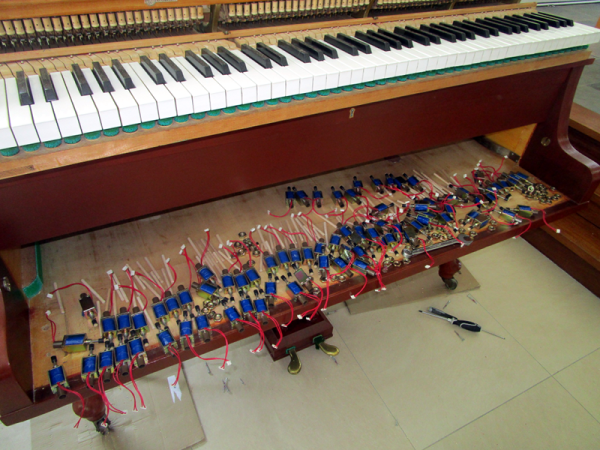
At $100, the price was right, although it cost more to move it. Between water damage, moth attacks, and storage in a garage, the piano — an old Zimmerman — needed a lot of tender loving care. When it came to MIDI, [Jacques] found a used Disklavier — a very expensive piece of kit — but it didn’t fit the Zimmerman or another piano at hand. The solenoids and optical sensors are set up for a particular piano, so what can you do? Easy! Rebuild the bar that holds the solenoids and sensors.


Continue reading “A Baby Grand Gets MIDI”

Excercise Ball Makes A Passable Landing Gear

Exercise balls are great for many things, from amusing children to breaking everything in your living room, often in quick succession. After seeing some German WWII prototype aircraft with wild landing gear designs, the [FliteTest] crew decided to see whether they could use an exercise ball to build a plane ready for even the bumpiest of runways.

Comparisons to the Gee Bee R-1 abound in the video.

The exercise ball created some constraints on the design, due to its weight and the large amount of drag it creates. To work around this, the design features a foamcore and carbon fibre construction to save weight. The exercise ball is placed front and center, serving as both the nose and landing gear of the aircraft. V-tails are used to place the rear control surfaces outside of the shadow of the ball, to help maintain control authority. Initial tests of the airframe showed handling problems. The team solved this by using a pair of gyro stabiliser boards of their own design, named Aura.

With the issues solved, the final aircraft is hilarious to behold. The huge, bouncing ball makes an excellent landing gear, able to launch off lumps and bumps and even skim over water. We’ve seen [FliteTest] get up to other escapades in the past, too. Video after the break.

[Thanks to Baldpower for the tip!]

Continue reading “Excercise Ball Makes A Passable Landing Gear”

Measuring The Time Is A Breeze With This Air Flow Clock

If you’ve ever had surgery, and you’re over a certain age, chances are good you’re familiar with the dreaded incentive spirometer. It’s a little plastic device with one or more columns, each of which has a plastic ball in it. The idea is to blow into the thing to float the balls, to ensure that your lungs stay in good shape and reduce the chance of pneumonia. This unique air-powered clock reminds us a little of that device, without all the pain.

Like a spirometer, [Nir Tasher]’s clock has three calibrated tubes, each big enough to hold a foam ball loosely. At the bottom of each tube is a blower whose motor is under PWM control. A laser rangefinder sits below each ball and measures its height; the measurement is used by a PID loop to control the speed of each fan and thus the height of each ball. The video below shows that the balls are actually pretty steady, making the clock easy to read. It doesn’t, however, reveal what the clock sounds like; we’re going to go out on a limb here and guess that it’s pretty noisy. Still, we think it’s a fantastic way to keep time, and unique in the extreme.

[Nir]’s Air Flow clock is an early entry in the 2020 Hackaday Prize, the greatest hardware design contest on Earth. Everyone should enter something, or at least check out the cool things people are coming up with. It’s still early in the process, but there are so many neat projects already. What are you waiting for?

Continue reading “Measuring The Time Is A Breeze With This Air Flow Clock”

Grey Gear: French TV Encryption, 1980s Style

Who among us didn’t spend some portion of their youth trying in vain to watch a scrambled premium cable TV channel or two? It’s a wonder we didn’t blow out our cones and rods watching those weird colors and wavy lines dance across the screen like a fever dream.

In the early days of national premium television in America, anyone who’d forked over the cash and erected a six-foot satellite dish in the backyard could tune in channels like HBO, Showtime, and the first 24-hour news network, CNN. Fed up with freeloaders, these channels banded together to encrypt their transmissions and force people to buy expensive de-scrambling boxes. On top of that, subscribers had to pay a monthly pittance to keep the de-scrambler working. Continue reading “Grey Gear: French TV Encryption, 1980s Style”

DIY TV-B-Gone Is A-OK

Where won’t they put a TV these days? We’ve even seen one creeping behind semi-transparent mirror film in the ladies’ room of a sports bar, though that one didn’t last long. Up until that moment, we had never wished so hard for a TV-B-Gone, especially one as small and powerful as this DIY version by [Shane].

The best thing about [Shane]’s DIY TV-B-Gone is the strength of signal, though the size is nothing to sneeze at. That’s a 10-watt array or IR LEDs out of a security camera, and you can see how much brighter it is than a single IR LED in the video after the break.

Packed inside this minty enclosure is an Arduino Nano, which holds all the TV power-off codes known to hackers and fires them off in quick succession. [Shane] salvaged a MOSFET from an electronic speed controller to drive that LED array, and there’s a voltage booster board to raise the 3.7V lithium battery to 5V. [Shane] hasn’t really had the chance to test this out in public what with the global pandemic and all, but was able to verify a working distance of 40 feet inside the house.

Don’t care for such a raw look? Hide your zapper inside a toy, like this sonic screwdriver version.

Continue reading “DIY TV-B-Gone Is A-OK”

Ditching X86, Apple Starts An ARM Race

At its annual World Wide Developer Conference, Apple dropped many jaws when announcing that their Mac line will be switching away from Intel processors before the year is out. Intel’s x86 architecture is the third to grace Apple’s desktop computer products, succeeding PowerPC and the Motorola 68000 family before it.

In its place will be Apple’s own custom silicon, based on 64-bit ARM architecture. Apple are by no means the first to try and bring ARM chips to bear for general purpose computing, but can they succeed where others have failed?

Continue reading “Ditching X86, Apple Starts An ARM Race”

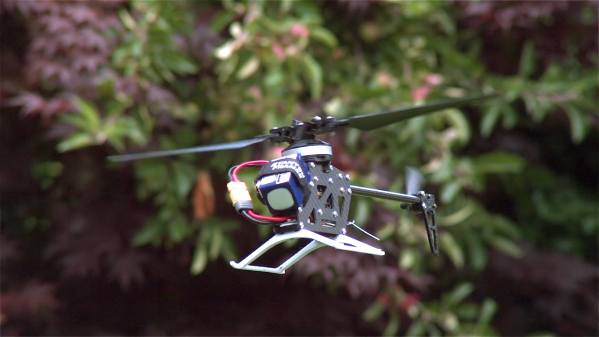
Building And Flying A Helicopter With A Virtual Swashplate

They say that drummers make the best helicopter pilots, because to master the controls of rotary-wing aircraft, you really need to be able to do something different with each limb and still have all the motions coordinate with each other. The control complexity is due to the mechanical complexity of the swashplate, which translates control inputs into both collective and cyclical changes in the angle of attack of the rotor blades.

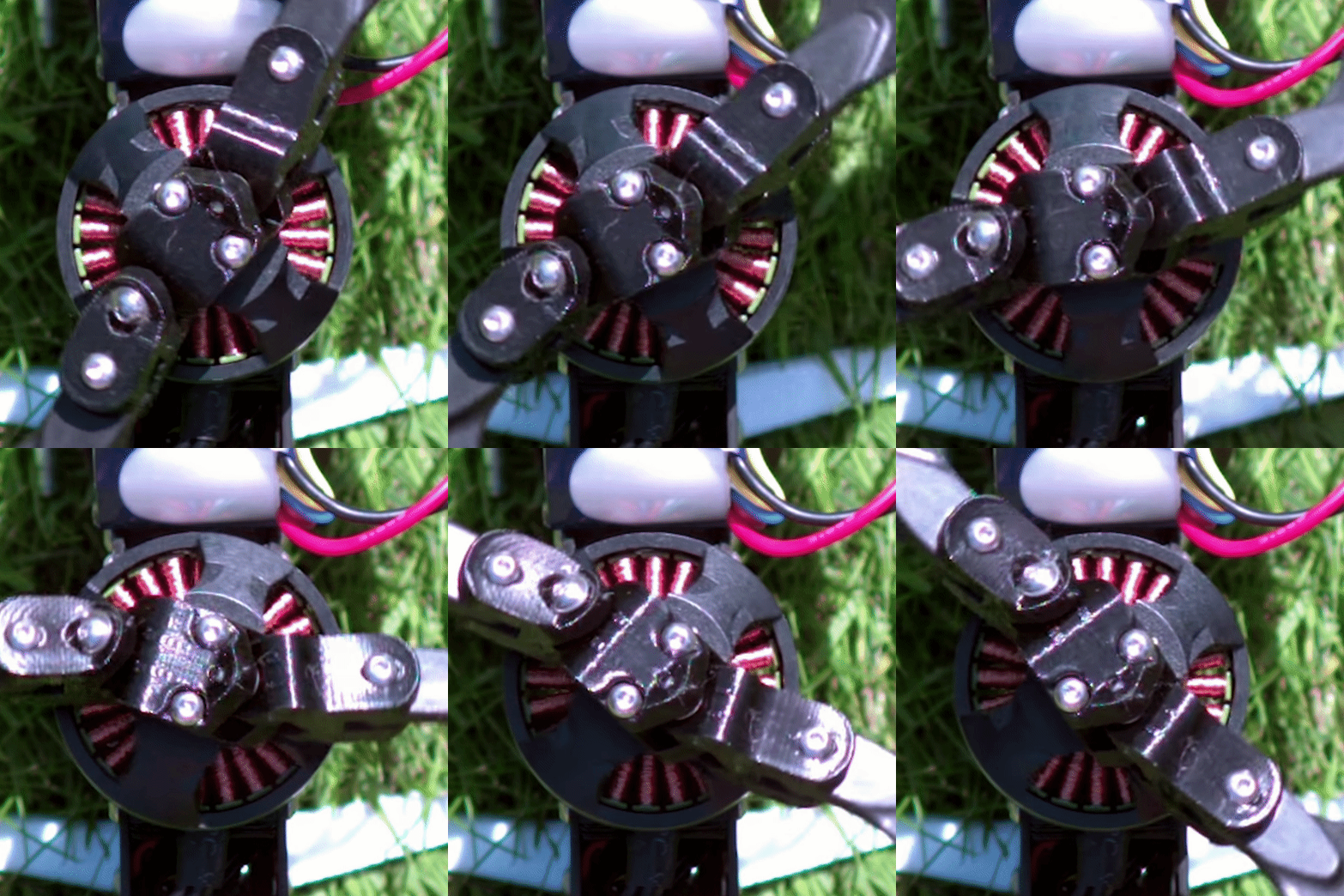
As [Tom Stanton] points out in his latest video, a swashplate isn’t always needed. Multicopters dispense with the need for one by differentially controlling four or more motors to provide roll, pitch, and yaw control. But thanks to a doctoral thesis he found, it’s also possible to control a traditional single-rotor helicopter by substituting flexible rotor hinges and precise motor speed control for the swashplate.

You only need to watch the slow-motion videos to see what’s happening: as the motor speed is varied within a single revolution, the tips of the hinged rotor blades lead and lag the main shaft in controlled sections of the cycle. The hinge is angled, which means the angle of attack of each rotor blade changes during each rotation — exactly what the swashplate normally accomplishes. As you can imagine, modulating the speed of a motor within a single revolution when it’s spinning at 3,000 RPM is no mean feat, and [Tom] goes into some detail on that in a follow-up video on his second channel.

It may not replace quadcopters anytime soon, but we really enjoyed the lesson in rotor-wing flight. [Tom] always does a great job of explaining things, whether it’s the Coandă effect or anti-lock brakes for a bike.

Continue reading “Building And Flying A Helicopter With A Virtual Swashplate”