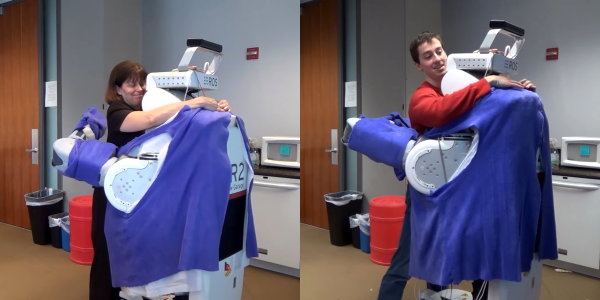
Can Robots Give Good Hugs?

We could all use a hug once in a while. Most people would probably say the shared warmth is nice, and the squishiness of another living, breathing meatbag is pretty comforting. Hugs even have health benefits.

But maybe you’re new in town and don’t know anyone yet, or you’ve outlived all your friends and family. Or maybe you just don’t look like the kind of person who goes for hugs, and therefore you don’t get enough embraces. Nearly everyone needs and want hugs, whether they’re great, good, or just average.

So what makes a good hug, anyway? It’s a bit like a handshake. It should be warm and dry, with a firmness appropriate to the situation. Ideally, you’re both done at the same time and things don’t get awkward. Could a robot possibly check all of these boxes? That’s the idea behind HuggieBot, the haphazardly humanoid invention of Katherine J. Kuchenbecker and team at the Max Planck Institute for Intelligent Systems in Stuttgart, Germany (translated). User feedback helped the team get their arms around the problem.

Continue reading “Can Robots Give Good Hugs?”

Bendy Straws

Compliant Mechanisms Hack Chat

Join us on Wednesday, January 26 at noon Pacific for the Compliant Mechanisms Hack Chat with Amy Qian!

When it comes to putting together complex mechanisms, we tend to think in a traditional design language that includes elements like bearings, bushings, axles, pulleys — anything that makes it possible for separate rigid bodies to move against each other. That works fine in a lot of cases — our cars wouldn’t get very far without such elements — but there are simpler ways to transmit force and motion, like compliant mechanisms.

Compliant mechanisms show up in countless products, from the living hinge on a cheap plastic box to the nanoscale linkages etched into silicon inside a MEMS accelerometer. They reduce complexity by putting the elasticity of materials to work and by reducing the number of parts it takes to create an assembly. And they can help make your projects easier and cheaper to build — if you know the secrets of their design.

join-hack-chatAmy Qian, from the Amy Makes Stuff channel on YouTube,  is a mechanical engineer with an interest in compliant mechanisms, so much so that she ran a workshop about them at the 2019 Superconference. She’ll stop by the Hack Chat to share some of what she’s learned about compliant mechanisms, and to help us all build a little flexibility into our designs.

Our Hack Chats are live community events in the Hackaday.io Hack Chat group messaging. This week we’ll be sitting down on Wednesday, January 26 at 12:00 PM Pacific time. If time zones have you tied up, we have a handy time zone converter.


Continue reading “Compliant Mechanisms Hack Chat”

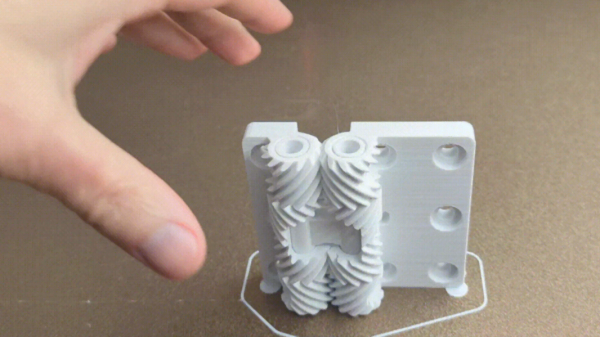
Hand reaching for a 3d-printed hinge

One-piece Geared Hinge Can Take The Weight

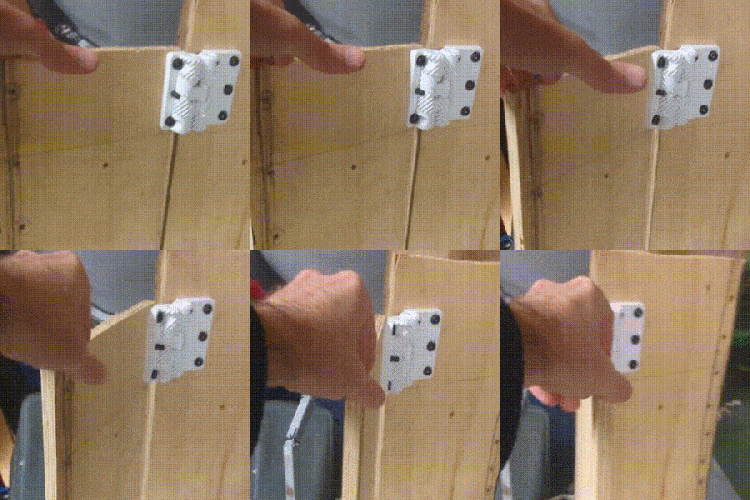
3D printers have come a long way from cranking out things like bottle openers and coat pegs, and [E. Soderberg]’s Print in Place Geared Hinge is a pretty nifty demonstration of that. This hinge is designed as a print-in-place part, meaning it is 3D printed as a single piece, requiring no assembly. Not only that, but the herringbone gears constrain the sturdy device in a way that helps it support heavy loads.

Of course, hinges — even strong ones — are not particularly hard to find items. They’re available in a mind-boggling array of shapes and sizes. But what’s interesting about this design is that it shows what’s easily within the reach of just about any hobbyist nowadays. Not that long ago, designing and creating an object like this would not have been accessible to most home enthusiasts. Making it without a modern 3D printer would certainly have been a challenge in its own right.



It doesn’t always matter that a comparable (or superior) off-the-shelf part is available; an adequate part that can be created in one’s own workshop has a value all its own. Plus, it’s fun to design and make things, sometimes for their own sake. After all, things like 3D-printed custom switch assemblies would not exist if everyone were satisfied with the ability to just order some Cherry MX switches and call it a day.

Floating Solar Farms Are Taking The World’s Reservoirs By Storm

Photovoltaic solar panels are wonderful things, capable of capturing mere light and turning it into useful electricity. They’re often installed on residential and commercial rooftops for offsetting energy use at the source.

However, for grid-scale generation, they’re usually deployed in huge farms on tracts of land in areas that receive plenty of direct sunlight. These requirements can often put solar farms in conflict with farm-farms — the sunlight that is good for solar panels is also good for growing plants, specifically those we grow for food.

One of the more interesting ideas, however, is to create solar arrays that float on water. Unlike some of the wackier ideas out there, this one comes with some genuinely interesting engineering benefits, too!

Continue reading “Floating Solar Farms Are Taking The World’s Reservoirs By Storm”

View of a well-organized workspace in front of a window view to outdoors

How To Optimize Your Workspace: Analyze How You Work

[Jay Carlson] has shared some fantastic guidance on how to optimize one’s home workspace, and you just might want to emulate some of his layout, especially if you routinely juggle multiple projects. He makes the important point that different people have different needs, so one size does not fit all. Optimizing one’s workspace must first take into account what kind(s) of work one does, and many of his tips and tricks are pretty broadly applicable.

A rack of trays, each with a project
Looking online for these? A common industry term is “bun rack”. This one is “half-height” in size.

[Jay] works on embedded systems, and often switches between many different jobs and projects. Get your notepads ready, because there are plenty of great takeaways.

For example, to get a good top-down camera view of what’s on the workbench, he uses a camera mounted on an articulated arm (the kind that usually has a lamp attached to the end.) This makes the camera easy to deploy and easy to stow, and he can effortlessly save footage or share video with colleagues online.

Another great tip is using what most of us would call cafeteria trays and a matching rack. With each tray devoted to a different project or version of hardware, it makes switching between jobs as simple as sliding in one tray and pulling out another. It’s also a highly space-efficient way to store a lot of in-progress hardware. [Jay] gives a detailed walkthrough of his workspace and explains every decision, it’s well worth a read.

It’s always better to save space, as long as doing so doesn’t negatively impact the work itself. If you’re looking for space-saving tips, be sure to check out this tiny workshop’s space-saving hacks for more ideas.

A HP Proliant 360 g6 server with its lid taken off, showing separate green wires coming out of every fan, enabling Dave's modification

Domesticating Old Server Hardware In The Age Of Shortages

Our own [Dave Rowntree] started running into bottlenecks when doing paid work involving simulations of undisclosed kind, and resolved to get a separate computer for that. Looking for budget-friendly high-performance computers is a disappointing task nowadays, thus, it was time for a ten-year-old HP Proliant 380-g6 to come out of Dave’s storage rack. This Proliant server is a piece of impressive hardware designed to run 24/7, with a dual CPU option, eighteen RAM slots, and hardware RAID for HDDs; old enough that replacement and upgrade parts are cheap, but new enough that it’s a suitable workhorse for [Dave]’s needs!

After justifying some peculiar choices like using dual low-power GPUs, only populating twelve out of eighteen RAM slots, and picking Windows over Linux, [Dave] describes some hardware mods needed to make this server serve well. First, a proprietary hardware RAID controller backup battery had to be replaced with a regular NiMH battery pack. A bigger problem was that the server was unusually loud. Turns out, the dual GPUs confused the board management controller too much. Someone wrote a modded firmware to fix this issue, but that firmware had a brick risk [Dave] didn’t want to take. End result? [Dave] designed and modded an Arduino-powered PWM controller into the server, complete with watchdog functionality – to keep the overheating scenario risks low. Explanations and code for all of that can be found in the blog post, well worth a read for the insights alone.

If you need a piece of powerful hardware next to your desk and got graced with an used server, this write-up will teach you about the kinds of problems to look out for. We don’t often cover server hacks – the typical servers we see in hacker online spaces are full of Raspberry Pi boards, and it’s refreshing to see actual server hardware get a new lease on life. This server won’t ever need a KVM crash-cart, but if you decide to run yours headless, might as well build a crash-cart out of a dead laptop while you’re at it. And if you decide that running an old server would cost more money in electricity bills than buying new hardware, fair – but don’t forget to repurpose it’s PSUs before recycling the rest!

Silicone Devices: DIY Stretchable Circuits

Flexible circuits built on polyimide film are now commonplace, you can prototype with them at multiple factories, at a cost that is almost acceptable to your average hacker. Polyimide film is pretty tough for something so thin, but eventually it will tear, and with larger components, bend radii are quite restricted. But what about stretchable circuits, as in circuits you can flex, twist and stretch? Let us introduce silicone devices. A research group from Hasselt University, Belgium, have been prototyping making truly flexible, silicone-based circuit substrates, managing to integrate a wide range of SMT component types with a dual layer interconnect, with vias and external contacts.

It should be possible to reproduce the process using nothing more special than your average Makerspace CO2 laser cutter, and a couple of special tools that can be easily made — a guide for that is promised — it is purely a matter of gathering a few special materials, and using off-cuts you have lying around for the rest. The interconnect uses Galinstan, which is a low melting point alloy of gallium, indium, and tin. Unfortunately, this material is fairly expensive and cannot be shipped by air due to the gallium content, without specialised handling, at considerable expense. But that aside, other than some acrylic sheets, some vinyl, copper foil and a few sprays, nothing is beyond reach.

The construction process is reverse to what we normally see, with the components and copper contact plates placed first, on to a primed vinyl sheet. This sheet is laser marked with the component outlines to enable them to be corrected placed. Yes, that’s right, they’re using a laser cutter to mark vinyl, a chlorine-containing plastic. Hold on to that thought for a bit.

Insulating layers and substrate layers are constructed by blade-coating with a layer of clear silicone. Interconnect layers are formed by sticking a fresh vinyl sheet onto the exposed contacts and laser cutting just though it to expose the pads and the interconnect traces. Next the fancy Galinstan is applied by brush and the vinyl stencil removed. Rinse and repeat for the next layer of insulating silicone, more circuit traces, then use the laser cutter to precisely etch through the via regions to allow more metalisation to be added. Finally a coating of silicone is applied over the whole assembly, the laser is again used to etch the silicone away from the contact pads, and with a little solder tinning of these, you’re done. Simple, if only our Makerspaces didn’t have rules against laser cutting vinyl.

This was clearly a very brief overview, here is a very detailed instructables guide ready for you, as well as a formal research paper, detailing why this came about and why you might want to try this yourself.

If you’re into custom wearables, you might remember this earlier piece about silicone circuits, and this one weird organic-looking thing from the same time-frame.

Continue reading “Silicone Devices: DIY Stretchable Circuits”