Keep Livestock From Razing Your Field With An Overgrazing Shield

You know, not every solution needs to be complicated to be absolutely awesome. Take the humble clothespin, for example, two pieces of cleverly carved wood (or plastic; we won’t judge) and a spring. And yet, the service it provides is useful for many applications.
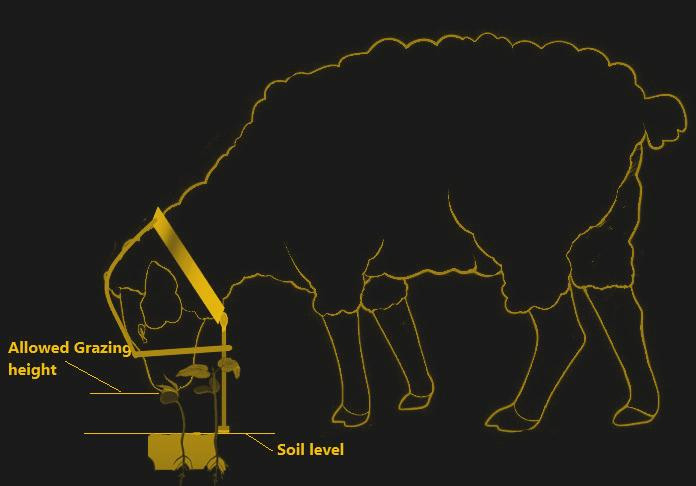
The same simple elegance is also present in [Anteneh]’s overgrazing shield. When sheep and other animals are allowed to eat the vegetation down to the soil, it leads to soil erosion if not kept in check with regular grazing location rotation. As it turns out, if you want to keep an animal from eating grass and plants down to the soil, just slip a leather harness over its neck with a piece of wood in the right place so it literally can’t graze any lower than the wood allows.

According to [Anteneh]’s prototype tests, it only takes a few seconds to fit the shield to the animal’s head and neck, and then they’re off to grazing to the prescribed depth. We think this is a great solution and hope to see it in wide use along with regular rotation.

Need a way to track your livestock? [Sean Boyce]’s experiments with subcutaneous pig tracking makes for a good read, but the reality of that system will probably have you looking for a simpler solution.

Soundbar Bested By Virtual Android Bluetooth Sniffer

Out of the box, the Yamaha YAS-207 soundbar can be remotely controlled over Bluetooth, but only when using a dedicated application on iOS or Android. Users who want to command their hardware with their computer, or any other Bluetooth device for that matter, are left out in the cold. Or at least they were, before [Wejn] got on the case.

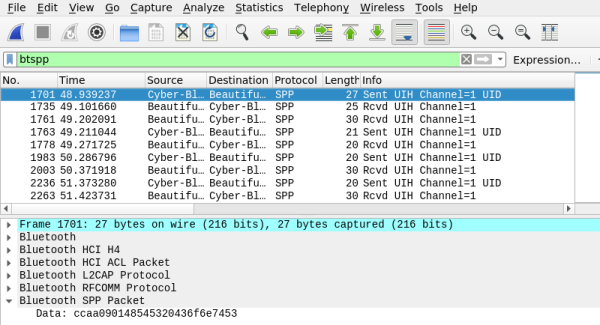
To capture the communication between the soundbar and the application, [Wejn] first installed Android-x86 in a virtual machine on his computer and then enabled the “Bluetooth HCI snoop log” within Developer Settings. From there, a netcat command running on the virtual Android device continually sent the contents of the btsnoop_hci.log file out to Wireshark on his Linux desktop. As he hit buttons in the Yamaha application, he could watch the data come in live. We’ve seen plenty of people use Android’s integrated Bluetooth packet capture in the past, but never quite like this. It’s certainly a tip worth mentally filing away for the future.

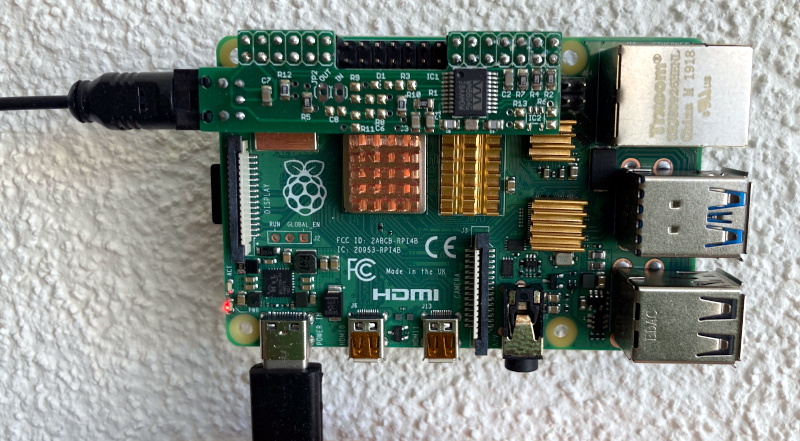
The Pi can now control the TOSLINK connected speakers.

From there, things move pretty quickly. [Wejn] is able to determine that the devices are communicating over a virtual serial port, and starts identifying individual command and response packets. It turns out the commands closely mirror the NEC IR codes that he’d previously decoded on a whim, which helped clear things up. Once the checksum was sorted out, writing some code that can talk to the soundbar from his Raspberry Pi media player was the next logical step.

[Wejn] combined this with the Shairport Sync project, which lets the Raspberry Pi turn on the speaker and switch the input over when he wants to stream AirPlay from his phone. But of course, the same technique could be applied to whatever source of digital audio captures your fancy.

This is one of those posts you should really read in its entirety to truly appreciate. While every device is going to be different, the basic principles and workflow that [Wejn] demonstrates in this project will absolutely be useful in your own reverse engineering adventures. If you’re more of a visual learner, we recently covered a series of YouTube tutorials that cover sniffing BLE devices that’s not to be missed as well.

Active Suspension On A DIY Racing Car

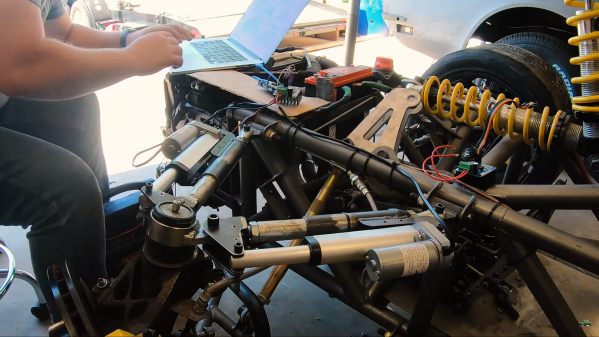
In automotive engineering, almost every design choice is a trade-off, like performance versus fuel economy, straight-line speed versus cornering, or strength versus weight. Inspired by controversial technology for the 2020 Formula 1 season, [Wesley Kagan] is fitting his DIY racing car with actuators to change the suspension geometry while driving.

The controversial technology in question is Mercedes’ DAS (Dual Axis Steering). By pushing the steering wheel in and out, the driver and change the wheel alignment to toe-out (wheels pointing outwards) for better cornering stability, or neutral for the straight sections.

Like many racing cars, [Wesley] used A-arm suspension on his racing car. By replacing the top arms with telescoping tubes with mounted actuators, the geometry can be actively adjusted. For this proof of concept, he used linear actuators but plans to move to a hydraulic system for improved speed and force. The length of the A-arms is sensed with ultrasonic sensors, while a potentiometer senses the suspension position.

Tuning the software for optimum performance will probably require some track testing which we hope to see in the future. This is not the first time [Wesley] has taken inspiration from a multimillion-dollar project and implemented it in his garage. Just check out how he converted a Miata and a Harbor Freight engine to a Free Valve system.

Continue reading “Active Suspension On A DIY Racing Car”

Hackaday Links Column Banner

Hackaday Links: May 2, 2021

Mars is getting to be a busy place, what with helicopters buzzing around and rovers roving all about the place. Now it’s set to get a bit more crowded, with the planned descent of the newly-named Chinese Zhurong rover. Named after the god of fire from ancient Chinese mythology, the rover, which looks a little like Opportunity and Spirit and rides to the surface aboard something looking a little like the Viking lander, will carry a suite of scientific instruments around Utopia Planitia after it lands sometime this month. Details are vague; China usually plays its cards close to the vest, and generally makes announcements only when a mission is a fait accompli. But it appears the lander will leave its parking orbit, which it entered back in February, sometime this month. It’s not an easy ride, and we wish Zhurong well.

Speaking of space, satellites don’t exactly grow on trees — until they do. A few groups, including a collaboration between UPM Plywood and Finnish startup Arctic Astronautics, have announced intentions to launch nanosatellites made primarily of wood. Japanese logging company Sumitomo Forestry and Kyoto University also announced their partnership, formed with the intention to prove that wooden satellites can work. While it doesn’t exactly spring to mind as a space-age material, wood does offer certain advantages, including relative transparency to a wide range of the RF spectrum. This could potentially lead to sleeker satellite designs, since antennae and sensors could be located inside the hull. Wood also poses less of a hazard than a metal spaceframe does when the spacecraft re-enters the atmosphere. But there’s one serious disadvantage that we can see: given the soaring prices for lumber, at least here in the United States, it may soon be cheaper to build satellites out of solid titanium than wood.

If the name Ian Davis doesn’t ring a bell with you, one look at his amazing mechanical prosthetic hand will remind you that we’ve been following his work for a while now. Ian suffered a traumatic amputation of the fingers of his left hand, leaving only his thumb and palm intact, and when his insurance wouldn’t pay for a prosthetic hand, he made his own. Ian has gone through several generations, each of which is completely mechanical and controlled only by wrist movements. The hands are truly works of mechanical genius, and Ian is now sharing what he’s learned to help out fellow hand-builders. Even if you’re not building a hand, the video is well worth watching; the intricacy of the whiffle-tree mechanism used to move the fingers is just a joy to behold, and the complexity of movement that Ian’s hand is capable of is just breathtaking.

If mechanical hands don’t spark your interest, then perhaps the engineering behind top fuel dragsters will get you going. We’ll admit that most motorsports bore us to tears, even with the benefit of in-car cameras. But there’s just something about drag cars that’s so exciting. The linked video is a great dive into the details of the sport, where engines that have to be rebuilt after just a few seconds use, fuel flows are so high that fuel lines the size of a firehouse are used, and the thrust from the engine’s exhaust actually contributes to the car’s speed. There’s plenty of slo-mo footage in the video, including great shots of what happens to the rear tires when the engine revs up. Click through the break for more!

Continue reading “Hackaday Links: May 2, 2021”

Reverse Engineering Self-Powered Wireless Switches

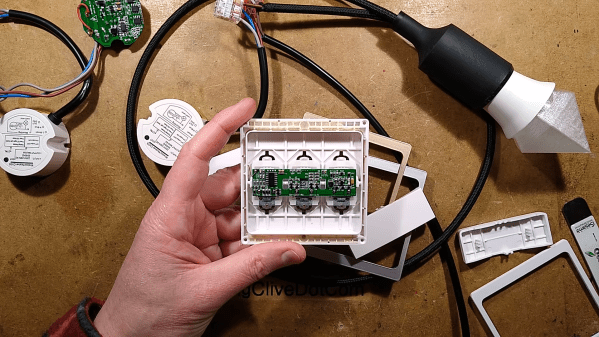
The plethora of wireless communications technologies have cut the comms wire for many applications, but these devices still require power. For home automation, this might mean a battery or mains power, but there is also an alternative that we don’t see often: Kinetic power. [Bigclivecom] bought some kinetic switches from eBay and gave it his usual reverse engineering treatment.

True to the marketing, these switches do not require external power or a battery to send a wireless signal. Instead, it harvests energy from the magnetic latching action of the switch itself. When the switch is actuated, a small current is induced in a coil as the polarity of the magnetic field through its core changes rapidly. Through a series of diodes and resisters, the energy is stored in a capacitor, which is then used to power a small transmitter chip. The antenna coil is wrapped around the switch housing.

The receiver side is powered by mains and includes a relay output for lights. It would be really nice to have a hacker-friendly module for projects. We would be curious to see the range that these devices are capable of.

The same technology is used inside the Philips Hue Tap switch, of which Adafruit did a teardown a few years ago. If you want to learn more about RF modulation, check out the crash course article we put out a while back. Of course, the RTL SDR is an indispensable and affordable tool if you want to do some experimentation.

Continue reading “Reverse Engineering Self-Powered Wireless Switches”

The Amiga 2000 You Always Wanted

Back in the late 1980s, Commodore pulled the masterstroke of selling several models and generations of Amiga that were all powered by essentially the same speed 68000 and associated chipset. Sure, there were differences in the RAM and other options you could fit and later models had a few extra graphics modes. Still, the entry-level A500 did substantially the same as the high-end A2000. No matter, we the fans all wanted a 2000 anyway, though we typically found ourselves unable to afford one. It’s 2021 now though, so if you never achieved the dream of owning your own A2000, now you can build one of your own! It’s the task [Drygol] has taken on, with an A2000 made entirely from new components, save for a few salvaged Commodore-specific chips and connectors.

At its heart is a beautiful recreation of the original PCB that we’re guessing will be of great interest to owners whose NiCd batteries have leaked and corroded their originals. It’s all through-hole, but the sheer size of a motherboard still makes it a daunting prospect to solder by hand. There are a huge quantity of decoupling and ESD components that all have to be held with tape before the board is flipped over for soldering, and then all the chips are socketed. A Fat Agnes address generator was fitted on a RAM expansion daughterboard, leading to some significant problems as it proved not to be compatible and had to be removed.

The whole is put in a very low-profile PC case with appropriate risers for the Zorro slots, and then in goes a set of upgrades probably not seen in the same place since about 1993. We don’t recognize them all, but we can see accelerators, a floppy emulator, an HDD emulator using a CF card, and is that a network card we spy? This machine is still a work in progress, but we can guarantee it would have been an extreme object of desire thirty years ago. See it in action in the video below the break.

If rebuilding an Amiga interests you, we took a look at the state of the remanufactured parts scene for the platform last year.

Continue reading “The Amiga 2000 You Always Wanted”

Ingenuity Completes Fourth Flight On Mars, Gets A New Mission

It’s the same on Mars as it is here — just when you’re getting used to your job, the bosses go and change things up.

At least that’s our read on the situation at Jezero crater, where the Mars Ingenuity helicopter has just had its mission upgraded and extended. In a Friday morning press conference, the Ingenuity flight team, joined by members of the Perseverance team and some NASA brass, made the announcement that Ingenuity had earned an extra 30 sols of flight time, and would be transitioned from a mere “technology demonstrator” to an “operations demonstration” phase. They also announced Ingenuity’s fourth flight, which concluded successfully today, covering 266 meters and staying airborne for 117 seconds.

Continue reading “Ingenuity Completes Fourth Flight On Mars, Gets A New Mission”