Revisiting Making Your Own Internet Router In 2026

After my recent misadventures setting up an OpenWrt installation on a scruffy e-waste-level x86 PC, quite a few people chimed in with feedback, criticism and friendly hostility regarding things like a presumed ‘x86 bias’. There were also some system-related things that simply didn’t seem to want to work, such as booting from an SD card with a USB adapter, which cut short a lot of the actual OpenWrt testing that I had intended. This made it mostly an enlightening look at what issues you can run into when ‘quickly’ throwing an OpenWrt router together with some junk parts these days.

In this second article I’ll try to address as many of these points as possible, as well as attempt to show off an actual working OpenWrt installation in action. In addition, since just using random junk x86 PC parts was the way to go back in the late 90s/early 2000s doesn’t mean that this is still the way in 2026, so I’ll be taking a look at alternatives that exist today. This includes everything from mini PCs, to ancient business PCs being sold for peanuts, as well as more dedicated (ARM-based) hardware solutions.

Continue reading “Revisiting Making Your Own Internet Router In 2026”
Reverse Engineering A Rock Bottom NES Clone

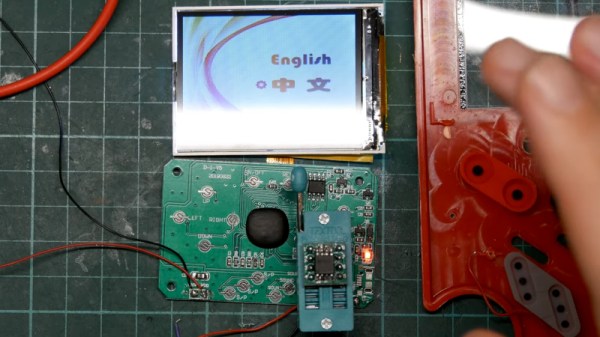
The NES was Nintendo’s smash hit console of the 1980s, the international version of their Japanese Famicom system. It wasn’t a particularly complex device, so it was the subject of many clones back in the day. More recently, it has enjoyed a new life thanks to “NES on a chip” systems. It’s one of these that [Poking Technology] has, real rock bottom for the console built into a cheap phone case.

Continue reading “Reverse Engineering A Rock Bottom NES Clone”

Classically-named Argus Robot Is Terminator Meets Tumbleweed

If you were making a multi-limbed symmetric nightmare of a robot, where else would you look for a name but Greek Mythology? The team at Duke University that came up with this particular multi-limbed creature had two obvious choices: name it for one of the Hundred-Handed giants, the Hecatoncheires, or lean on the fact that each limb has its own sensor and go for many-eyed Argus. Argus sounds better to a funding committee, so Argus it is.

Hecatoncheries would be a bit of a reach anyway, considering Argus only has 20 limbs in its current incarnation. It uses what the researchers are calling its ‘dynamic symmetry’ to get around– extending and retracting its many limbs to exert forces in any direction, it can bounce about like a beach ball on a windy day.

Continue reading “Classically-named Argus Robot Is Terminator Meets Tumbleweed”

Making A Zippy FDM Printer Out Of Wood

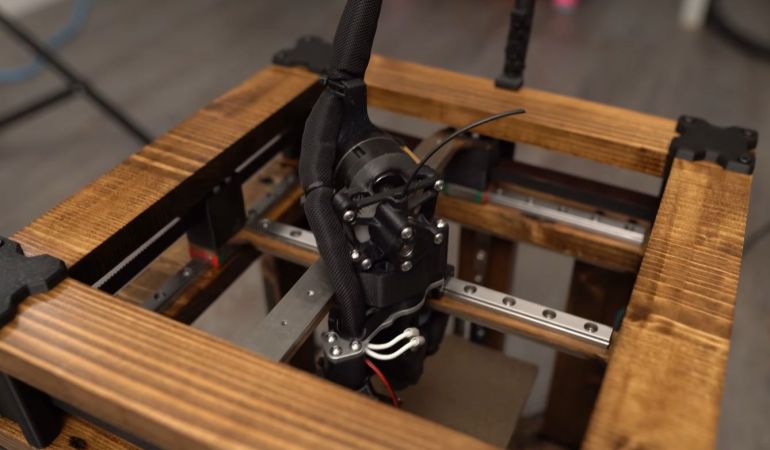
Generally, the frame and other structural parts of an FDM printer use steel or similar, but could you use wood instead for that truly artisan look? As [Mitsu Makes] demonstrates after half a year of work, you absolutely can, and it looks about as amazing as you might imagine.

Naturally, you cannot make everything out of wood – such as the linear rails and lead screws – and there is a fair bit of FDM-printed black PLA in there too, but the wood is both structural and decorative. The stained look does really add something. For the FDM-specific parts, the Voron 0 was taken as the base, including the bed. The motion system isn’t CoreXY but Cartesian for ease of construction and driving the axes, while also providing more torque due to the additional motors.

Since it’s more or less a Voron FDM printer and even has automatic bed leveling, it works basically perfectly after assembly and input shaping. Even if it’s not the most practical way to make your own FDM printer from parts, it definitely makes it look unique and would be the focal point of any printing farm.

Continue reading “Making A Zippy FDM Printer Out Of Wood”

Off-Grid OCR Server Powered By IPhone

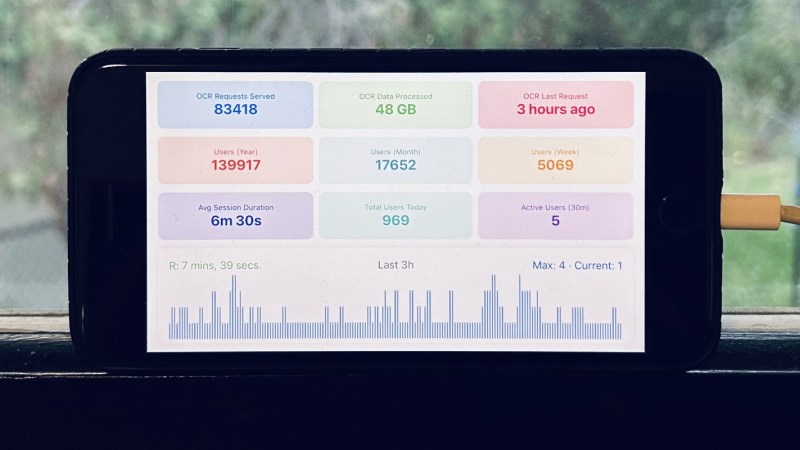
Running an optical character recognition (OCR) server might sound like it would need some powerful hardware, like a rack-mounted, water-cooled machine, or at least a nice desktop or laptop. But if you have the time, anything could be used. [Hemant] has a long-running personal project that processes a lot of image data over a long time, and set up the OCR server on an iPhone 8 running entirely with solar power, rather than turn to more typical hardware.

Part of what makes this task feasible for low-powered hardware is Apple’s Vision framework, which uses machine learning to aid in things like character recognition (among other tasks). It will run on an iPhone just as easily as a Mac. The phone’s built-in battery already provides the first step of an off-grid setup. This build relies on a separate power bank to integrate the phone with the solar panel more easily. On the software side, [Hemant] reports that the true challenge wasn’t setting up the server as much as it was keeping the iPhone from sleeping or stopping his program from running full-time.

A system like this running off-grid, especially considering the costs of the solar panel and power bank, might seem counterproductive. But when comparing electricity costs for running the same software on his server, he estimates he saves about $10 per month with this setup, which has a payback of somewhere around 2-3 years. Not too bad for a phone that would have otherwise ended up in a landfill. Old phones can be surprisingly good choices for servers, too. It helps if they can run Linux, but plenty of phones will support server applications, even when running their native OS.

Hackaday Links Column Banner

Hackaday Links: May 31, 2026

If you’re located in the Northeast United States and thought you heard an explosion yesterday afternoon, it wasn’t just your imagination — multiple sources have now confirmed that a 1 meter (3 foot) meteor entered the Earth’s atmosphere and broke up in the air off the coast of Massachusetts, releasing the energy equivalent of 300 tons of TNT.

Well, maybe. The latest update from NASA says it might actually qualify as a meteorite, with radar data indicating that debris from the space rock may have fallen into Cape Cod Bay. For those unfamiliar, the difference between a meteor and a meteorite is whether or not any of the object survived its encounter with the atmosphere and made it down to the surface.

There’s an argument to be made that a larger asteroid would have likely set off some alarm bells as it approached the planet, but the fact that this deep space interloper showed up unannounced is a sobering reminder that our ability to detect incoming threats isn’t nearly as robust as we’d like. Fortunately, it looks like the event didn’t result in any serious damage or injury.

Continue reading “Hackaday Links: May 31, 2026”

A Camera Viewfinder Makes A Great TV

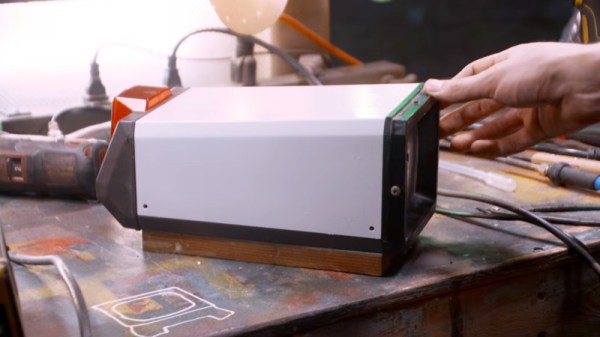
When we think of CRT camera viewfinders, most of us probably imagine the tiny CRTs you’d find in a 1980s camcorder. They’re super cute and a load of fun to play with, but they’re very much a consumer device. Professional cameras of the type you’d find in a studio had their own viewfinders, which were a lot closer to a small TV. They’re about as high quality as it gets for a monochrome CRT, and [Evan Monsma] has done the conversion to a general-purpose monitor.

On one side, this is a very straightforward hack, simply a case of tracing wires to identify the power and video pins. Given a tool battery, the monitor fires up and gives a super-sharp picture. What we like about this is the wooden base he’s made for the thing, at the same time rough-and-ready, and professional-looking from the outside. It has a routed space for the cables, and once mounted flush with the monitor base and given a bit of wood stain, it looks almost as though it was manufactured that way.

It’s likely most of us won’t find a broadcast viewfinder in the trash, instead settling at best for a little Chinese portable TV. But it’s still interesting to see these unusual devices. Perhaps it might make a good cyberdeck.

Continue reading “A Camera Viewfinder Makes A Great TV”