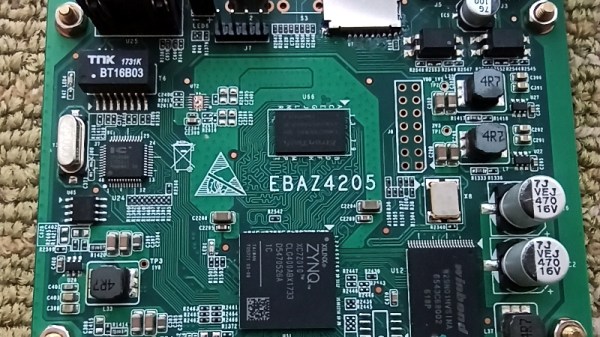
Easy Carrier Board For The Compute Module 4 Shows You Can Do It, Too

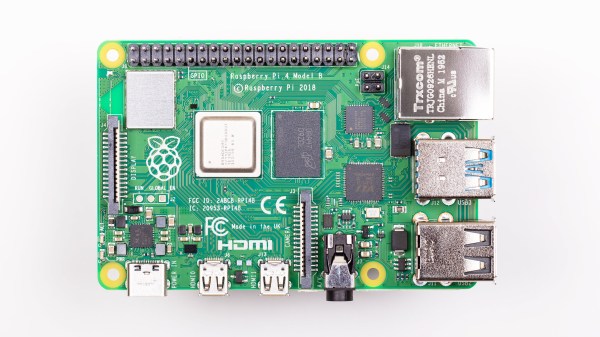
The Raspberry Pi Compute Module 4 has got many excited, with a raft of new features bringing exciting possibilities. However, for those used to the standard Raspberry Pi line, switching over to the Compute Module form factor can be daunting. To show just how easy it is to get started, [timonsku] set about producing a quick and dirty carrier board for the module at home.

The Twitter thread goes into further detail on the design of the board. The carrier features HDMI, USB-A and USB-C ports, as well as a microSD slot. It’s all put together on a single-sided copper PCB that [timonsku] routed at home. The board was built as an exercise to show that high-speed signals and many-pin connectors can be dealt with by the home gamer, with [timonsku] sharing tips on how to get the job done with cheap, accessible tools.

The board may look rough around the edges, but that’s the point. [timonsku] doesn’t recommend producing PCBs at home when multi-layer designs can be had cheaply from overseas. Instead, it serves to show how little is really required to design a carrier board that works. Even four-layer boards can be had for under $10 apiece now, so there’s never been a better time to up your game and get designing.

For those eager to learn more about the CM4, we’ve got a full breakdown to get you up to speed!

Tracking Drone Flight Path Via Video, Using Cameras We Can Get

Calculating three-dimensional position from two-dimensional projections are literal textbook examples in geometry, but those examples are the “assume a spherical cow” type of simplifications. Applicable only in an ideal world where the projections are made with mathematically perfect cameras at precisely known locations with infinite resolution. Making things work in the real world is a lot harder. But not only have [Jingtong Li, Jesse Murray et al.] worked through the math of tracking a drone’s 3D flight from 2D video, they’ve released their MultiViewUnsynch software on GitHub so we can all play with it.

Instead of laboratory grade optical instruments, the cameras used in these experiments are available at our local consumer electronics store. A table in their paper Reconstruction of 3D Flight Trajectories from Ad-Hoc Camera Networks (arXiv:2003.04784) listed several Huawei cell phone cameras, a few Sony digital cameras, and a GoPro 3. Video cameras don’t need to be placed in any particular arrangement, because positions are calculated from their video footage. Correlating overlapping footage from dissimilar cameras is a challenge all in itself, since these cameras record at varying framerates ranging from 25 to 59.94 frames per second. Furthermore, these cameras all have rolling shutters, which adds an extra variable as scanlines in a frame are taken at slightly different times. This is not an easy problem.

There is a lot of interest in tracking drone flights, especially those flying where they are not welcome. And not everyone have the budget for high-end equipment or the permission to emit electromagnetic signals. MultiViewUnsynch is not quite there yet, as it tracks a single target and video files were processed afterwards. The eventual goal is to evolve this capability to track multiple targets on live video, and hopefully help reduce frustrating public embarrassments.

[IROS 2020 Presentation video (duration 14:45) requires free registration, available until at least Nov. 25th 2020.]

Domino Clock Tells The Time In Style

It seems there are as many ways to display the time as there are ways to measure it in the first place. [Kothe] saw a fancy designer domino clock, and wanted a piece of the action without the high price tag. Thus, the natural solution was to go the DIY route.

An Arduino Nano is the heart of the build, paired with a DS1307 RTC for accurate timekeeping. The case of the clock consists of a 3D printed housing, fitted with layers of lasercut acrylic. Behind this, a smattering of WS2812B addressable LEDs are fitted, which shine through the translucent grey plastic of the front panel. This enables each LED to light up a dot of the domino, while remaining hidden when switched off. Reading the time is as simple as counting the dots on the dominoes. The first domino represents hours, from 1 to 12, while the second and third dominoes represent the minutes.

As a timepiece, the domino clock serves well as a stylish decor piece, and could also be a fun way to teach kids about electronics and telling the time. Makers do love a good timepiece, and our clock tag is always overflowing with fresh hacks on a regular basis. If you’ve got your own fancy build coming together at home, you know who to call!

Rotating Magnetic Fields, Explained

If you made a motor out of a magnet, a wire coil, and some needles, you probably remember that motors and generators depend on a rotating magnetic field. Once you know how it works, the concept is pretty simple, but did you ever wonder who worked it all out to start with? Tesla figures into it, unsurprisingly. But what about Michael Dobrowolsky or Walter Bailey? Not common names to most people. [Learn Engineering] has a slick video covering the history and theory of rotating magnetic field machines, and you can watch it below.

Motors operated on direct current were not very practical at the time and caused a jerky motion. However, Tesla and another inventor named Ferraris realized that AC current could cause a rotating magnetic field without a moving commutator.

Continue reading “Rotating Magnetic Fields, Explained”

Bringing An IBM Model F Into 2020

We know that the Hackaday family includes many enthusiasts for quality keyboards, and thus mention of the fabled ‘boards of yore such as the IBM Model F is sure to set a few pulses racing. Few of us are as lucky as [Brennon], who received the familial IBM PC-XT complete with its sought-after keyboard.

This Model F has a manufacture date in March 1983, and as a testament to its sturdy design was still in one piece with working electronics. It was however in an extremely grimy condition that necessitated a teardown and deep clean. Thus we are lucky enough to get a peek inside, and see just how much heavy engineering went into the construction of an IBM keyboard before the days of the feather-light membrane devices that so many of us use today. There follows a tale of deep cleaning, with a Dremel and brush, and then a liberal application of Goo Gone. The keycaps had a long bath in soapy water to remove the grime, and we’re advised to more thoroughly dry them should we ever try this as some remaining water deep inside them caused corrosion on some of the springs.

The PC-XT interface is now so ancient as to have very little readily available in the way of adapters, so at first a PS/2 adapter was used along with a USB to PS/2 converter. Finally though a dedicated PC-XT to USB converter was procured, allowing easy typing on a modern computer.

This isn’t our first look at the Model F, but if you can’t afford a mechanical keyboard don’t worry. Simply download a piece of software that emulates the sound of one.

Highly Sensitive Camera Makes A Great Night Vision Scope

Traditional military-grade nightvision gear has a history stretching back to the Second World War, relying on photomultiplier tubes to help soldiers see in the dark. Such devices have trickled down to the civilian market in intervening years, however other simpler techniques can work too. [Happy_Mad_Scientist] whipped up a simple nightvision monocular using a very sensitive camera instead.

Due to the high noise, still photos don’t do it justice. The video quality is highly impressive for a system running with no IR illumination.

The camera in question is the Runcam Night Eagle 2, prized for its 0.00001 lux sensitivity. Black and white only, its capable of providing vision in moonlight and starlight conditions without external illumination. In this project, it’s hooked up to a monocle display designed for use with drone FPV setups. With lithium batteries and a charge circuit hooked up, and everything stuffed inside a compact 3D printed case, the final result is a portable, pocket sized night vision device for under $200 USD.

[Happy_Mad_Scientist] notes that in starlight conditions, it provides an advantage over other nighttime Airsoft players relying on IR illumination to see in the dark. We can imagine it would perform well in concert with a bright IR headlamp for those times when there’s simply no ambient light available – particularly indoors.

If your tastes are more military-spec, consider this teardown of a high-end Norweigan device. Video after the break.

Continue reading “Highly Sensitive Camera Makes A Great Night Vision Scope”

Three-Wheeled Turret Car Looks Like It Should Be Orbiting Thunderdome

In a post-apocalyptic world, this is the hacker you want rebuilding society. He’s showing off a three-wheeled go-kart that pivots the cockpit as it steers. A hand crank mounted at the center of the vehicle pivots each of the three wheels in place, but keeps the driver facing forwards with a matching rotation. Hit up the video after the break to see it for yourself.

The real question here is, how did he pull this off? The watermark on the video shows that this was published by [wo583582429], a user on Douyin (the platform known as TikTok in the US). We plied our internet-fu but were unable to track down the user for more of the juicy details we crave. If you have a lead on more info, leave it in the comments below. For now, please join us in speculating on this build.

This is a pretty good closeup of one of the wheel assemblies. First question is how does the turning mechanism work? Since all three wheels and hub are smoothly coordinated it’s likely this is a planetary gearing setup where the inner ring has teeth that turn the rings around the tires themselves. However, we can see a spring suspension system which makes us doubt the lower ring surrounding the tire would stay engaged with a planetary gear. What do you think?

Trying to figure out how control and locomotion happens is even more of a head-scratcher. First guess is that it’s electric from the mere simplicity of the setup and this closeup shows what looks like a circuit breaker and wires connecting to batteries on either side of the suspension system. But where is the electric motor?

It’s a horrible image, but this is the best we can do for a view of the other side of the wheel assembly. There is a box that appears to be made from aluminum mounted to the wheel frame. After a few hundred times through the demo video we don’t think there’s a chain drive going down to the axle. It doesn’t look like there is a hub motor at play here either. We wondered if there was a second smaller wheel under the top of the frame to drive the main tire, but again, the suspension system would make this unfeasible and at points in the video there is clear daylight. Spend some time reviewing the Zapruder demo film below and when you figure all of this out, clue the rest of us in please!

It’s awesome seeing bootstrapped vehicles come to life. One of our favorites remains this all-terrain motorcycle that has no problem taking on stairs.

Continue reading “Three-Wheeled Turret Car Looks Like It Should Be Orbiting Thunderdome”