Getting Rid Of All The Space Junk In Earth’s Backyard

Space, as the name suggests, is mostly empty. However, since the first satellite launch in 1957, mankind began to populate the Earth orbit with all kinds of spacecraft. On the downside, space also became more and more cluttered with trash from defunct or broken up rocket stages and satellites. Moving at speeds of nearly 30,000 km/h, even the tiniest object can pierce a hole through your spacecraft. Therefore, space junk poses a real threat for both manned and unmanned spacecraft and that is why space agencies are increasing their efforts into tracking, avoiding, and getting rid of it.
Continue reading “Getting Rid Of All The Space Junk In Earth’s Backyard”

Air Cannon Serves Up A Blast Of Ferrocerium Sparks

OK, looks like we have a new way to entertain the kids and wreak havoc in the neighborhood, if this spark-shooting ferrocerium cannon is as easy to build as it looks.

This one comes to us by well-known purveyor of eyebrow-singing projects [NightHawkInLight], whose propane torch never seems to get a break. The idea here is a large scale version of an apparently popular trick where the “flints” from lighters, which are actually rods of ferrocerium, an aptly named alloy of iron and cerium, are heated to a nearly molten state and dropped onto a hard surface. The molten alloy thence explodes in a shower of sparks, to the mirth and merriment of those in attendance.

[NightHawkInLight]’s version of the trick scales everything up. Rather than lighter flints, he uses ferrocerium rods from firestarters of the type used for camping. The rod is stuffed into a barrel formed from steel brake line which is connected to the output of a PVC air chamber. His ominpresent propane torch is attached in such a way as the flame plays upon the loaded pyrophoric plug, heating it to a molten state before the air is released from the chamber. The massive display of sparks seen in the video below is pretty impressive, but we’re getting tired of  gender reveal parties and forest fires.  We just hope he had fire extinguishers on hand.

Seriously, be careful with stuff like this. [NightHawkInLight] has a lot of experience working with these kinds of projects, from his plasma-propelled soda bottles to making synthetic rubies with an arc welder. We’re sure he wouldn’t want to see anyone get hurt.

Continue reading “Air Cannon Serves Up A Blast Of Ferrocerium Sparks”

A Smart Speaker That Reminds You It’s Listening

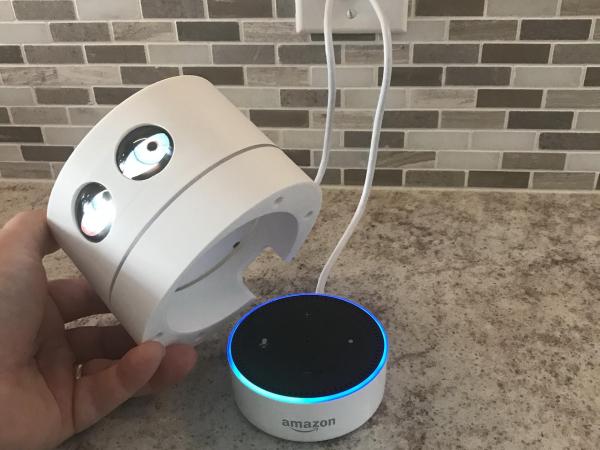
[markw2k9] has an Alexa device that sits in his kitchen and decided it was time to spruce it up with some rather uncanny eyes. With some inspiration from the Adafruit Uncanny Eyes project, which displays similar animated eyes, [markw2k9] designed a 3d printed shell that goes on top of a 2nd generation Amazon Echo. A teensy 3.2 powers two OLED displays and monitors the light ring to know when to turn the lights on and show that your smart speaker is listening. The eyes look around in a shifty sort of manner. Light from the echo’s LED ring is diffused through a piece of plexiglass that was lightly sanded on the outside ring and the eye lenses are 30mm cabochons (a glass lens often used for jewelry).

One hiccup is that the ring on the Echo will glow in a steady pattern when there’s a notification. As this would cause the OLEDs to be on almost continuously and concerned for the lifetime of the OLED panels, the decision was made to detect this condition in the state machine and go into a timeout state. With that issue solved, the whole thing came together nicely. Where this project really shines is the design and execution. The case is sleek PLA and the whole thing looks professional.

We’ve seen a few other projects inspired by the animated eyes project such as this Halloween themed robot that is honestly quite terrifying. The software and STL files for the smart speaker’s eyes are on Github and Thingiverse.

Continue reading “A Smart Speaker That Reminds You It’s Listening”

Modern Network Adapter For Retro Computers

Universal Serial Bus, or USB, is so ingrained in modern computing that it’s hard to imagine a time without it. That time did exist, though, and it was a wild west of connector types, standards, and interfacing methods. One of the more interesting interfaces of the time was the SIO system found in 8-bit Atari computers which ended up sharing a lot of the features of modern USB, and its adaptability is displayed in this modern project which brings WiFi, Bluetooth, USB, and SD card slots to any old Atari with an SIO port.

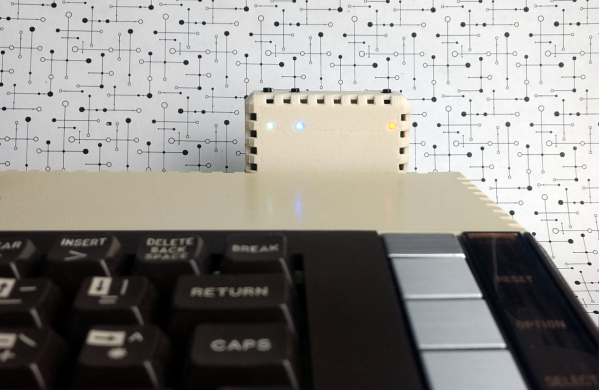
The project is called FujiNet and it uses the lightweight protocol of SIO to add a number of modern features to the 8-bit machine. It’s based on an ESP32, and the chip performs the functions of a network adapter by bridging WiFi and Bluetooth to the Atari. It does this by simulating drives that would have potentially been used on the Atari in its time, such as a floppy disk drive, an RS232 interface, or a modem, and translating them to the modern wireless communication protocols. It even has the ability to emulate a printer by taking the output of the print job from the Atari and converting it to PDF within the device itself.

Not only does this bring a lot of functionality to the Atari, which you may be able to use to view sites like retro.hackaday.com, but the FujiNet is housed in a period-appropriate 3D-printed case that matches the look and feel of the original Atari. If you need a more generic solution for your retrocomputing networking adventures that isn’t limited to SIO, we recommend grabbing a Raspberry Pi to handle that.

Thanks to [Gavin] for the tip!

Grab A Stanford Computer Science Education

There are two reasons to go to school: learn about something and to get a coveted piece of paper that helps you get jobs, or at least, job interviews. With so many schools putting material online, you can do the first part without spending much money as long as you don’t expect the school to help you or grant you that piece of paper. Stanford has a huge computer science department and [Rui Ma] cataloged over 150 computer science classes available online in some form from the University. Just the thing to while away time during the quarantine.

Apparently, [Rui] grabbed the 2020 course catalog to find on-campus classes and found the companion website for each class, organizing them for our benefit. The list doesn’t include the actual online class offerings, which you can find directly from Stanford, although there is another list for that.

Continue reading “Grab A Stanford Computer Science Education”

Rolling Your Own TiVo WiFi Adapter

The only thing more surprising than finding out TiVo actually put out a new 4K set-top box recently is learning that somehow they didn’t bother to build WiFi into the thing. You’re forced to buy a special wireless adapter to the tune of $60 USD to add the feature. We’d make a joke about the company living in the past, but frankly, it would be too easy.

Having to buy just one of these expensive dongles in 2020 would be insulting enough, but TiVo superfan [xxbiohazrdxx] needed four of them. Rather than hand nearly $250 to the antennae-headed overlords, they decided to reverse engineer the adapter and produce their own low-cost version. While the final result might not be as slim and svelte as the original, it does come in at less than 1/4 the price.

Operating under the assumption that the TiVo would only talk to a WiFi adapter based on the same Broadcom BCM43569 chipset used in the official one, [xxbiohazrdxx] started by trying to find a standard USB dongle that might be a drop-in replacement. Unfortunately, it looks like this particular chip was almost exclusively used in proprietary applications, most commonly as a WiFi board inside of smart TVs. But as it turns out, that wasn’t necessarily a deal breaker.
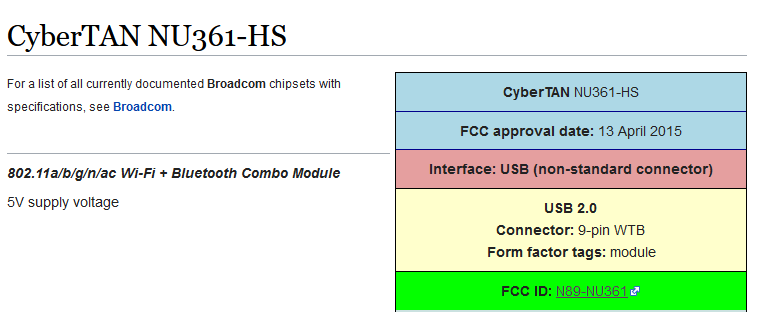
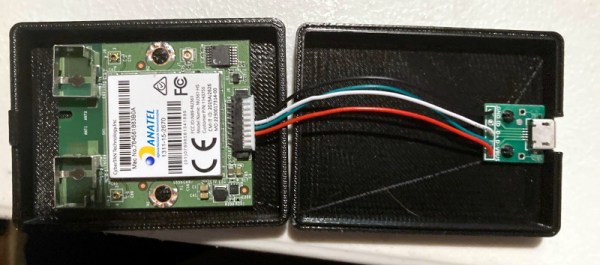
After some searching, [xxbiohazrdxx] eventually found the promising CyberTAN NU361-HS board. Not only was it based on the right chipset and ran from 5 volts, but its FCC ID entry had a complete pinout for the connector. This particular WiFi module is used in a number of budget TVs and is widely available as a spare part for less than $10. By combing the board and a USB breakout PCB inside of a 3D printed case, you’ve got a plug-and-play WiFi adapter that the TiVo thinks is the real deal.

There was a time when Hackaday was flooded with TiVo hacks, but it’s now been more than a decade since cheap carrier-provided DVRs ate the company’s lunch. Realistically, there’s an excellent chance that this post will be the only time a mention of the once-mighty DVR graces the front page in 2020. While the reign of the TiVo might be at its end, the impact it had as one of the first Linux-powered consumer devices will be etched in hacker history forever.


Designing And Building A Custom Optical Fuel Sensor

At some time or another, we’ve all had an idea we thought was so clever that we jumped on the Internet to see if somebody else had already come up with it. Most of the time, they have. But on the off chance that you can’t find any signs of it online, you’re left with basically two possible conclusions. Either you’re about to enter uncharted territory, or your idea is so bad that everyone has collectively dismissed it already.

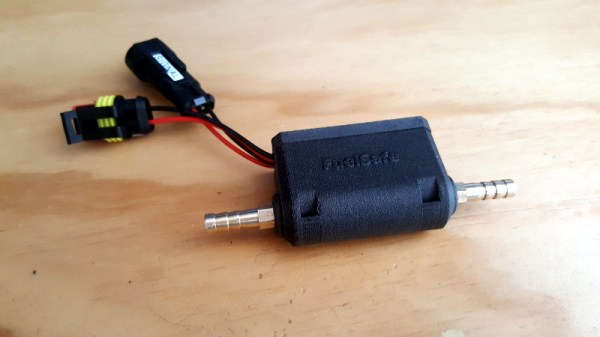
Which is precisely where [James Stanley] recently found himself. He had an idea for an non-contact optical sensor which would detect when his racing mower was about to run out of gas by analyzing light passed through a clear section of fuel hose. He couldn’t find any previous DIY examples of such a device, nor did there appear to be a commercial version. But did that mean it wouldn’t work, or that nobody had ever tried before?

Continue reading “Designing And Building A Custom Optical Fuel Sensor”