
Ground Off Part Number Leads To Chip Detective Work

Sometimes when a piece of electronics lands on the bench, you find that its chips have their markings sanded off. The manufacturer is trying to make the task of the reverse engineer less easy, thus protecting their market. [Maurizio Butti] found an unexpected one in an electronic switch designed for remote control systems, it had the simple job of listening to the PWM signal from a receiver in a model aircraft or similar and opening or closing a FET.

From previous experience he suspected it might be a microcontroller from STC based on the location of power, ground, Rx, and Tx pins. This 8051-compatible device could be readily reprogrammed, so he has able to create his own firmware for it. He’s published the code and it’s pretty simple, as it simply replicates the original. He acknowledges that this might seem odd, but makes the point that it is left open for future upgrades such as for example repeatedly cycling the output as in a flashing light.

We don’t see so much of the STC chips here aside from one of their earlier offerings, but the 8051 core features here more regularly as it’s found in Nordic’s NRF24 series of wireless-capable chips.

Tiny Chain-Link Fence Made With Hand-Cranked Brilliance

Chain link fences are woven with a mechanism that is almost hypnotic to watch, so [Levsha] decided to build his own tiny hand-crank tabletop version to make tiny copper wire fences.

Chain link consist of a series of wires bent and woven in a zigzag pattern. The zigzag bends are made by winding the wire around a rotating flat plate inside a stationary tube with a spiral slot in the side to keep the spacing of the bends consistent. [Levsha]’s version is roughly 1/10 scale of the real thing, and only does the bending and winding parts. Linking the bent wire together is up to the operator. All the components were machined on a lathe and CNC router, and beautifully finished and assembled on a wood base. The hardest part was the tube with the spiral slot, which took a few attempts to get right. [Levsha] initially tried to use steel wire, but it was too stiff and caused the winding mechanism to lock up. 0.4 mm copper wire turned out to be the best choice.

Although there is no practical use for this device that we can see, the craftsmanship is excellent, and it is one of those videos that reminds us how badly we want some machine tools.

Fine attention to detail is really what makes videos like this enjoyable to watch. Wee seen a few other such project, like a beautiful scratch-built lathe, or a pneumatic powered drone that can’t fly.

Continue reading “Tiny Chain-Link Fence Made With Hand-Cranked Brilliance”

DIY Automated Roller Blinds

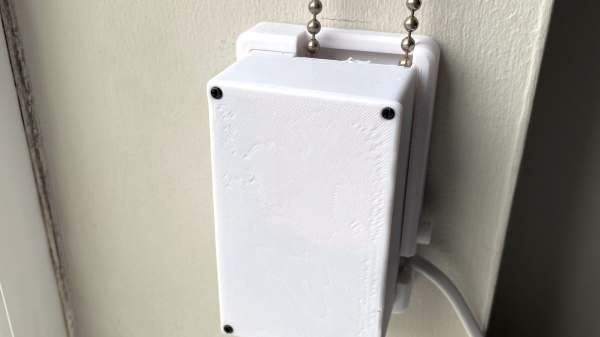
Controlling blinds using off the shelf solutions can be expensive – more so if you have multiple blinds you want to control. [HumanSkunk87] felt the cost was too high, so they designed a controller to automatically open and close the blinds.

The main part of this build is a motor and a ball chain gear – a wheel that captures the balls of a ball chain so that the chain can be pulled. The wheel was designed using Fusion3D and then printed out. The motor requires enough power to pull the chain — [HumanSkunk87] figures it needs to be able to pull about 2.5kg in order to raise the blind. After giving up on stepper motors, a DC motor with a worm gear was found to have enough torque to work. A WEMOS D1 Mini controls the motor controller that drives the ball chain wheel. Two micro switches tell the WEMOS when to stop at the bottom and top of the window.


The WEMOS is programmed using ESPHome and it connects to [HumanSkunk87]’s HomeAssistant to complete the automation. Check out the descriptions in the link for the parts and the code used to run everything. There are many other creative ways to open your blinds, It’s even possible to automate curtains instead of blinds.

Continue reading “DIY Automated Roller Blinds”

Slot Machine Has A Handle On Fun

For some reason, when slot machines went digital, they lost their best feature — the handle. Who wants to push a button on a slot machine, anyway? Might as well just play video poker. [John Bradnam] seems to agree, and has built an open-source three-color matrix slot machine complete with handle.

In this case, you’ll be losing all of your nickels to an Arduino Pro Mini. The handle is an upgrade to an earlier slot machine project that uses three 8×8 matrices and a custom driver board. When the spring-loaded handle is pulled, it strikes a micro switch to spins the reels and then snaps back into place. Between each pull, the current score is displayed across the matrix. There’s even a piezo buzzer for victory squawks. We only wish the button under the handle were of the clickier variety, just for the feels. Check out the short demo video after the break.



If you’re not a gambler, you could always turn your slot machine into a clock.

Continue reading “Slot Machine Has A Handle On Fun”

Hybrid Respirator Uses Repurposed Filters

With the coronavirus raging worldwide, 2020 has seen major shortages of personal protective equipment impact healthcare workers and individuals alike. This has led many to improvise their own solutions. One of the more complete offerings we’ve seen is this hybrid respirator build from [Ben Howard].

[Ben’s] build goes above and beyond the usual craft project masks. It uses a laser-cut chipboard frame to fit three HEPA filters, originally designed for the Roomba robotic vacuum cleaner. Two are used for exhalation, while one is used for inhalation. A small blower fan is installed with the intake filter, to provide mild positive pressure when breathing in. The assembly is wrapped up in fabric, using layers of spandex, fleece, and ripstop nylon to provide the best possible seal against the wearer’s face.

It’s a build that should appeal to those who want to breathe cleaner air and also protect others from exhaled particles that can spread respiratory viruses. We’ve seen all kind of masks hit the scene this year; the graphene-impregnated variety is one of the more interesting designs. Still, one can hope that future years lead to less reliance on such measures!

A Retro Camcorder Upgraded As A Raspberry Pi HQ Camera

In 2020 when we carry an all-purpose computer and data terminal able to store our every thought and deed on a global computer network, it’s easy to forget that once upon a time we were excited by the simpler things. Take the camcorder for example, back in the 1990s the idea of a complete video recording solution that captured moving images on tape cartridges and fit in the palm of your hand was a very big deal indeed, and camcorders as we called them in those innocent times were a prized posession. Now they’re a $0.50 find a Goodwill, which is how [Dustin] picked up the RCA camcoder he’s converting into something altogether more modern. He’s gutted it and upgraded it by removing the analogue innards and retaining only the case and lens assembly to put around a Raspberry Pi and associated HQ camera module.

Opening the camcorder up reveals a ton of miniaturised analogue circuitry, but once the original assemblies are removed it’s relatively straightforward to put the Pi camera on the rear of the lens unit. There’s plenty of space for the Pi in the box, and he’s putting a touchscreen on the outside.

Sadly the camcorder’s original tiny CRT is no longer working, else that would have been the ultimate retro viewfinder. Still we hope to see some tinkering on that part of the project since those little CRTS make for delightful hacks. The project is very much a work in progress, but should serve that these once ubiquitous devices are now in the realm of the throwaway.

This isn’t the first such conversion we’ve seen with a Raspberry Pi, the original camera module is a handy fit to an 8mm movie camera.

Killing Mosquitoes With Cardi B

Keeping a bird bath or a pond in your yard is a great way to add ambiance and style, but both of these things can be a haven for mosquitoes. Popular methods of getting rid of them are often with harsh pesticides, but [Shane] has brought us a more environmentally-friendly way of taking care of these disease-carrying insects by looping a Cardi B playlist underwater, killing the mosquito larvae.

While the build does include some other favorites such as “Baby Shark” and would probably work with any song (or audio of sufficient volume) the build is still pretty interesting. It’s based on a 555 timer circuit which powered an ultrasonic sound gun, but was repurposed for this build. The ultrasonic modules were replaced with piezo modules which were waterproofed with silicone. The sound produced vibrates at a frequency which resonates with the mosquito larvae and is fatal to them. [Shane] put the build into a small boat which can be floated in any pond, bird bath, horse trough, or water feature.

The major caveat to this build is that it may be damaging to other beneficial animals such as fish or frogs, so he suggests limiting its use to uninhabited stagnant water. Either way, though, it’s a pretty unique way of taking care of a mosquito problem not unlike another build which takes care of these insects in water a slightly different way.

Continue reading “Killing Mosquitoes With Cardi B”